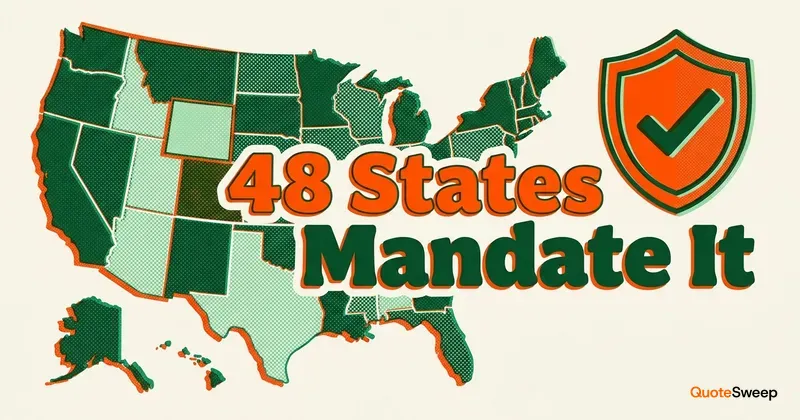
Yes — in nearly every state, if you have employees you are legally required to carry workers' compensation insurance, and that mandate is set and enforced at the state level rather than by a single federal law (per NerdWallet, Insureon, and OnPay). There are two exceptions: Texas, the only state where private employers can fully opt out of the workers' comp system, and South Dakota, where coverage is technically elective rather than compelled by statute.
This is an independent guide from QuoteSweep, which maps the modern commercial insurance landscape. Every legal claim below is attributed to its source, because the exact trigger, exemptions, and penalties vary by state and should always be confirmed with that state's workers' comp agency or department of insurance.
TL;DR: If you have employees, you almost certainly need workers' compensation insurance — it's compulsory in nearly every state once you cross that state's employee threshold (NerdWallet, Insureon, OnPay). The threshold is your first employee in most states, but a minority set it higher (Georgia and Arkansas at ~3, Florida non-construction at 4, Alabama and Tennessee non-construction at 5), and construction almost always starts at employee #1. Texas is the only state where private employers can fully opt out (becoming a "non-subscriber"); South Dakota makes it elective. Four states — North Dakota, Ohio, Washington, and Wyoming — bar private policies entirely and require you to buy from a state fund. Going without required coverage means fines, stop-work orders, and losing the lawsuit protection that comes with a policy.
Compare business insurance options
Workers' comp requirements by state
The overall picture is consistent across sources: once you cross your state's employee threshold, coverage is compulsory (NerdWallet, Insureon, OnPay). What varies is where that threshold sits and who's carved out.
The threshold. Most states require coverage from the first employee. A minority set higher triggers — for example Georgia and Arkansas at roughly 3 employees, Alabama and Tennessee (non-construction) at 5, and Florida non-construction at 4 (NerdWallet, OnPay). Construction employers almost always face lower thresholds, often coverage from employee #1 — Florida and Tennessee construction, for instance, require it from the first employee regardless of headcount (NerdWallet, OnPay).
The two exceptions. Texas is the only state where a private employer can decline the workers' comp system entirely and become a "non-subscriber" (NerdWallet, Insureon, OnPay, Texas Department of Insurance). South Dakota has no statute compelling coverage, so it is elective — though the state strongly urges it (NerdWallet, Insureon, OnPay).
Monopolistic (state-fund-only) states. In North Dakota, Ohio, Washington, and Wyoming, private workers' comp policies are barred — employers must buy coverage from the state fund (Insureon, NerdWallet, OnPay).
Because the specifics differ and change, verify the exact rule with your state's workers' comp agency or department of insurance before relying on any threshold or exemption. This framework is well established, but the individual state employee-counts above reflect current secondary-source reporting and should be confirmed for your business.
When you need it / who it applies to
You need coverage once you have W-2 employees and meet your state's headcount threshold. A few nuances decide whether a given worker counts:
- Part-time, seasonal, minor, and family-member workers generally count toward the threshold (NerdWallet, OnPay, Alabama Department of Labor). You can't stay under the line by calling someone "just seasonal."
- Owners are often exempt or can elect out — sole proprietors, business partners, LLC members, and corporate officers, depending on the state (Insureon, NerdWallet). But construction owners frequently cannot opt out: California, for example, requires owners in roofing, HVAC, tree service, and asbestos work to carry it (NerdWallet).
- Independent contractors who are properly classified are usually not covered by your policy — but misclassifying an employee as a contractor to avoid coverage triggers audits and penalties (NerdWallet, Insureon).
- Commonly exempt or state-dependent: many agricultural/farm workers, domestic workers under hour thresholds, and commission-only real estate agents (Insureon, NerdWallet).
- Federal, maritime, and railroad workers are covered by separate federal programs, not your state policy (US DOL, NerdWallet) — see the next section.
For how employer liability fits alongside the statutory benefits, see employers liability vs workers comp.
What the law (or your contract) requires
Three different forces can put you on the hook for coverage.
State law is the primary driver. Each state's workers' compensation act — administered by its workers' comp board, commission, or department of insurance — sets who must carry coverage and at what employee count (NerdWallet, Insureon, OnPay). The SBA frames workers' comp as a baseline obligation for any business with employees while noting that "laws requiring insurance vary by state" — so the actual mandate, thresholds, and enforcement live in state statutes, not a single federal law.
Federal law covers only specific worker categories — not private state employers. Separate federal programs handle federal civilian employees (FECA, per the US Department of Labor / OWCP), maritime workers (the Longshore and Harbor Workers' Compensation Act), railroad workers (FELA), and coal miners (the Black Lung Benefits Act). If your workers fall into one of these buckets, the federal program applies instead of a state policy (US DOL).
Contract is a frequent third driver. Even where your business is below the state threshold or otherwise exempt, general contractors, commercial landlords, and clients routinely require proof of workers' comp on a certificate of insurance as a condition of the contract (Insureon, NerdWallet). In practice, that means you may end up buying coverage to win work well before your state would force you to.
What happens if you don't have it
Operating without required coverage carries steep, state-specific penalties (OnPay, NerdWallet):
- Fines assessed per day or per uninsured employee.
- Stop-work orders that shut the business down until you obtain coverage.
- Personal and criminal liability. Failing to carry it in California, for instance, is a misdemeanor punishable by a fine of at least $10,000 and/or up to one year in jail (state guidance via NerdWallet).
- Back premiums you can be ordered to pay.
The larger financial risk is losing the "exclusive remedy" protection. With a policy in force, workers' comp is generally the injured worker's sole path to recovery. Without required coverage, an injured worker can sue you directly in civil court for the full cost of the injury — medical bills, lost wages, and pain and suffering — paid out of pocket (OnPay). This is the risk cited even in the elective states: Texas non-subscribers lose their common-law defenses (Texas Department of Insurance), and South Dakota employers face the same civil exposure (OnPay). And avoidance through misclassification adds audit costs, fines, and, in extreme cases, jail time (NerdWallet).
One note on Texas and the monopolistic states: opting out isn't free of paperwork. A Texas non-subscriber must file an annual notice with the Texas Department of Insurance, post no-coverage notices, and notify new hires (TDI). In North Dakota, Ohio, Washington, and Wyoming, you must buy from the state fund rather than a private carrier (Insureon, NerdWallet, OnPay).
Get covered
If your state requires coverage — or a contract does — these are workers' comp insurtechs QuoteSweep has profiled independently. Compare at least two: appetite, pricing, and state availability vary by carrier and by business. For the full field, see the workers-comp hub.
Pie Insurance is a data-driven, full-stack workers' comp carrier for small businesses that quotes online in about three minutes and, since 2023, underwrites the coverage itself (The Pie Insurance Company, AM Best A- rated). It's the best-capitalized workers' comp insurtech and writes coverage in 39 states plus DC. A strong default if you want fast, data-priced workers' comp direct or through an agent.
Cerity is a direct-to-business digital workers' comp brand backed by EMPLOYERS Holdings (NYSE: EIG), a workers' comp specialist carrier with more than a century of history. It offers instant online quotes with monthly payments and no long-term commitment. Best when you want carrier strength plus a modern, low-commitment buying experience for standard small-business risk.
Hourly combines payroll, time tracking, HR, and workers' comp in one platform built for businesses that employ hourly workers. Because premium is calculated off real-time wage data each pay run, it delivers true pay-as-you-go workers' comp — no big deposit and no year-end audit surprise. Best fit if you run hourly-worker trades like construction, transportation, or food service and want payroll and coverage in one place.
Frequently Asked Questions
Do I need workers' comp insurance in my state?
Almost certainly, if you have employees. Nearly every state legally requires it once you cross that state's employee threshold, and the mandate is set and enforced by state law (NerdWallet, Insureon, OnPay). The only exceptions are Texas, where private employers can fully opt out as "non-subscribers," and South Dakota, where coverage is elective rather than compelled by statute. Confirm the exact rule with your state's workers' comp agency before relying on any threshold.
How many employees before I'm required to carry workers' comp?
In most states, coverage is required from your first employee. A minority set higher triggers — Georgia and Arkansas at roughly 3 employees, Florida non-construction at 4, and Alabama and Tennessee non-construction at 5 (NerdWallet, OnPay). Construction almost always starts at employee #1 regardless of headcount. Part-time, seasonal, minor, and family-member workers generally count toward the threshold (NerdWallet, OnPay, Alabama DOL).
Is workers' comp required by federal or state law?
Primarily state law. Each state's workers' compensation act sets who must carry coverage and at what employee count; the SBA frames it as a baseline obligation but notes the rules vary by state (SBA, NerdWallet, Insureon, OnPay). Federal law governs only specific worker categories through separate programs — FECA for federal civilian employees, the Longshore and Harbor Workers' Compensation Act for maritime workers, FELA for railroad workers, and the Black Lung Benefits Act for coal miners (US DOL). Separately, a contract with a general contractor, landlord, or client can require coverage even when your state wouldn't (Insureon, NerdWallet).
What happens if I don't carry required workers' comp?
Steep, state-specific penalties: per-day or per-employee fines, stop-work orders that halt your business until you get coverage, orders to pay back premiums, and personal or criminal liability — failing to carry it in California, for example, is a misdemeanor with a fine of at least $10,000 and/or up to a year in jail (state guidance via NerdWallet; OnPay). The bigger risk is losing the "exclusive remedy" protection: without coverage, an injured worker can sue you directly for the full cost of the injury, paid out of pocket — the exposure cited even in Texas and South Dakota (OnPay, TDI).
The bottom line
If you have employees, treat workers' comp as required until you've confirmed otherwise. In nearly every state it's compulsory once you cross the employee threshold — usually your first hire, sometimes 3, 4, or 5 — and construction almost always triggers at employee #1 (NerdWallet, Insureon, OnPay). Only Texas lets private employers fully opt out, and only South Dakota makes it elective; North Dakota, Ohio, Washington, and Wyoming force you to buy from a state fund. The penalties for going without — fines, stop-work orders, criminal liability, and direct lawsuits from injured workers — dwarf the premium. The framework here is well established, but the specific thresholds and exemptions vary and change, so confirm your state's rule with its workers' comp agency or department of insurance, then compare at least two carriers on the workers-comp hub.