Usually yes — at least some. There is no single federal law forcing every business to buy "business insurance" in general, but specific coverages become legally mandatory the moment you have employees or company vehicles: the U.S. Small Business Administration (SBA) states plainly that "the federal government requires every business with employees to have workers' compensation, unemployment, and disability insurance," and that some states require more (SBA).
This is an independent guide from QuoteSweep, which maps the modern commercial insurance landscape. QuoteSweep does not sell these policies and does not compete with the insurers named below.
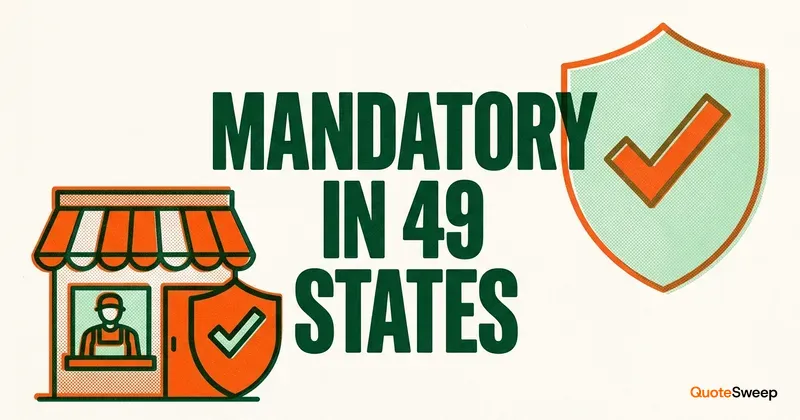
TL;DR: If you have employees, workers' compensation is effectively required in 49 states — every state except Texas, which lets private employers opt out (Insureon, Texas DOI). If you own business vehicles, commercial auto is required in most states (Insureon, NerdWallet). If you have neither, no statute forces a solo owner with no vehicles to carry coverage — but general liability is still commonly required by leases, lenders, and client contracts even when no law demands it (NerdWallet, Insureon). Compare providers on the small-business hub.
Compare business insurance options
Do I need business insurance?
Usually yes, at least some. The honest answer is that "do I need business insurance?" is really three questions in one — a legal question, a contract question, and a risk question — and the answer flips based on whether you have employees, vehicles, a lease, or a loan.
- If you have employees: yes. The SBA says every business with employees must carry workers' compensation, unemployment, and disability insurance (SBA). Workers' comp is effectively required in 49 states (Insureon, NCCI).
- If you own business vehicles: yes. Commercial auto is required in most states for business-owned vehicles (Insureon, NerdWallet).
- If you have neither, but you lease space, took a loan, or sign client contracts: usually yes in practice. No statute forces you to buy general liability, but your lease, lender, or client contract typically does (NerdWallet, Insureon).
- If you're a true solo owner — no employees, no vehicles, no lease, no loan, no contracts: no law compels you to carry any coverage, though it is still strongly advised (NerdWallet, Insureon).
When you need it / who it applies to
Match yourself to the rows below — most businesses land in more than one.
- You have W-2 employees. You need workers' compensation (subject to your state's threshold), plus unemployment coverage, plus statutory disability insurance if you're in one of the five states that mandate it (SBA, Insureon).
- You own vehicles used for work. You need commercial auto (Insureon, NerdWallet).
- You lease commercial space, took a business loan, or sign B2B/client contracts. You typically need general liability — and often property coverage — to satisfy those agreements even without a statute behind them (NerdWallet, Insureon). A certificate of insurance is often the proof they'll ask for.
- You're a licensed professional — doctor, lawyer, real estate or insurance agent — or a construction contractor. You often need professional liability (E&O) or GL to obtain or keep a license (Insureon).
- You sell or serve alcohol. You commonly need liquor liability, especially in dram-shop states (Insureon, SBA).
- You're a true solo owner with none of the above. You're generally not legally compelled to carry any coverage — but it's still strongly advised, because one uninsured claim can be enough to bankrupt a small business (NerdWallet, Insureon).
What the law (or your contract) requires
There are three overlapping bases for a business-insurance requirement, and it matters which one you're facing — a statute is enforced by the government, a contract by the other party.
1. Federal/state statute, if you're an employer. The SBA says every business with employees must carry workers' compensation, unemployment, and disability insurance (SBA). Workers' comp is administered at the state level and is mandatory in every state except Texas, where private employers may opt out (Insureon; Texas Department of Insurance). Unemployment coverage is generally satisfied through state and federal unemployment payroll taxes (SUTA/FUTA) rather than a purchased policy, and statutory disability insurance is only mandated in a handful of states (SBA; Triage Cancer state-disability guide).
2. State vehicle law, if you own business vehicles. Commercial auto liability is legally required for business-owned vehicles in most states, with minimum limits set by each state (Insureon, NerdWallet).
3. Contract, not statute — the most common trigger. General liability, property, and other coverages are usually not required by law, but they are routinely required by commercial leases, lenders, and client or vendor contracts (NerdWallet, Insureon). SBA-backed loans typically require hazard/property coverage and sometimes GL, flood, or life insurance (SBA loan requirements per participating lenders). Some professional and contractor licenses also require professional liability or GL as a condition of licensing (Insureon).
What happens if you don't have it
The downside depends on which requirement you miss — a government penalty, or a broken contract.
- Skipping legally required workers' comp is the highest-risk gap. States impose fines and penalties, stop-work orders, and in some states misdemeanor or felony criminal liability — and you lose the statutory shield against employee lawsuits, exposing you personally to an injured worker's full medical costs and lost wages (MoneyGeek, Nolo).
- Driving business-owned vehicles without required commercial auto exposes the business to state penalties (fines, registration or license suspension) and full out-of-pocket liability for accidents (Insureon).
- Missing contractually required coverage isn't a government penalty, but it can be a breach that voids a lease, triggers loan default or acceleration, or disqualifies you from a client contract or an SBA loan (NerdWallet, SBA).
- Broadly, a single uninsured liability claim, lawsuit, or property loss can be severe enough to bankrupt a small business (NerdWallet).
State variation — confirm before you rely on this
Requirements vary substantially, so verify specifics with your state's department of insurance or workers' comp board rather than assuming.
- Texas is the notable exception: it's the only state that does not require private employers to carry workers' comp (Texas DOI).
- Employee-count thresholds differ. Most states require workers' comp at the first employee, but some set a floor — Insureon notes Georgia requires it at 3+ employees, and several states use a 3–5 employee threshold depending on the state (Insureon, MoneyGeek).
- Four "monolithic" states — Ohio, North Dakota, Washington, and Wyoming — require employers to buy workers' comp through a state fund rather than from private insurers (NCCI-related guidance).
- Statutory disability insurance is mandated in only five states — California, Hawaii, New Jersey, New York, and Rhode Island — plus Puerto Rico (Triage Cancer 2026 guide).
- Commercial auto minimum limits are set state by state (Insureon).
Because these thresholds, exemptions, and limits vary and change, confirm your exact obligation with the relevant state agency before relying on it.
Get covered
Once you know what you're required to carry, the practical question is where to buy it. These are independent, profiled insurtechs on the QuoteSweep small-business hub — none pays for placement here. Match the provider to how you buy and what you need to cover.
Next Insurance (ERGO NEXT) — broadest multi-line stack, bought fast online. If you need several of the coverages above from one place — general liability, a BOP, workers' comp, and commercial auto — Next quotes and binds online in minutes across a wide coverage set, so it's a strong default when you're covering an employer's or vehicle-owner's requirements at once.
biBERK — maximum financial strength, bought direct. If what matters most is who stands behind the policy, biBERK sells directly to businesses and writes on Berkshire Hathaway carriers, covering general liability, BOP, workers' comp, and commercial auto.
Hiscox — the professional-liability specialist. If your license or client contract requires professional liability / E&O, Hiscox is the specialist to compare — just note it doesn't write commercial auto, so you'll need that requirement covered elsewhere.
Thimble — on-demand, by the job, month, or year. If your need is short-term — a weekend event, a single job that requires a certificate of insurance — Thimble sells coverage by the job, month, or year rather than forcing an annual policy.
Frequently Asked Questions
Is business insurance legally required?
Not in general — there's no single federal law forcing every business to buy "business insurance." But specific coverages are required by law once you cross a trigger: the SBA says every business with employees must carry workers' compensation, unemployment, and disability insurance (SBA), and commercial auto is legally required for business-owned vehicles in most states (Insureon, NerdWallet).
Do I need business insurance if I have no employees?
If you also have no business vehicles, no statute forces a true solo owner to carry any coverage (NerdWallet, Insureon). But general liability is still commonly required by your commercial lease, your lender, or your client contracts even when no law demands it — so in practice most solo owners who rent space, borrow, or sign B2B contracts end up needing it anyway (NerdWallet, Insureon).
Which states don't require workers' comp?
Texas is the exception: it's the only state that does not require private employers to carry workers' compensation, where private employers may opt out (Insureon, Texas DOI). Every other state effectively requires it, though employee-count thresholds vary — some states require it at the first employee, while others set a floor such as 3+ employees (Insureon, MoneyGeek).
What happens if I don't carry required business insurance?
For workers' comp, states impose fines and penalties, stop-work orders, and in some states criminal liability, and you lose the shield against employee lawsuits — exposing you personally to a worker's full medical costs and lost wages (MoneyGeek, Nolo). For commercial auto, you face state penalties and full liability for accidents (Insureon). Missing contractually required coverage can void a lease, trigger loan default, or disqualify you from a client contract or SBA loan (NerdWallet, SBA).
The bottom line
Do you need business insurance? Usually yes, at least some. If you have employees, workers' comp is effectively required in 49 states, with Texas the only exception (SBA, Insureon, Texas DOI). If you own vehicles, commercial auto is required in most states (Insureon, NerdWallet). If you have neither, no statute forces you — but your lease, lender, or client contract usually will (NerdWallet, Insureon). The framework here is high-confidence; the granular numbers — exact employee-count thresholds, minimum auto limits, penalty amounts — vary by state and change, so confirm your exact obligation with your state's department of insurance or workers' comp board before relying on it. When you're ready to shop, compare the profiled providers on the small-business hub.