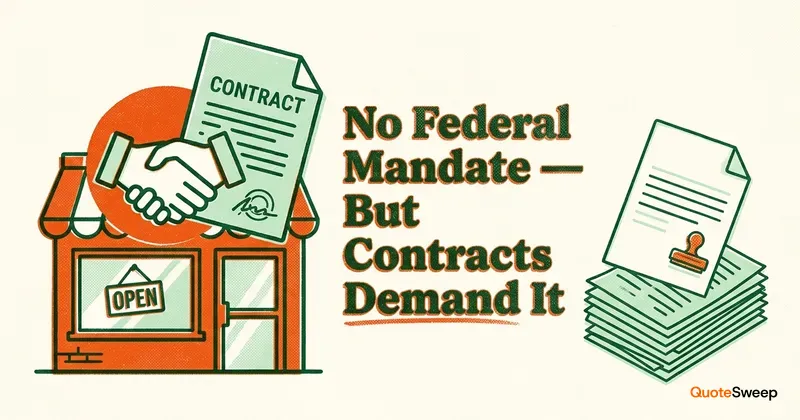
No — general liability (GL) insurance is not required by law for most US small businesses. There is no federal mandate, and no state broadly requires GL for every business. But before you take that as a reason to skip it: GL is very often effectively mandatory, because clients, landlords, lenders, and licensing boards make proof of coverage a condition of doing business.
This is an independent guide from QuoteSweep, which maps the modern commercial insurance landscape. Every legal and requirement claim below is attributed to its source so you can see exactly where the obligation comes from — because "required" almost always means required by a contract or a license, not by a statute.
TL;DR: GL is usually not required by law — Insureon and NerdWallet both say so plainly, and the SBA does not list GL among the coverages the federal government legally requires. In practice it's still close to universal: it gets required by your client contracts, your commercial lease, your business loan, and your professional license. NerdWallet flatly "recommends that all businesses carry general liability insurance." Don't confuse GL with workers' compensation — that one is state-mandated for employers in nearly every state.
Compare business insurance options
Is general liability insurance required?
Short answer: no, not by law, for most small businesses. Insureon and NerdWallet both state plainly that GL "is usually not required by law," and the SBA does not list GL among the coverages the federal government legally requires (Insureon, NerdWallet, SBA). There is no federal GL mandate, and no state imposes a universal GL requirement on all businesses.
That said, "not legally required" is not the same as "optional." The binding force behind GL is usually contractual or license-driven rather than statutory. In day-to-day practice, you'll find GL demanded by the people you want to do business with — and both Insureon and NerdWallet strongly recommend that virtually every business carry it anyway. So the honest answer is: the government probably won't require it, but your customers, your landlord, and your bank very likely will.
When you need it / who it applies to
GL is recommended for essentially all small businesses — NerdWallet explicitly "recommends that all businesses carry general liability insurance." The need is highest if you have exposure to third parties: any business with a storefront, office, or premises open to the public, and any business that interacts with clients or customers on-site or on a client's property, has the strongest case for carrying it (Insureon).
It becomes effectively mandatory — through a contract, a lease, or a license — in these situations (Insureon, NerdWallet, MoneyGeek, SBA-lender guidance):
- You're a construction contractor, one of the trades, or a developer. GL is commonly required for licensure and to win work (Insureon).
- You're in another licensed profession — for example real estate agents, childcare providers, or cannabis dispensaries — where the licensing board conditions your license on coverage (Insureon).
- You sign client or vendor contracts that require proof of coverage. Clients, and general contractors hiring subcontractors, routinely demand a certificate of insurance before work starts (Insureon, NerdWallet).
- You're a tenant under a commercial lease. Commercial landlords typically require GL as a condition of the lease (Insureon, NerdWallet).
- You're taking an SBA or conventional business loan. SBA loans and other business loans routinely carry covenants requiring GL coverage (the Hartford and SBA-lender guidance).
If any of those apply to you, treat GL as required in practice — because the counterparty won't sign, lease, or lend without it.
What the law (or your contract) requires
Here's where the obligation actually comes from, by level:
Federal. The SBA states that the federal government requires every business with employees to carry workers' compensation, unemployment, and disability insurance. GL is not on that list — the SBA describes it only as a coverage businesses "should consider" (SBA). So there is no federal GL mandate.
State. The SBA notes that "some states also require additional insurance" and that "laws requiring insurance vary by state," but no state imposes a universal GL mandate on all businesses (SBA). Where GL is state-required, it's tied to specific licensed occupations. As Insureon puts it, "some states include general liability insurance in their licensing requirements for construction contractors or developers" (Insureon).
Contract and license. This is where the real obligation lives for most businesses. Insureon and NerdWallet both note that GL is commonly demanded by clients, by general contractors hiring subcontractors, by commercial landlords as a lease condition, and by licensing boards (Insureon, NerdWallet). And the Hartford and SBA-lender guidance note that SBA loans and other business loans routinely carry covenants requiring GL coverage. So when you hear GL is "required," it's almost always one of these — a contract clause, a lease term, a loan covenant, or a licensing rule — not a statute.
One clarification worth keeping straight: the coverage that's genuinely state-mandated for most businesses is workers' comp, not GL. Workers' comp is required for employers in nearly every state — the notable exception is Texas, where it's optional for most private employers (Insureon, SBA). So if you're asking "what business insurance am I legally required to carry?", the answer for a business with employees is usually workers' comp, not general liability.
What happens if you don't have it
Because GL is rarely a legal mandate, the main consequence of going without it is financial exposure, not a government penalty. If you cause third-party bodily injury or property damage and have no policy, you pay the claims, the legal defense, and any settlement out of your own pocket. As MoneyGeek puts it, you "might pay expensive claims out of pocket, which could be financially devastating" (MoneyGeek) — potentially business-ending for a small firm.
The practical consequences bite even if you never have a claim, because going uninsured blocks operations and costs you business (Insureon, NerdWallet):
- You can be denied contracts by clients or general contractors who require proof of coverage.
- You can be refused a commercial lease by a landlord who requires GL.
- You can be denied a business loan whose covenants require coverage.
- You can be unable to obtain or renew a professional license or permit that conditions issuance on proof of GL.
NerdWallet also points out the flip side: if you cause an accident while uninsured, a landlord's or client's own policy may have to absorb the cost — which is exactly why they require certificates of insurance up front (NerdWallet). In other words, the people you work with have already decided GL is required, even if the law hasn't.
Get covered
If you've concluded you need GL — whether because the law, a contract, a lease, or a license says so — these are insurtechs QuoteSweep has profiled independently. Compare at least two; appetite and pricing vary by carrier and by business, and you'll want a provider that can issue the certificate of insurance your counterparty is asking for.
Next Insurance — now branded ERGO NEXT after Munich Re's ERGO Group acquired it in 2025 — is a digital-first small-business insurer that quotes and binds online in under 10 minutes and can issue certificates of insurance instantly. It writes a broad multi-line stack including general liability, and per its own site has insured 750,000+ customers across 1,300+ business types. Good fit if a contract or lease needs proof of coverage fast.
biBERK is a direct-to-business insurer that's part of the Berkshire Hathaway Insurance Group, writing on carriers rated A++ (Superior) by AM Best. It sells GL online with no brokers and positions on savings of up to 20% by removing the middleman. The trust-and-stability pick for standard small-business risk that needs a solid, recognized carrier name on the certificate.
Thimble sells on-demand coverage — by the job, month, or year — that you can modify, pause, or cancel instantly, and generate certificates for on the spot. It writes GL for contractors, creatives, cleaners, landscapers, and 1,000+ activities, and is a wholly owned subsidiary of Arch Insurance Group. Best when a single client or event contract requires proof of coverage but you don't need a full annual policy.
Hiscox is a specialty small-business insurer, part of the publicly listed Hiscox Group, strongest in professional liability (E&O) but also writing general liability, BOP, and cyber; it was the first US insurer to sell business owner's coverage direct and online. Best if you're a professional-services firm — consultant, agency, IT shop — that needs GL alongside E&O. Note its BOP is available in 43 states plus DC, and it does not write commercial auto.
See the full field of small-business insurtechs on the small-business hub.
Frequently Asked Questions
Is general liability insurance legally required for a small business?
No — for most US small businesses, GL is not required by law. Insureon and NerdWallet both state it "is usually not required by law," and the SBA does not list GL among the coverages the federal government legally requires (it lists workers' comp, unemployment, and disability for businesses with employees). There's no federal GL mandate and no state that broadly requires GL for all businesses. In practice, though, it's often required by client contracts, commercial leases, business loans, and professional licenses.
Which states require general liability insurance?
No state broadly mandates GL for all businesses. Where GL is state-required, it attaches to specific licensed occupations — Insureon cites construction contractors, developers, real estate agents, and cannabis dispensaries as common examples. Because the rules vary by state and by trade, confirm your situation directly with your state's licensing board or department of insurance (Insureon advises checking a business's "business licensing criteria") rather than relying on a general figure. Don't assume a specific dollar limit or a specific state's rule without verifying it with that state.
Do I need general liability insurance to sign a contract or lease?
Very often, yes — not because the law says so, but because the other party requires it. Insureon and NerdWallet note that clients, general contractors hiring subcontractors, and commercial landlords routinely require proof of GL coverage (a certificate of insurance) before they'll sign. Business loans, including SBA loans, also frequently carry covenants requiring GL. So if a contract, lease, or loan is on the table, treat GL as effectively required.
What happens if I operate without general liability insurance?
Mostly it's financial risk, not a government penalty. If you cause third-party bodily injury or property damage without a policy, you pay claims, legal defense, and settlements out of pocket — MoneyGeek warns this "could be financially devastating." You can also be denied contracts, refused a commercial lease, denied a business loan, or blocked from obtaining or renewing a license or permit that requires proof of GL (Insureon, NerdWallet).
The bottom line
For most US small businesses, general liability insurance is not required by law — there's no federal mandate and no blanket state one, which Insureon, NerdWallet, and the SBA all confirm. But that's the wrong question to stop at. The obligation almost always comes from somewhere else: a client contract, a commercial lease, a business loan covenant, or a professional license. That's why NerdWallet still recommends every business carry it, and why going without it mostly means lost contracts, blocked leases and loans, and uncovered claims you'd pay yourself (MoneyGeek). Confirm any occupation- or state-specific requirement directly with your state's licensing board or department of insurance, keep in mind that workers' comp — not GL — is the coverage most employers are legally required to carry, and if you do need GL, compare at least two carriers. See the full field of small-business insurtechs on the small-business hub.