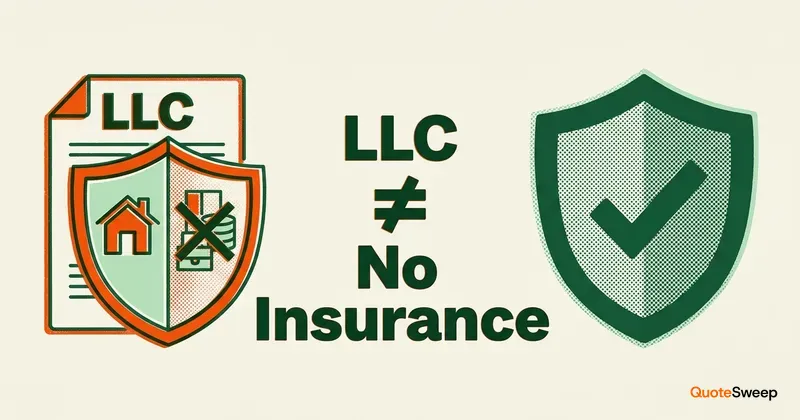
No — there is no single "LLC insurance" requirement, and forming an LLC does not by itself trigger any insurance mandate. But in practice most LLCs are legally or contractually required to carry at least some coverage, and nearly all should: the LLC structure shields your personal assets from business debts and lawsuits, yet it does not protect the business's own assets, pay your legal defense costs, or stop a single claim from bankrupting the company (SBA; NerdWallet; Nolo).
This is an independent guide from QuoteSweep, which maps the modern commercial insurance landscape.
TL;DR: Forming an LLC does not require you to buy insurance. But the moment you hire a W-2 employee, workers' compensation is required in every state except Texas (SBA; Insureon), and if your LLC owns or operates vehicles, commercial auto liability is required in every state (SBA). Licensed professionals may be required by their board to carry E&O, and contracts — leases, client agreements, SBA/bank loans — routinely require general liability. Even where nothing is mandated, insurance is strongly recommended, because the LLC shield covers neither the business's own assets nor its legal defense costs (Nolo; NerdWallet).
Compare business insurance options
Does an LLC need insurance?
No single "LLC insurance" mandate exists, and forming an LLC does not by itself trigger any insurance requirement — but in practice most LLCs are legally or contractually required to carry at least some coverage, and nearly all should (SBA; NerdWallet; Nolo).
Here is the distinction that trips people up. An LLC is a legal structure, not a risk profile. It shields your personal assets — your house, your savings — from the business's debts and lawsuits. What it does not do is protect the business's own assets, cover the cost of defending a claim, or keep a large judgment from bankrupting the company (SBA; NerdWallet; Nolo). Insurance is what fills those gaps, which is why it is strongly recommended even when no law or contract requires it.
The clearest legal triggers are specific and event-based, not tied to the LLC itself:
- The moment your LLC hires a W-2 employee, workers' compensation is required in every state except Texas (SBA; Insureon).
- If your LLC owns or operates vehicles, commercial auto liability is required in every state (SBA).
- Licensed professionals may be required by their state board to carry E&O or malpractice coverage (state licensing boards).
- Contracts — commercial leases, client and vendor agreements, and SBA or bank loans — routinely require general liability and sometimes property coverage (SBA; NerdWallet).
When you need it / who it applies to
Sort your LLC into one of three buckets.
You must carry it by law if you:
- Have W-2 employees — workers' compensation is required in all states except Texas, though employee-count thresholds vary by state, industry, and headcount (SBA; Insureon).
- Own or operate vehicles — commercial auto is required in every state for business-owned or business-operated vehicles (SBA).
- Are a licensed professional whose state board requires E&O or malpractice coverage (state licensing boards).
- Employ people in one of the five states with a disability or paid-family-leave mandate: California, New York, New Jersey, Rhode Island, or Hawaii (state agencies).
You must carry it by contract if you:
- Lease commercial space — leases typically require general liability (SBA; NerdWallet).
- Sign client or vendor agreements — these often require general liability plus E&O and additional insured status.
- Take SBA or bank financing — lenders require property (and sometimes flood, life, or liability) coverage tied to the collateral (SBA).
You strongly should carry it even though it is not mandated if you run a single-member LLC with no employees, a home-based LLC, or any LLC that has customers on your premises, sells products, gives professional advice, or holds business property. The reason is the same in every case: the LLC liability shield covers neither the business's own assets nor its legal defense costs, and if you commingle personal and business finances a plaintiff may be able to "pierce the corporate veil" and reach your personal assets (Nolo; NerdWallet).
One note on owners: LLC members and managers are generally not counted as employees and are often excludable from workers' comp, though the exemption is capped — Insureon cites a limit of about eight people — and family-member LLCs are treated differently, with rules that vary by state (Insureon).
What the law (or your contract) requires
Requirements come from three separate sources, and it is worth keeping them straight.
Federal law imposes no broad general-business-insurance mandate. Narrow exceptions apply to interstate commercial trucking, which faces an FMCSA minimum liability requirement, and to certain federally licensed industries. The SBA frames workers' compensation, unemployment, and disability as required for "every business with employees" (SBA) — but that is a loose framing. Workers' comp and unemployment are actually administered and mandated at the state level, and unemployment is a payroll tax (state SUTA plus federal FUTA), not a purchased insurance policy.
State law is where most true insurance mandates live:
- Workers' compensation — required in roughly 49 states once you have employees, with thresholds that vary by state, industry, and headcount (Insureon; NCCI and state agencies).
- Commercial auto liability — required in every state for business-owned or business-operated vehicles (SBA).
- Disability / paid-family-leave — mandated only in California, New York, New Jersey, Rhode Island, and Hawaii (state agencies).
- Professional liability / E&O or malpractice — required by some state licensing boards for certain professions.
Contract is the third, and very common, trigger. Commercial leases typically require general liability; client and vendor contracts often require GL plus E&O and additional insured status; and SBA or bank loans require property — and sometimes flood, life, or liability — coverage tied to the collateral (SBA; NerdWallet).
A word on state variation: Texas is the only state that does not require private employers to carry workers' comp at all — it is optional there (SBA; Texas Dept. of Insurance). Employee-count thresholds differ widely: most states require coverage from the first employee, but some exempt small employers — Florida, for example, requires it for non-construction employers with four or more employees but for construction with even one, and Tennessee requires it for non-construction with five or more but for all construction regardless of size (Insureon; state agencies). How LLC members and managers are treated also varies by state. Because specific thresholds, exemptions, and penalty amounts change and differ by state, confirm them directly with your state's department of insurance or workers' compensation agency rather than assuming — and do not rely on another state's rule as a proxy.
What happens if you don't have it
Operating without legally required coverage carries escalating penalties.
Uninsured workers' comp: expect fines, stop-work orders that halt the business, personal liability for the injured worker's medical bills and lost wages, and criminal charges in many states. Per Insureon's penalties page and state agencies: Florida imposes $1,000 per day or twice the avoided premium plus a stop-work order; Tennessee runs $50 to $10,000 per violation and a Class A misdemeanor if a worker is injured while you are uninsured; New Jersey allows up to a $10,000 fine and up to 18 months imprisonment; California can reach $100,000 in fines; Pennsylvania treats intentional noncompliance as a third-degree felony with a $15,000 fine and up to seven years in jail; and Illinois treats it as a misdemeanor, or a felony if willful (Insureon; state agencies). These amounts vary and change over time — confirm the current figures with your state agency.
Uninsured commercial auto: it is illegal to operate, exposing you to fines and license or registration suspension, plus full out-of-pocket liability for an at-fault accident (SBA).
No liability coverage generally: the business pays claims and judgments itself, and a single lawsuit can bankrupt it. And if you have commingled personal and business finances, that exposure can reach your personal assets despite the LLC (Nolo; NerdWallet).
Contractual gaps: breaching an insurance covenant can mean lease default or eviction, loss of clients, or loan default (SBA; NerdWallet).
Get covered
Once you know which coverages you are required to carry — and which you simply should — the next step is to quote your actual business. These four independent small-business insurers each fit a different LLC profile. Compare the full field on the small-business hub.
Next Insurance — broad multi-line, bought fast online
Next Insurance writes one of the widest small-business stacks in a single online flow — general liability, BOP, workers' comp, commercial auto, and professional liability — so an LLC that needs several of the required coverages at once can quote and bind them in one place. Best if you want breadth and speed without an agent relationship.
biBERK — direct, with maximum financial strength
biBERK sells directly to businesses online and is part of the Berkshire Hathaway Insurance Group, writing on carriers rated A++ (Superior) by AM Best. It covers general liability, workers' comp, commercial auto, and professional liability. Best if you want to buy direct and value the strongest possible balance sheet behind standard small-business risk.
Hiscox — the professional-liability specialist
Hiscox is the specialist to reach for when your board or a client contract requires E&O, or when being sued for your work is your main exposure. It also writes general liability and BOP, but note it does not write commercial auto — a gap if your LLC operates vehicles. Best for professional-services LLCs whose core risk is professional liability.
Thimble — on-demand coverage by the job, month, or year
Thimble sells small-business insurance by the job, month, or year, which fits contractors and seasonal LLCs that need to satisfy a lease or client general liability or additional insured requirement for a short window rather than a full year. Best when your coverage need is job-based or seasonal.
Frequently Asked Questions
Does forming an LLC require you to have insurance?
No. No single "LLC insurance" mandate exists, and forming an LLC does not by itself trigger any insurance requirement (SBA; Nolo). Requirements attach to what your business does — hiring employees, operating vehicles, holding a professional license, or signing a lease or loan — not to the LLC structure itself.
Does a single-member LLC with no employees need insurance?
Usually not by law, but it is strongly recommended. The LLC shields your personal assets, but it covers neither the business's own assets nor its legal defense costs, and commingling personal and business finances can let a plaintiff "pierce the corporate veil" and reach your personal assets (Nolo; NerdWallet). Any LLC with customers on premises, products, professional advice, or business property should carry coverage.
What insurance is an LLC legally required to carry?
It depends on your situation. Workers' compensation is required once you hire W-2 employees, in every state except Texas (SBA; Insureon). Commercial auto is required in every state if you own or operate vehicles (SBA). Some state boards require E&O or malpractice for licensed professionals, and California, New York, New Jersey, Rhode Island, and Hawaii mandate disability or paid-family-leave coverage for employers (state agencies). Contracts frequently add general liability on top.
If the LLC already protects me, why do I need insurance?
Because the protection is narrower than it sounds. The LLC shield stops the business's debts and lawsuits from reaching your personal assets, but it does not protect the business's own assets, pay your legal defense costs, or stop a claim from bankrupting the company (SBA; NerdWallet; Nolo). Insurance is what covers the claim itself — and it backstops the shield if commingled finances put your personal assets at risk.
The bottom line
Forming an LLC does not, on its own, require you to buy any insurance — but that is not the same as needing none. The moment you hire a W-2 employee, workers' compensation is required in every state except Texas; if you own or operate vehicles, commercial auto is required everywhere; licensed professionals may face a board E&O requirement; and leases, client contracts, and loans routinely require general liability (SBA; Insureon; NerdWallet). Even where nothing is mandated, the LLC shield covers neither your business's assets nor its defense costs, so insurance is strongly recommended (Nolo; NerdWallet). Confirm your exact requirements with your state's insurance or workers' comp agency, then quote more than one carrier — start with the small-business hub.