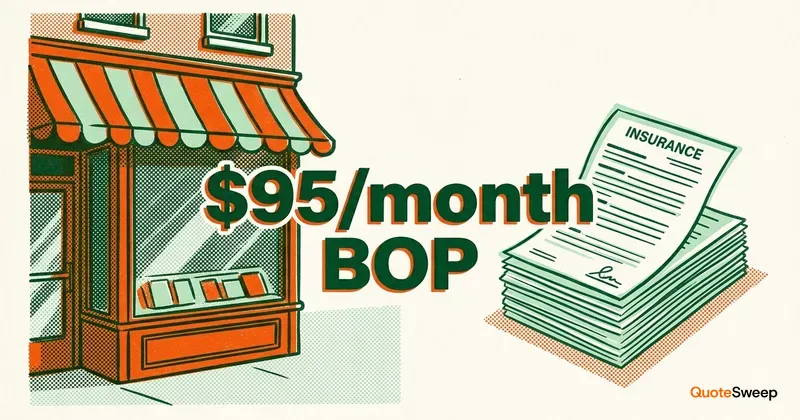
The single most representative insurance cost for a retail store is a business owner's policy (BOP) — the standard bundle of general liability and commercial property — which Insureon reports at a median of $95/month ($1,136/year) for its retail customers, with limits of $1M per occurrence / $2M aggregate and a $500 deductible. If your store carries only general liability, the typical cost is much lower — about $42/month ($500/year), per Insureon.
This is an independent guide from QuoteSweep, which maps the modern commercial insurance landscape. Every figure below is attributed to its source so you can see exactly which population each number describes — because a retailer's "average" premium looks very different depending on whose book you measure and which lines you include. For what coverage a store actually needs (rather than what it costs), see our companion guide on what retail stores need.
TL;DR: The most representative retail number is a BOP at a median $95/month ($1,136/year) per Insureon. Buy general liability on its own and you'll pay about $42/month ($500/year) per Insureon; run a fuller multi-line program (GL + property + workers' comp + cyber + auto) and MoneyGeek's 2026 benchmark averages $129/month ($1,549/year), ranging $33–$293/month by size, state, and inventory value. Insuranceopedia pegs a basic liability-plus-property package at $41–$66/month ($500–$800/year). Insureon quotes medians (lower); MoneyGeek and Insuranceopedia quote averages (higher). Cite the population, not just the number.
Compare business insurance options
How much does retail store insurance cost?
The most defensible single number for a retail store is Insureon's median BOP of $95/month, or about $1,136/year (Insureon) — limits of $1M/$2M and a $500 deductible. A BOP is the right anchor because it's what most stores actually buy: general liability and commercial property packaged together. Insureon reports that 52% of its retail customers pay under $100/month and 79% pay under $200/month.
If you only need general liability — the classic slip-and-fall and product-injury coverage — the typical cost drops to about $42/month ($500/year) per Insureon, with 65% of retail customers paying under $50/month.
For a fuller program spanning several lines (general liability + property + workers' comp + cyber + commercial auto), MoneyGeek's 2026 benchmark averages $129/month ($1,549/year), ranging $33–$293/month depending on your size, state, and inventory value. Insuranceopedia frames a basic liability-plus-property package at $41–$66/month ($500–$800/year).
One caveat before you anchor on any of these: Insureon's figures are medians of its own retail customer book, while MoneyGeek's and Insuranceopedia's are averages, which run higher. The spread between sources is driven by methodology and by which lines are included — not by contradiction. If you're a small single-location store, the Insureon end is closer to reality; if you want a broad multi-line average, MoneyGeek's is more representative.
Cost by coverage
Here's how the major lines price out for retail, by source. Insureon figures are retail-specific medians of its customers; MoneyGeek and Insuranceopedia are averages.
| Coverage | Typical retail cost | Source |
|---|---|---|
| General liability | ~$42/mo ($500/yr); 65% pay under $50/mo | Insureon |
| BOP (GL + property bundle) | Median $95/mo ($1,136/yr); $1M/$2M, $500 deductible | Insureon |
| Workers' compensation | ~$86/mo ($1,036/yr); 55% pay under $50/mo | Insureon |
| Commercial property | ~$221/mo ($2,658/yr) — the most expensive line | MoneyGeek |
| Commercial auto | ~$171/mo ($2,054/yr) | Insureon |
| Cyber | ~$57/mo ($683/yr) | Insureon |
| Commercial umbrella | ~$59/mo ($707/yr) | Insureon |
| Liquor liability | ~$28/mo ($336/yr) | Insureon |
General liability
Insureon puts retail GL at an average $42/month ($500/year) with $1M/$2M limits — 65% of its retail customers pay under $50/month and 88% under $100/month. Simply Business reports a median $59/month for retail shops bought separately, noting retail runs above its $42/month all-customer average because of slip-and-fall foot traffic. MoneyGeek models a 1–4 employee retailer at $110/month ($1,320/year) — roughly $85/month for a solo store up to about $465/month at 20–49 employees — with a state range from Louisiana at $99/month to California at $131/month. Insuranceopedia lists an average $41/month.
BOP (the bundle most stores buy)
The BOP packages GL and commercial property at a discount to buying them separately. Insureon reports a median $95/month ($1,136/year) with $1M/$2M limits and a $500 deductible. Simply Business shows an average $48/month ($576/year) baseline, with retail bundles landing $57–$150/month. Insuranceopedia lists an average $93/month, close to Insureon's median.
Workers' compensation
Once you hire staff, workers' comp is legally required in nearly every state. Insureon reports an average $86/month ($1,036/year) for retail, with 55% paying under $50/month and 84% under $100/month. MoneyGeek models $61/month ($726/year) per employee, with a state range from Indiana at $34/month to California at $147/month. Insuranceopedia lists an average $50/month. For the all-industry picture, NerdWallet (citing Coverdash 2025) cites $1,000–$10,000/year, and NASI 2024 data of $0.57–$1.62/month per $100 of payroll depending on state — a useful reminder that this line scales with your payroll, not a flat rate.
Professional liability
There's no clean retail-specific published figure here, and for good reason: retail stores sell goods rather than professional services, so professional liability is rarely quoted for pure retail. The relevant analog is product liability, which Insuranceopedia lists at about $45/month for retail. If you do offer an advisory or service component, NerdWallet (Coverdash 2025) cites a general small-business professional liability / E&O range of $1,200–$2,200/year (~$100–$183/month).
Other retail lines
Beyond the core stack, Insureon reports commercial auto at $171/month ($2,054/year), cyber at $57/month ($683/year), commercial umbrella at $59/month ($707/year), and liquor liability at $28/month ($336/year) for stores that sell alcohol. MoneyGeek flags commercial property as the single most expensive line at $221/month ($2,658/year) and puts cyber at $89/month — higher than Insureon's median, consistent with the average-vs-median gap you'll see throughout.
What drives the cost for retail stores
In rough order of impact:
Coverage mix. This is the biggest lever. A single GL policy ($42/month per Insureon) is a fraction of a BOP bundle ($95/month per Insureon), which is in turn less than a full multi-line program (~$129/month+ per MoneyGeek). Property is the single most expensive line at about $221/month per MoneyGeek.
Inventory value and type. High-value stock — jewelry, electronics, firearms — raises both property and liability premiums.
Store size and revenue. Larger footprints and higher sales volumes increase exposure and premium.
Employee count and payroll. Workers' comp scales per employee and per $100 of payroll. MoneyGeek models a 1–4 employee retailer at ~$110/month in GL versus ~$465/month at 20–49 employees.
Location / state. MoneyGeek's GL range runs Louisiana $99/month to California $131/month, and its workers' comp range runs Indiana $34/month to California $147/month per employee.
Foot traffic and slip-and-fall exposure. Simply Business notes mall and high-traffic storefronts pay more because of the injury exposure.
Claims history and years in business. Prior claims raise your rate; a longer clean track record lowers it.
Alcohol and data exposure. Selling alcohol adds liquor liability ($28/month per Insureon); accepting card payments or running e-commerce adds cyber ($57–$89/month per Insureon and MoneyGeek).
Chosen limits and deductible. A standard retail BOP uses $1M/$2M limits with a $500 deductible, per Insureon; higher limits raise the premium, and a higher deductible lowers it.
How to lower your premium
- Bundle GL and property into a BOP instead of buying them separately — the bundle is priced at a discount to standalone policies (Insureon, Simply Business).
- Raise your deductible above the standard $500 to lower the premium, keeping it to an amount you could actually pay on a claim.
- Improve loss prevention. Anti-slip flooring, security systems, cameras, and shrinkage controls reduce both liability and property claims.
- Keep a clean claims history. Fewer claims lowers your renewal pricing.
- Right-size your limits to your store's actual inventory value and exposure rather than over-insuring.
- Pay annually rather than monthly to avoid installment fees where offered.
- Comparison-shop across carriers. Insuranceopedia shows retail package quotes spanning roughly $2,800–$3,020/year across State Farm, Nationwide, Progressive, Hartford, Travelers, and others — real money for the same store.
- Manage payroll classification and workplace safety to control workers' comp, the largest variable line for staffed stores.
- Bundle multiple policies with one carrier for multi-policy discounts.
For the broader playbook beyond retail, see our small-business insurance cost guide.
Affordable options
If you want to shop retail coverage directly, these are insurtechs QuoteSweep has profiled independently. Compare at least two — appetite and pricing vary by carrier and by business.
Next Insurance — now branded ERGO NEXT after Munich Re's ERGO Group acquired it in 2025 — is the multi-line pick for a store that wants several coverages bought fast. It quotes and binds online in under 10 minutes across general liability, BOP, workers' comp, commercial auto, and more, and per its own site has insured 750,000+ customers across 1,300+ business types. Good fit if you want much of the retail stack from one fast, well-backed provider.
biBERK is a direct-to-business insurer that's part of the Berkshire Hathaway Insurance Group, writing on carriers rated A++ (Superior) by AM Best. It sells GL, BOP, workers' comp, and more online with no brokers and positions on savings of up to 20% by removing the middleman. The trust-and-stability pick for a standard storefront risk.
Coverdash is a digital platform that gets a small business from quote to coverage "in clicks, not weeks," and it names retail among the owners it serves. It lists the lines a store cares about — GL, a BOP, workers' comp, and cyber — and generates certificates of insurance instantly, which is exactly what a landlord or shopping center asks for before you sign a lease. A clean self-serve option for simpler retail risk.
Coalition is the cyber specialist to compare if your store processes meaningful card volume or runs an e-commerce arm. It's the leader in Active Insurance — cyber coverage bundled with security technology that monitors, alerts, and responds — and every policyholder gets its risk platform and continuous monitoring. Coalition is broker-distributed, so you buy through an appointed broker rather than direct.
Frequently Asked Questions
How much does retail store insurance cost per month?
The most representative figure is a BOP — the standard bundle of general liability and commercial property — at a median $95/month ($1,136/year) per Insureon, with 52% of retail customers under $100/month. General liability on its own runs about $42/month ($500/year) per Insureon, and a fuller multi-line program averages $129/month ($1,549/year) per MoneyGeek.
Why is my retail insurance quote higher than $95/month?
Because $95/month is Insureon's median BOP for a fairly simple store, and several things push a real quote above it: more coverage lines (property is the most expensive at ~$221/month per MoneyGeek), higher inventory value, more employees (workers' comp scales with payroll), a high-cost state, or high foot traffic. Insureon quotes medians; averages from MoneyGeek and Insuranceopedia run higher by design.
What's the cheapest way to insure a retail store?
Bundle GL and property into a BOP rather than buying them separately (the bundle is discounted, per Insureon and Simply Business), raise your deductible above the standard $500, invest in loss prevention, right-size your limits, pay annually, and compare multiple carriers — Insuranceopedia shows retail package quotes spanning roughly $2,800–$3,020/year across major carriers for the same store.
How much is workers' comp for a retail store?
Insureon reports an average $86/month ($1,036/year) for retail, with 55% paying under $50/month. MoneyGeek models $61/month ($726/year) per employee, ranging from Indiana at $34/month to California at $147/month. It scales with payroll — NASI 2024 data via NerdWallet puts the rate at $0.57–$1.62/month per $100 of payroll depending on state — so headcount and wages drive your number more than any flat rate.
The bottom line
The most defensible single number for retail store insurance is a BOP at a median $95/month ($1,136/year), sourced from Insureon — but treat it as a starting anchor, not a quote. It describes a fairly simple store bundling GL and property; a store buying GL alone pays closer to $42/month (Insureon), while a full multi-line program averages $129/month ($1,549/year) per MoneyGeek. Your own number lands somewhere on that spectrum based mostly on your coverage mix, your inventory value, your employee count, and your state. The only way to know your real price is to quote it — start with what retail stores need to size your coverage, compare at least two carriers, and see the full field on the small-business insurtech hub.