Small business insurance does not have one price. What you pay depends on the coverage you buy, your industry, your revenue and payroll, where you operate, and your claims history. The single most useful number is the median premium businesses actually pay for their most common core policy — and that is where this guide starts, before breaking down the ranges, the drivers, and the levers that move the number down.
This is an independent guide from QuoteSweep, which maps the modern commercial insurance landscape.
TL;DR: Per Insureon's median of policies its 40,000-plus small-business customers actually purchase, general liability — the most common core coverage — costs $45/month ($538/year) and a business owner's policy (BOP) costs $83/month ($990/year). MoneyGeek's 2026 report puts a blended cross-coverage national average near $111/month. Most small businesses land between $40 and $250/month; high-risk trades run higher. Industry and payroll drive the price most.
Compare business insurance options
How much does it cost?
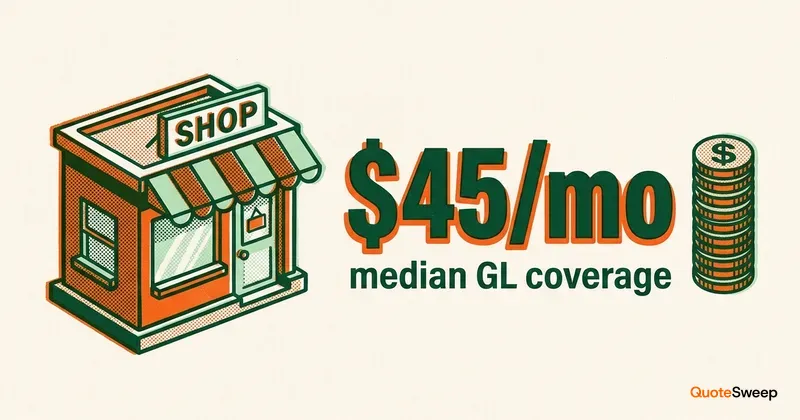
The most representative benchmark comes from Insureon, which reports the median premiums its customers actually pay rather than modeled estimates. Per Insureon, the median general liability policy — the most common core coverage a small business buys — costs $45 per month, or $538 per year. A business owner's policy (the standard bundle of property plus liability) runs higher, at $83 per month, or $990 per year, per Insureon.
Because most businesses carry more than one policy, a blended number sits above either of those. Per MoneyGeek's 2026 report, the blended cross-coverage national average is roughly $111 per month, which works out to about $1,320 to $1,440 per year across six coverage types.
In practice, most small businesses land somewhere between $40 and $250 per month depending on coverage and business size — a range that brackets the Insureon medians above and the NerdWallet and Trusted Choice figures that follow. Per NerdWallet (using 2025 Coverdash data), general liability or a BOP runs $700 to $3,000 per year for businesses under $1 million in revenue. Trusted Choice puts low-risk businesses with basic coverage at $300 to $1,200 per year (cited by NerdWallet). At the other end, high-risk trades such as construction can exceed $5,000 per year, and MoneyGeek flags extreme outliers — pressure washing, for example, at roughly $1,346 per month.
A note on median vs. average
You will see very different "typical" numbers depending on the source, and the gap is methodological, not a contradiction. MoneyGeek's 2026 report shows a general liability average of $123 per month — far above Insureon's $45 per month median. MoneyGeek averages across 408 industries (inflated by high-risk trades) using roughly 6 million modeled pricing estimates, while Insureon reports medians of policies its customers actually purchased. Insureon's figures skew toward micro-businesses — 57% of its customers have one employee and 53% earn under $100,000 a year — so they are the better gut-check for a typical small operation, while MoneyGeek's average better captures the full spread including hazardous trades. Both are given here so you can place your own business on the range.
What drives the cost
Carriers price each account on a specific set of factors. The ones that move the number most:
- Industry and risk classification. This is one of the two most influential factors, per MoneyGeek 2026. A consulting firm and a roofer are priced on entirely different loss experience.
- Employees and payroll size. Workers' compensation scales directly with payroll — roughly $0.57 to $1.62 per month per $100 of payroll, per NASI 2024 data cited by NerdWallet. More employees also means more exposure across the board.
- Business revenue. More customers and more activity means more claim exposure, which raises liability premiums.
- Coverage limits and deductibles. Higher limits cost more; higher deductibles cost less. For reference, Insureon's average deductible is $500.
- Location and state regulations. Litigation climate, claims frequency, and catastrophe exposure vary by state and even by ZIP.
- Prior claims history. A clean loss run earns better rates; a pattern of claims signals higher risk to underwriters.
- Years in operation. Established businesses often price better than brand-new ventures.
- Number and type of policies carried. Each added policy — general liability, BOP, workers' comp, professional liability, commercial property, cyber, commercial auto — adds to the total.
How to lower your premium
The premium is not fixed. The most reliable levers:
- Bundle into a BOP or buy multiple policies from one insurer to earn a package discount.
- Raise your deductible in exchange for a lower premium, if you can absorb a small loss without filing.
- Pay the annual premium upfront rather than monthly to capture the pay-in-full discount.
- Compare quotes across multiple carriers before buying — pricing and appetite vary widely for the same risk.
- Invest in workplace safety and risk-management programs to reduce claims and, over time, your rate.
- Right-size your coverage limits to your actual exposure instead of over-buying.
- Maintain a clean claims history — it is the factor most in your control over the long run.
Affordable options
If you want to compare real quotes, these are established small-business insurers profiled independently on QuoteSweep. Which fits depends on your business; see the small-business hub for the full landscape.
NEXT Insurance is a full-stack digital carrier that quotes and issues small-business coverage online in minutes — a good fit for straightforward, low-risk operations that want to buy direct.
biBERK is a direct-to-business small-business insurer backed by Berkshire Hathaway's financial strength, aimed at simple risk profiles that want a strong balance sheet behind the policy.
Hiscox is a specialty small-business insurer strongest in professional liability (E&O) and BOP — worth a look for consultants and other professional-services firms.
Thimble is an on-demand insurer that sells coverage by the job, month, or year — useful for seasonal, part-time, or event-based operations that do not need a full annual policy.
Frequently Asked Questions
How much is small business insurance per month?
For the most common core policy, general liability, the median is $45 per month, per Insureon. A BOP runs $83 per month (Insureon), and a blended cross-coverage average is about $111 per month, per MoneyGeek 2026. Most small businesses fall between $40 and $250 per month depending on coverage and size.
Why is my quote higher than the median?
Medians skew toward the smallest businesses — 57% of Insureon's customers have one employee and 53% earn under $100,000. If you have more employees, higher revenue, or work in a higher-risk trade, expect to pay more. High-risk trades like construction can exceed $5,000 per year, and MoneyGeek flags extreme outliers such as pressure washing near $1,346 per month.
How much does a business owner's policy (BOP) cost?
Per Insureon, the median BOP costs $83 per month, or $990 per year. A BOP bundles general liability and commercial property, which is why it runs above a standalone general liability policy.
What is the cheapest way to insure a small business?
Start with the coverage you actually need, bundle it into a BOP or buy from one insurer for a package discount, choose a deductible you can absorb (Insureon's average is $500), pay annually to capture the pay-in-full discount, and compare quotes across several carriers before you buy. For low-risk businesses with basic coverage, Trusted Choice cites $300 to $1,200 per year (via NerdWallet).
The bottom line
There is no single price for small business insurance, but there is a reliable starting point: about $45 per month for general liability and $83 per month for a BOP, per Insureon's median of policies actually purchased, with a blended average near $111 per month per MoneyGeek. Where your own number lands is driven mostly by your industry and payroll. The levers that move it down — bundling, deductibles, paying annually, and comparing carriers — are all in your control. Match your business to the right insurer using the small-business hub, then quote your actual operation to price it.