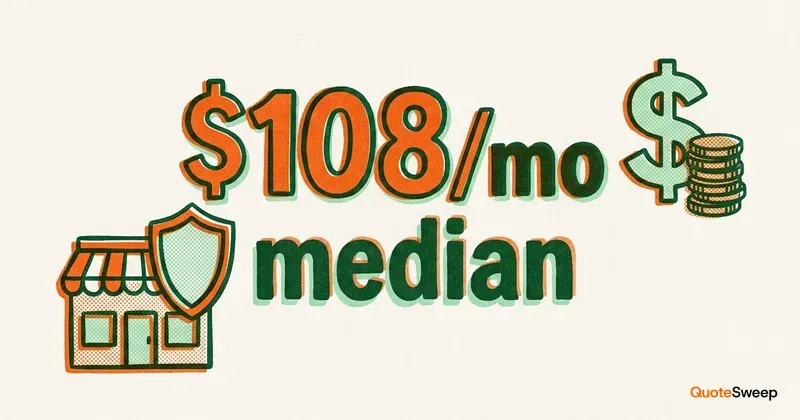
Commercial property insurance costs a typical US small business about $108 per month at the median, according to Insureon — the same figure cited by NerdWallet and TechInsurance. What you actually pay depends on the value of your building and contents, how and where the building is constructed, your industry, and the coverage you choose. A low-hazard consulting office sits near the bottom of the range; a food-and-beverage business or a property in a high-cost, catastrophe-exposed state sits well above it.
This is an independent guide from QuoteSweep, which maps the modern commercial insurance landscape. We are not an insurer, and every figure below is attributed to its source so you can check it yourself.
TL;DR: The median small-business commercial property premium is about $108/month (~$1,296/year), per Insureon — a number NerdWallet and TechInsurance both repeat, making it the most defensible single figure. MoneyGeek's separate 2026 modeled dataset puts the national average higher, at $125/month ($1,498/year) for a business with 1–4 employees on minimum coverage. Most small businesses land roughly $30–$250/month, driven by property value, building characteristics, location risk, and industry.
Compare business insurance options
How much does it cost?
The headline number is $108 per month at the median, per Insureon, drawn from its own book of small-business customers. Because NerdWallet and TechInsurance both cite the same figure, it is the most defensible single number to anchor on. At $108/month, the annual premium is roughly $1,296/year.
A second, independent read comes from MoneyGeek's 2026 dataset, which models pricing across 10 providers, 25 industries, and all 50 states. It puts the national average at $125/month — about $1,498/year — for a business with 1–4 employees on minimum coverage. Treat this as a modeled average rather than a survey of actual premiums, and note it runs a bit higher than Insureon's median.
Most small businesses land roughly $30–$250/month. Insureon reports that 46% of its customers pay under $100/month and 22% pay $100–$200/month, with annual premiums among its customers spanning under $350 to over $15,000 depending on property value and risk. MoneyGeek's 2026 analysis spans an even wider band across business profiles — from $12/month (a low-risk business with no employees) to $480/month (wholesale/distribution).
Where you fall depends heavily on industry and state:
- By industry (among Insureon customers): consulting firms are the cheapest at about $81/month, while food & beverage businesses are the priciest at about $131/month, per Insureon.
- By state (among Insureon customers): monthly averages range from about $38 in Washington to about $208 in New York, per Insureon — which is why high-cost, catastrophe-exposed states like New York, Texas, and Florida run well above the national figure.
If you are still deciding what coverage you need and who to buy it from, our small-business hub maps the providers by use case.
What drives the cost
Carriers price commercial property on the value at risk and how likely that value is to be damaged. The biggest levers, drawing on Insureon, MoneyGeek, and TechInsurance:
- Property value and replacement cost. The replacement cost of the building plus your business contents and equipment is the single biggest driver. More value at risk means more premium.
- Building construction, age, and condition. Older or non-fire-resistant structures cost more to insure than newer, fire-resistive buildings.
- Location risk. Crime rates, distance from a fire station, and exposure to weather perils like hurricanes, wildfire, and hail all push the premium up. This is a large part of why New York, Texas, and Florida run high.
- Industry and operations risk. Manufacturing, wholesale, and food & beverage cost more than office or consulting work — consistent with Insureon's finding that consulting (
$81/month) is cheapest and food & beverage ($131/month) is priciest among its customers. - Coverage form and valuation. A "special" form and replacement-cost coverage cost more than a "basic" form or actual cash value.
- Deductible amount. The higher your deductible, the lower your premium. Insureon customers average a $1,000 deductible.
- Claims history and employee count. A cleaner loss history means a lower rate. MoneyGeek goes further and calls employee count the single strongest pricing signal in its dataset.
How to lower your premium
Several of these are within your control, and the percentage estimates below are MoneyGeek's modeled figures — directional, not guaranteed:
- Bundle property with general liability in a Business Owner's Policy (BOP). A BOP averages about $83/month per Insureon and is cheaper than buying the coverages separately.
- Raise your deductible. MoneyGeek estimates this can cut premiums 10%–25%.
- Pay the annual premium up front instead of in monthly installments — about 5%–10% savings per MoneyGeek, and also recommended by Insureon.
- Invest in risk and loss control — security systems, fire suppression, sprinklers, and alarms. MoneyGeek estimates 5%–20% savings.
- Choose actual cash value instead of replacement cost where appropriate, which lowers the premium, per TechInsurance.
- Shop and compare quotes across carriers, since rates vary widely by insurer and state.
Affordable options
These are digital small-business insurers that quote commercial property fast and tend to sit toward the affordable end for standard risks. Each links to our independent profile so you can dig into the details before you get a quote.
Next Insurance (now ERGO NEXT after Munich Re's ERGO Group acquired it) is a digital-first insurer that quotes and binds a broad multi-line stack — including commercial property — online in under 10 minutes, with the backing of a global reinsurer.
biBERK is a direct-to-business insurer that is part of the Berkshire Hathaway Insurance Group, writing on A++ (Superior) AM Best–rated carriers and positioning on savings of up to 20% by removing the middleman.
Coterie Insurance is an API-first, tech-enabled MGA that delivers instant bindable small-business quotes — including BOP, which bundles property and liability — with admitted products in all 50 states.
Frequently Asked Questions
How much is commercial property insurance per month?
About $108/month at the median for a US small business, per Insureon — a figure NerdWallet and TechInsurance both repeat. MoneyGeek's 2026 modeled dataset puts the national average a little higher, at $125/month for a business with 1–4 employees on minimum coverage. Most small businesses pay roughly $30–$250/month.
How much does commercial property insurance cost per year?
Roughly $1,296/year at Insureon's $108/month median. MoneyGeek's 2026 national average is higher, at $1,498/year for a business with 1–4 employees on minimum coverage. Among Insureon customers, annual premiums span under $350 to over $15,000 depending on property value and risk.
Why is my commercial property insurance so expensive?
The biggest driver is the replacement cost of your building, contents, and equipment, per Insureon. After that, older or non-fire-resistant construction, location risk (crime, fire-station distance, and weather perils like hurricanes, wildfire, and hail), a higher-hazard industry, and a richer coverage form all add cost. It is also why high-exposure states run high — Insureon's state averages reach about $208/month in New York versus about $38/month in Washington.
What is the cheapest way to insure commercial property?
Bundle property with general liability in a Business Owner's Policy (BOP), which averages about $83/month per Insureon and beats buying the coverages separately. Then raise your deductible (MoneyGeek estimates a 10%–25% saving), pay annually rather than monthly (about 5%–10%), invest in loss control like alarms and sprinklers (5%–20%), and compare quotes across carriers.
The bottom line
Anchor on $108/month (~$1,296/year), per Insureon — the median that NerdWallet and TechInsurance both repeat — and treat MoneyGeek's $125/month ($1,498/year) as a modeled national average that runs slightly higher. Most small businesses land in the $30–$250/month band, and where you fall inside it comes down to property value, building characteristics, location, and industry. The fastest ways to pay less are bundling into a BOP, raising your deductible, paying annually, and improving loss control — then comparing quotes, since rates vary widely by insurer and state. Start with our small-business hub to match your business to the right provider.