A retail store carries a specific set of risks: customers walk your floor, you hold inventory and fixtures in a leased or owned space, you ring up card payments, and — once you hire staff — you take on the obligations of an employer. The right insurance program covers all four of those exposures without leaving gaps. This guide explains the coverage lines a retail store actually needs, what drives the price, and which digital insurers fit storefront businesses best.
This is an independent guide from QuoteSweep, which maps the modern commercial insurance landscape. QuoteSweep does not compete with any of these companies, and none pays for placement here.
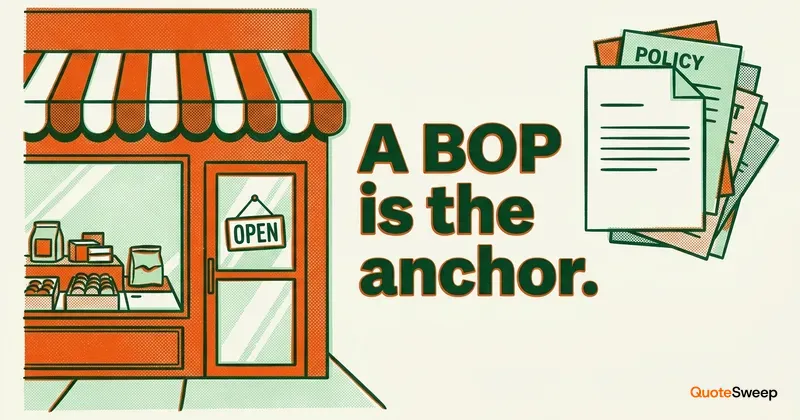
TL;DR: Most retail stores anchor on a business owner's policy (BOP), which bundles general liability and commercial property. Add cyber if you take card payments, workers' comp once you have employees (legally required in nearly every state), and commercial auto if you deliver or run errands. For providers: Next Insurance (ERGO NEXT) for multi-line breadth in one fast flow, biBERK for Berkshire Hathaway financial strength, Coverdash for a fast self-serve buy with instant certificates, and Coalition for serious cyber. Pricing is quote-based.
Compare business insurance options
What insurance does a retail store need?
Retail is one of the most insurable small-business categories because the exposures are well understood. Here are the lines that matter, in the order most stores add them.
General liability — the foundation
General liability (GL) covers third-party claims of bodily injury, property damage, and personal or advertising injury. For a retail store this is the single most important liability line, because the classic retail claim is a customer slipping on a wet floor in your store — the textbook example the standard ISO Commercial General Liability form is built to answer. GL is written on an occurrence basis with standard limits of $1 million per occurrence and $2 million aggregate, and it's required by nearly every commercial lease and shopping-center agreement you'll sign.
Two parts of GL matter especially for retailers. Personal and advertising injury (Coverage B) responds to claims like using a competitor's copyrighted tagline in a promotion. And the products/completed operations aggregate built into the CGL form is where your product exposure lives — if you sell physical goods, a customer harmed by a product you stocked can bring a claim against the store, and GL's products coverage is the first line of defense. Retail is typically rated on revenue plus square footage, so your floor size and sales volume both feed the price.
Business owner's policy (BOP) — the retail anchor
For most stores, GL doesn't get bought on its own — it gets bundled into a business owner's policy (BOP). A BOP combines general liability with commercial property, which covers your building (if you own it), plus business personal property: fixtures, shelving, point-of-sale equipment, and inventory. Small retail is the textbook BOP class — the BOP is designed for exactly this kind of business, with revenue generally under $5 million and a straightforward risk profile.
The BOP is the retail anchor for three reasons. First, it covers the two risks every store faces — liability for a customer injury and protection for your own physical assets — in one policy. Second, most carriers build in business interruption coverage (which replaces lost income if a covered loss like a fire forces you to close) and equipment breakdown at no extra charge, both of which a store owner would otherwise overlook. Third, bundled BOP pricing is consistently lower than buying general liability and commercial property separately. If you have a storefront with inventory and fixtures worth insuring, quote the BOP first.
BOPs also accept endorsements that map cleanly onto retail: hired and non-owned auto for staff who make deliveries or bank runs in their own cars, employee dishonesty / crime coverage for internal theft, and a limited cyber endorsement. Note that the built-in cyber sub-limit is small — more on that below.
Workers' compensation — required once you have staff
The moment your store has employees — cashiers, stock clerks, floor associates — you almost certainly need workers' compensation. It pays medical bills and lost wages when an employee is hurt on the job (a stock clerk straining their back, a slip in the back room), and it's mandatory in every state except Texas, where it's optional for private employers. The penalties for going without it are severe, including personal liability for the owner if an uninsured employee is injured.
Workers' comp is rated differently from your other lines: premium is payroll divided by 100, times the class code rate, times your experience modification rate (EMR). Retail store class codes generally carry moderate rates — well below construction or roofing — but a clerical role and a warehouse-stocking role can be classified differently, so accurate classification matters. Carriers audit payroll at year-end, so estimate it accurately up front to avoid a surprise audit bill.
Cyber liability — essential if you take card payments
If your register accepts credit and debit cards, you handle payment data — and that means you have cyber exposure. This is the coverage most retail owners assume they already have and don't. Standard GL policies contain absolute cyber exclusions, and while some BOPs include a small cyber endorsement (often $50,000–$100,000), a real breach at a retailer routinely costs far more once you add forensic investigation, breach notification to affected customers (required by law in all 50 states), credit monitoring, PCI-DSS regulatory exposure, and lost business.
A standalone cyber liability policy covers both sides of a breach: first-party costs (forensics, notification, ransomware, business interruption from a POS outage) and third-party liability (lawsuits from customers whose card data was compromised, plus regulatory defense and fines). Carriers increasingly require basic security controls — multi-factor authentication, endpoint detection, and regular backups — before they'll quote, so put those in place first. For a store that runs an e-commerce site alongside the physical location, cyber moves from important to non-negotiable.
Commercial auto and hired/non-owned auto
If your store owns a delivery van or any vehicle titled to the business, you need commercial auto insurance — it's legally required in every state for a vehicle registered to a business entity, and personal auto policies exclude business use. It covers liability, physical damage, and medical payments for those vehicles.
Even if you don't own a vehicle, watch the hired and non-owned auto (HNOA) gap: if an employee uses their own car to drop off an order or make a bank run and causes an accident, that exposure isn't covered unless HNOA is in place — either as a BOP endorsement or the right ISO symbols on a commercial auto policy. It's one of the most commonly missed retail exposures.
Professional liability (E&O) — situational
Standard retail — selling goods over a counter — doesn't usually need professional liability (E&O), because GL and product coverage handle the physical-goods exposure. But if your store sells advice along with product — a specialty bike shop doing custom fittings, an optical shop, a supplement store making recommendations — then an error in that professional advice is an E&O claim that GL explicitly excludes. E&O is written on a claims-made basis (mind the retroactive date), so raise it only if your store provides a genuine service or advice component.
How much does it cost?
Retail insurance is quote-based — there's no flat price, and any store that gives you a number without your details is guessing. What actually drives the premium:
- Revenue and square footage. Retail general liability is rated primarily on sales volume and floor size, so a larger, higher-traffic store pays more than a small boutique.
- Payroll and class codes (workers' comp). More employees and higher-hazard roles (warehouse stocking vs. clerical) raise workers' comp premium, which is calculated directly off payroll.
- Property values. The more inventory, fixtures, and equipment you insure under the property/BOP portion, the higher that piece of the premium.
- Location. Stores in litigious states or higher-crime areas, and those in coastal or catastrophe-exposed regions, generally cost more to insure.
- Claims history. Prior liability claims, and a workers' comp experience modification rate (EMR) above 1.0, push premiums up; a clean history and an EMR below 1.0 bring them down.
- Cyber posture. For cyber coverage, your data volume and security controls (MFA, backups) drive both eligibility and price.
Entry pricing can start low for a simple, single-location store with modest revenue and no employees — Next Insurance, for example, lists general liability starting around $19/month per its site — but your real number depends on the mix above. Because carrier appetite and rating for retail vary widely, the single most reliable way to control cost is to compare more than one insurer on your actual business rather than a headline figure.
Best insurers for retail stores
There's no single best insurer for every store — the right fit depends on whether you want multiple lines in one fast flow, maximum financial strength, a self-serve buy with instant proof of coverage, or serious cyber protection. All four below are digital-first providers profiled in depth on the QuoteSweep small-business hub.
Next Insurance (ERGO NEXT) — best for multi-line breadth in one fast flow
Next Insurance — now branded ERGO NEXT after Munich Re's ERGO Group acquired it for $2.6B in 2025 — is the multi-line benchmark for a store that wants several coverages bought quickly. You can quote and buy online in under 10 minutes across general liability, BOP, workers' comp, commercial auto, professional liability, commercial property, tools & equipment, and EPLI — nearly the entire retail stack in one place. Per its site it has insured 750,000+ customers across 1,300+ business types, with general liability starting around $19/month, and it's now backed by a global reinsurer. Note it isn't available in every state, and cyber isn't among its listed lines, so a card-accepting store may need to source that separately.
Best for: Retail stores that want a BOP, workers' comp, and auto from one fast, well-backed provider.
biBERK — best for financial strength behind the policy
biBERK is the pick for owners who care most about who's standing behind the policy. It sells directly — no brokers — and positions on savings of up to 20% by cutting out the middleman, across general liability, BOP, workers' comp, professional liability, commercial auto, and umbrella. Its edge isn't a flashy interface; it's the balance sheet: biBERK is part of the Berkshire Hathaway Insurance Group and writes on carriers rated A++ (Superior) by AM Best, the top financial-strength tier, and reports being trusted by 200,000+ small businesses. Like Next, it doesn't list cyber among its lines.
Best for: Retail owners who want to buy direct and want the strongest possible financial strength behind the policy.
Coverdash — best for a fast self-serve buy with instant certificates
Coverdash is a digital platform that gets a small business from quote to coverage "in clicks, not weeks," and it names retail among the small-business owners it serves. It lists the lines a store cares about — general liability, a BOP, workers' comp, cyber, professional liability, and management liability — and it generates certificates of insurance instantly, which is exactly what a landlord or shopping center asks for before you sign a lease. Coverdash places coverage with carrier partners rather than underwriting itself, and it's a newer platform, so terms vary by carrier and some reviews note fees to watch for.
Best for: Store owners who want a fast, self-serve buy and need to prove coverage to a landlord or mall on day one.
Coalition — best for serious cyber coverage
If your store processes meaningful card volume or runs an e-commerce arm, Coalition is the cyber specialist to compare. It's the leader in what it calls Active Insurance — cyber coverage bundled with security technology that monitors, alerts, and responds, rather than a bare policy you only touch after a breach. Every policyholder gets the Coalition Control risk platform, continuous vulnerability and dark-web monitoring, email-fraud alerts, and managed detection and response, plus incident response when something goes wrong. It's backed by A-rated capacity (Allianz, Swiss Re, Lloyd's, Zurich, and others). Coalition is broker-distributed — you buy through an appointed broker rather than direct — and it doesn't publish flat pricing. Compare cyber players on the cyber insurtech hub.
Best for: Retailers with real payment-data exposure who want cyber coverage that comes with security tooling built in.
Frequently Asked Questions
What insurance is required for a retail store?
Two lines are effectively required. Workers' compensation is legally mandatory in nearly every state once you have employees, and general liability is required by virtually every commercial lease and shopping-center agreement — so you can't open the doors without it. Most stores satisfy the GL requirement through a BOP, which also protects their inventory and fixtures. If you own a business vehicle, commercial auto is required by law as well.
Do I need a BOP or just general liability?
If your store has a physical location with inventory, fixtures, and equipment worth insuring, quote the BOP first. It bundles general liability with commercial property — covering both a customer injury and damage to your own goods — usually at a lower combined price than buying the two separately, and it often includes business interruption and equipment breakdown at no extra charge. Standalone general liability makes sense mainly for a store with no property to insure or one that already carries property coverage elsewhere.
Does my store insurance cover a data breach?
Not by default. Standard general liability and BOP policies contain absolute cyber exclusions, and any built-in BOP cyber endorsement is typically a small sub-limit ($50,000–$100,000) that covers only a fraction of a real breach. If you accept card payments or run an online store, add standalone cyber liability coverage. Providers like Coalition specialize in it and bundle security tooling to help prevent the breach in the first place.
How much does retail store insurance cost?
Pricing is quote-based and varies with your revenue, square footage, payroll, location, inventory values, and claims history. Entry pricing can start low for a small single-location store with no employees — Next Insurance lists general liability starting around $19/month per its site — but your real number depends on your full coverage mix. The reliable way to control cost is to quote your actual business with more than one insurer.
The bottom line
A retail store's program comes together in a predictable order: a BOP to cover customer injuries and protect your inventory and fixtures, workers' comp once you hire staff, cyber if you take card payments, and commercial auto or hired/non-owned auto if you deliver. For providers, Next Insurance (ERGO NEXT) is the multi-line benchmark, biBERK wins on Berkshire Hathaway financial strength, Coverdash is the fastest self-serve buy with instant certificates, and Coalition is the cyber specialist. Match the provider to how your store actually operates, and quote more than one — compare the field on the small-business hub, the cyber hub, and the workers' comp hub.