The First 90 Days as a New Commercial Lines Producer: A Survival Guide
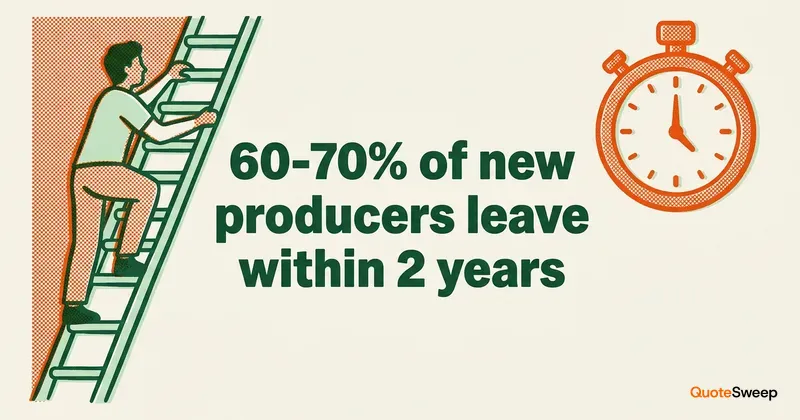
The majority of new commercial lines producers fail. That's not cynicism – it's an industry reality that deserves a direct answer before you read anything else. According to data from the Independent Insurance Agents & Brokers of America (IIABA), producer turnover in the first two years runs between 60% and 70%. The Council of Insurance Agents & Brokers (CIAB) has reported similar attrition figures across member agencies. Most of those departures happen not because the person lacked sales talent, but because they didn't have a structured plan for the critical first 90 days.
What separates the producers who build a sustainable book of business from those who flame out? Almost always, it comes down to how they spent their first three months. The producers who survive treat those 90 days as a deliberate ramp-up – learning the market before selling into it, building pipeline before needing closings, and tracking the right activity metrics instead of staring at a commission statement that hasn't started moving yet.
TLDR: Most new commercial producers fail within two years. The ones who make it follow a structured 90-day plan: month one is for learning carrier appetites and choosing niches, month two is for aggressive prospecting and first submissions, month three is for closing initial accounts and building renewal pipeline. Track your activity daily, pick 3-5 niches instead of going broad, and demand mentorship and technology from your agency.
The Brutal Math of New Producer Economics
Before diving into the 90-day framework, you need to understand why the odds are stacked against you – and what levers you can pull to shift them.
A new insurance producer typically works on a commission split with their agency – anywhere from 30% to 50% of the commission the agency earns on each policy. On a $5,000 annual premium BOP with a 15% agency commission, that's $750 to the agency and $225 to $375 to you. To hit a $50,000 first-year income target, you'd need to write roughly $333,000 to $500,000 in new premium. At an average account size of $4,000 to $6,000 in total premium, that's somewhere between 55 and 125 new accounts in year one.
That sounds daunting because it is. But here's the math that actually matters: commercial insurance renews. An 87% retention rate means last year's accounts keep paying this year. By year three, your renewal book is doing most of the heavy lifting while your new business production compounds on top.
The first 90 days determine whether you survive long enough for that compounding to kick in.
Why Most Producers Wash Out
The failure pattern is remarkably consistent across agencies:
- Weeks 1-4: New producer is excited, attends orientation, gets business cards, tells friends and family they're in insurance
- Weeks 5-8: Reality sets in. Cold calls go unanswered. Quotes don't close. The producer doesn't know which carriers to approach for what classes
- Weeks 9-14: Commission checks are nonexistent or tiny. The producer starts questioning their decision. Activity drops because the emotional return on effort feels negative
- Weeks 15-20: The producer either quits or gets terminated for missing production minimums
This guide exists to break that pattern.
Month 1 (Days 1-30): Learn Before You Earn
Your first month is not about selling. Repeat that to yourself. Every hour you spend cold calling in week one – before you understand your agency's carrier panel, appetite guides, and submission workflows – is an hour wasted. You'll pitch the wrong coverage, submit to the wrong carrier, and burn prospects you could have closed later with the right approach.
Week 1: Orientation and Systems
Get your licensing and appointments in order. Your insurance license should already be active, but you likely need carrier appointments to bind business. Ask your agency principal exactly which carriers you're appointed with on day one, which appointments are in progress, and the expected timeline. Some carrier appointments take 2 to 6 weeks to process – that timeline directly affects when you can start writing business with each market.
Learn the agency management system cold. Whether your agency runs Applied Epic, Hawksoft, AMS360, or another platform, you need to know how to look up existing accounts, enter new prospects, create activities, and log notes. This isn't glamorous work, but it's the plumbing that prevents E&O exposure and keeps your pipeline organized.
Understand the agency's submission workflow. Every agency has a process for how quotes get to carriers. Some use comparative raters that submit to multiple carriers simultaneously. Others require you to complete ACORD forms and submit through carrier portals individually. Know the process before your first submission.
Week 2: Carrier Appetite Deep Dive
This is the week that separates prepared producers from those who waste months quoting into the wrong markets.
Map every carrier on your panel. For each carrier, document:
| Carrier | Best Classes | Avoid Classes | Premium Sweet Spot | Appetite Quirks |
|---|---|---|---|---|
| Carrier A | Restaurants, retail | Contractors with heavy auto | $2K-$15K BOP | Won't write new ventures under 2 years |
| Carrier B | Contractors, manufacturing | Hospitality | $5K-$50K package | Requires 3 years loss runs, no exceptions |
| Carrier C | Professional services, tech | Anything with liquor exposure | $1K-$10K BOP | Fast-track for BOP under $5K |
Ask your agency's experienced producers and CSRs which carriers they go to first for specific classes. That tribal knowledge is more valuable than any appetite guide PDF. A carrier might technically write landscapers, but if your agency's underwriter at that carrier declines landscapers 80% of the time, that's a different reality than what the appetite guide suggests.
Week 3: Niche Selection
Going broad is the single most common mistake new producers make. You don't need to be an expert in every commercial class code – you need to be an expert in three to five. Read our full guide on how to niche your insurance agency for the strategic framework, but here's the short version for your first 90 days:
Pick niches based on three criteria:
- Carrier appetite depth – You need at least 3 to 5 competitive markets for any niche you choose. If only one carrier on your panel writes a class well, you can't compete on coverage or price
- Prospect accessibility – Can you build a list and reach these business owners? Restaurants are easy to find. Marine equipment distributors are not
- Premium density – Some niches generate higher total premium per account. A contractor with GL, workers' comp, commercial auto, and inland marine is worth 3 to 4 times a solo consultant with a BOP
Good starter niches for new producers include restaurants, small contractors (handymen, painters, cleaning services), professional services (accountants, consultants, IT firms), and retail. These classes have deep carrier appetite, abundant prospects, and straightforward coverage needs. For a deeper look at this segment, see our guide to selling commercial insurance to small business. For deeper guidance on these classes, see our guides on how to quote a BOP and how to quote workers' comp.
Week 4: Shadow and Observe
Spend this week riding along with experienced producers. Sit in on sales calls – not just the polished presentations, but the messy discovery meetings where the producer figures out what the prospect actually needs. Listen to how they handle objections. Watch how they explain coverage gaps. Pay attention to the questions they ask that you wouldn't have thought to ask.
If your agency allows it, sit in on renewal reviews too. Understanding how remarketing renewals works gives you a preview of what your second year will look like – and it demonstrates how existing book management feeds future revenue.
Month 1 Deliverables Checklist:
- All carrier appointments submitted or confirmed
- AMS proficiency (can enter prospects, log activities, pull reports)
- Carrier appetite matrix completed for your panel
- 3 to 5 target niches selected with rationale documented
- 5+ shadow sessions completed with experienced producers
- Prospect list of 100+ businesses across your chosen niches
Month 2 (Days 31-60): Build Pipeline Relentlessly
Month two is where the work shifts from preparation to production. You should be spending 70% of your time on prospecting activities and 30% on learning (you're still learning – you'll be learning for years). The goal by the end of month two is simple: have 10 to 15 submissions out with carriers and a pipeline of 30 to 50 qualified prospects at various stages.
Prospecting: The Activity That Pays Everything
There is no shortcut here. Every successful commercial producer built their book the same way – by making an uncomfortable number of calls, sending an uncomfortable number of emails, and showing up at an uncomfortable number of events.
Daily activity targets for month two:
- 20-30 outbound calls to prospects in your target niches
- 10-15 personalized emails to prospects who didn't answer the phone
- 2-3 LinkedIn connection requests with personalized messages to local business owners
- 1 in-person drop-by if geography allows (especially effective for restaurants and retail)
If those numbers seem high, read our detailed guide on cold calling scripts for insurance agents. The scripts and frameworks in that post will cut your call anxiety in half and double your conversation rate.
Networking: Play the Long Game
Attend 2 to 3 networking events per month. But be strategic – not every Chamber of Commerce mixer is worth your Tuesday evening. Prioritize:
- Industry-specific associations in your chosen niches (restaurant associations, contractor groups, local tech meetups)
- BNI or similar referral groups where you're the only insurance agent in the room
- CPAs, attorneys, and commercial lenders – these professionals refer insurance needs constantly. Our guide on building an insurance referral network covers how to structure these relationships so they actually produce referrals
Don't go to networking events expecting to sell insurance on the spot. Go to build relationships with people who know your target prospects. One strong relationship with a CPA who serves 40 restaurant clients is worth more than 40 individual cold calls.
Your First Submissions
By week 6 or 7, you should be submitting your first quotes. This is where everything you learned in month one pays off – or where gaps in your preparation become painfully obvious.
The anatomy of a good first submission:
- Gather complete information upfront. Half-baked submissions get declined or delayed. Use the insurance submission process checklist: legal entity name, FEIN, years in business, revenue, payroll by state, loss runs (minimum 3 years), current coverage details, and any operations-specific information the carrier needs
- Match the risk to the right carrier. Check your appetite matrix. Don't submit a new-venture restaurant to a carrier that requires 3 years of operating history
- Submit to 3 to 5 carriers simultaneously. This is where multi-carrier quoting tools save enormous time. Instead of logging into five separate carrier portals and re-entering the same data, you can submit once and get multiple quotes back. That time difference – hours versus minutes – is the difference between submitting 5 quotes per week and 15
- Follow up within 48 hours. If you haven't heard back from a carrier within two business days, call the underwriter. New producers with small premium submissions are not anyone's priority. Being politely persistent gets quotes back faster
Learning From Every Declination
You will get declined. A lot. Every declination is a data point. When a carrier says no, ask why. Was it the class code? Loss history? Revenue size? The territory? Document the reason in your carrier appetite matrix. After 20 declinations, you'll have a much sharper picture of what each carrier actually writes versus what their appetite guide claims.
This learning process is the hidden curriculum of your first year. No training program can replace the education of 50 real submissions.
Month 2 Deliverables Checklist:
- 400-600 total outbound calls made
- 10-15 submissions sent to carriers
- 2-3 networking events attended
- 3+ referral source relationships initiated
- Pipeline tracking sheet updated daily with 30-50 prospects
- Declination log maintained with reasons and patterns noted
Month 3 (Days 61-90): Close, Learn, Compound
By month three, your pipeline should start producing results. Some submissions come back with competitive quotes. Some prospects who said "call me next month" are now ready to talk. The work of months one and two starts converting into bound policies, and the rhythm of commercial insurance production begins to make intuitive sense.
Closing Your First Accounts
Your first close will probably be a straightforward account – a small BOP for a consulting firm, a GL policy for a handyman, a package policy for a small retailer. That's fine. Small accounts teach you the binding workflow, the insurance binder process, and client onboarding without the complexity of a multi-line commercial account that could create E&O exposure if you miss something.
When presenting quotes, don't just email a proposal and wait. Schedule a presentation – in person or on video – where you walk the prospect through coverage, explain what's included, what's excluded, and why you recommended specific limits. Our guide on writing commercial insurance proposals covers proposal structure, and our post on handling price objections will prepare you for the most common pushback.
Present three options when possible:
| Option | Coverage | Annual Premium | Best For |
|---|---|---|---|
| Essential | Base GL + property, minimum limits | $X | Tight budget, low exposure |
| Recommended | Full BOP with higher limits, added endorsements | $Y | Most businesses in this class |
| Comprehensive | BOP + umbrella + cyber + EPLI | $Z | Higher exposure, asset protection |
Three options shift the conversation from "should I buy" to "which one fits." The middle option closes most often.
Start the Renewal Pipeline Early
Here's something most new producers don't think about until it's too late: you need to start building a renewal remarketing pipeline now. When you're prospecting, you're talking to business owners who already have coverage with another agent. Many of them have renewal dates 3, 6, or 9 months away.
Document every prospect's renewal date in your AMS. Set a reminder for 90 days before each renewal to follow up and request current policy details for a coverage review. This creates a perpetual motion machine – every month, you have a list of prospects whose renewals are coming up and who already expressed interest in seeing what you can do.
By the end of month three, you should have 20 to 40 future renewal dates logged. That pipeline is gold for months four through twelve.
Plant Referral Seeds
Your first few clients are your first referral sources. After binding a new account and completing the onboarding, wait 2 to 3 weeks (long enough for the client to confirm everything went smoothly), then ask a simple question: "Is there anyone in your industry who might benefit from the same kind of coverage review we did for you?"
Don't ask for referrals at the point of sale – the client doesn't trust you yet. Ask after you've delivered value. Read our full playbook on building an insurance referral network for the complete framework.
Cross-Selling From Day One
Even on small accounts, think about cross-selling commercial lines. A restaurant with just a BOP is an immediate opportunity for liquor liability, workers' comp, commercial auto (if they deliver), and an umbrella. A contractor with just GL needs workers' comp, commercial auto, inland marine for tools and equipment, and possibly a builder's risk policy.
Every coverage gap on a new account is both a revenue opportunity and an E&O risk if you don't at least offer it. Document the offer even if the client declines – that documentation protects you.
Month 3 Deliverables Checklist:
- 3 to 8 accounts bound (varies by agency expectations)
- Proposals presented using three-option format
- 20-40 future renewal dates logged in AMS
- Referral conversations initiated with first clients
- Cross-sell opportunities identified and documented on every new account
- First commission check received (however small)
The Five Metrics That Predict Producer Survival
Feelings lie. Numbers don't. Track these five metrics daily, and review them weekly with your agency mentor or principal.
| Metric | What It Measures | Month 2 Target | Month 3 Target |
|---|---|---|---|
| Dials/Contacts | Raw prospecting activity | 20-30/day | 20-30/day |
| Quotes Submitted | Conversion from prospect to submission | 3-4/week | 5-7/week |
| Close Ratio | Submissions that bind | 15-25% | 20-30% |
| Average Premium | Revenue per account | $3,000-$5,000 | $4,000-$7,000 |
| Pipeline Value | Total premium of active opportunities | $50K-$100K | $100K-$200K |
The most important metric is the first one: dials and contacts. Everything downstream – quotes, closes, premium – is a function of how many conversations you have. If your close ratio is low but your activity is high, you'll improve through repetition. If your activity is low, no amount of sales skill will save you.
Track your agency KPIs in a spreadsheet or CRM from day one. When you have a bad week – and you will – the numbers tell you whether the problem is activity (not enough calls), conversion (wrong approach), or market (wrong niches).
Common Mistakes That Kill New Producer Careers
Having watched dozens of new producers attempt this transition, certain failure patterns repeat themselves with depressing regularity.
Mistake 1: Going Too Broad
"I'll write anything that walks in the door" sounds logical, but it's a trap. When you try to quote every class of business, you spend your limited learning capacity spread across too many industries, carrier appetites, and coverage structures. You become mediocre at everything instead of competent at a few things.
Pick your 3 to 5 niches and focus. You can expand later once your base book is established. For the strategic rationale behind this, read how to niche your insurance agency.
Mistake 2: Quoting Without Understanding Appetite
Nothing wastes time like submitting a risk to a carrier that will never write it. A landscaper with three auto losses submitted to a carrier that cherry-picks clean accounts will get declined in 48 hours – and you've lost the time it took to gather information, complete the submission, and wait for the response.
Always check your appetite matrix before submitting. If you're unsure, call the underwriter and describe the risk before sending anything. A two-minute phone call can save two hours of wasted work.
Mistake 3: Not Documenting E&O Exposure
When a prospect asks about coverage and you provide advice – even casually, even in a text message – you're creating potential E&O exposure. Every coverage recommendation, every declination by the client, every conversation about limits should be documented in your AMS.
This isn't paranoia. It's professional practice. The producers who get burned by E&O claims are almost always the ones who said "I'll document that later" and never did. Document in real time, every time.
Mistake 4: Avoiding the Phone
Email is comfortable. LinkedIn messages feel productive. But commercial insurance is still sold through conversations. The close rate on a phone call or in-person meeting is 5 to 10 times higher than the close rate on an email. You can use email and LinkedIn to warm up prospects and schedule calls, but the calls themselves are where business gets done.
If you struggle with phone anxiety, our guide on cold calling scripts for insurance agents provides word-for-word frameworks that remove the guesswork.
Mistake 5: Neglecting Your Pipeline CRM
A prospect list in your head is not a pipeline. A spreadsheet you update once a week is barely a pipeline. A CRM or AMS with every prospect, their status, their renewal date, and your next action – updated daily – is a pipeline.
By month three, you should be able to answer these questions instantly: How many active prospects do I have? What's my total pipeline value? Which prospects need follow-up this week? How many submissions are pending? If you can't answer those questions, your pipeline management needs work.
What Your Agency Should Provide (And What to Ask For)
A new producer's success isn't entirely on their shoulders. The agency bears responsibility for providing the infrastructure, mentorship, and support that makes success possible. Here's what a good agency provides – and if yours isn't providing these things, that's a conversation worth having.
Mentorship
You need a designated mentor – an experienced producer or agency principal who meets with you weekly to review your pipeline, role-play sales scenarios, and help you navigate carrier relationships. "My door is always open" is not a mentorship program. Scheduled weekly 30-minute pipeline reviews are.
Leads and Introductions
Some agencies provide leads to new producers. Others expect producers to generate everything from scratch. Neither approach is inherently right or wrong, but you should know which model you're in before you start. If the agency provides no leads, your ramp-up timeline will be longer, and your monthly draw or salary needs to reflect that reality.
Carrier Introductions
Your relationship with underwriters matters enormously in commercial insurance. A good agency introduces new producers to key underwriters at their top carriers – not via email, but through a call or meeting where the underwriter puts a face to your name. When your submissions come through, having that existing relationship can mean the difference between a quick quote and a slow decline.
Technology
The tech stack your agency provides directly affects your productivity. At minimum, you should have access to:
- An agency management system for pipeline and policy management
- A comparative rater or multi-carrier quoting tool that lets you submit to multiple carriers simultaneously
- A CRM (or AMS with CRM functionality) for tracking prospects and activities
- ACORD form templates pre-loaded for your most common submissions
If your agency expects you to log into 8 carrier portals individually and re-enter the same prospect data each time, that's hours per week of administrative work that should be spent prospecting. Multi-carrier quoting tools compress the submission process from hours to minutes – freeing you to make more calls, attend more meetings, and submit more quotes. Our post on finding insurance leads covers how technology amplifies prospecting efforts.
An Honest Limitation
This framework is exactly that – a framework. Your specific timeline will vary depending on your market, your agency's carrier panel, your geographic territory, the state of the hard or soft market cycle, and whether you're coming into insurance from a related field or starting completely cold.
An experienced sales professional switching from B2B software sales to commercial insurance will likely compress some of these milestones. Someone entering insurance as their first sales role may need to extend month one's learning phase. Agencies in competitive metropolitan markets face different pipeline dynamics than agencies in rural territories with fewer competitors but also fewer prospects.
Use this as a structure, not a rigid prescription. Adapt the activity targets to your reality – but don't adapt them downward because the work is uncomfortable. Discomfort is the price of admission for the first year. The producers who lean into it build books that generate six-figure renewal income by year three.
Your 90-Day Quick-Reference Timeline
| Phase | Days | Primary Focus | Key Milestones |
|---|---|---|---|
| Learn | 1-30 | Carrier appetites, AMS, niche selection, shadowing | Appetite matrix complete, 100+ prospect list, 5 shadow sessions |
| Prospect | 31-60 | Calls, networking, first submissions | 400+ dials, 10-15 submissions, 3 networking events |
| Close | 61-90 | First accounts, referral seeds, renewal pipeline | 3-8 accounts bound, 20-40 renewal dates logged, referral asks made |
Frequently Asked Questions
How much should a new commercial lines producer expect to earn in their first year?
First-year earnings vary widely by agency compensation structure. Producers on a draw-against-commission model typically receive a monthly draw of $3,000 to $5,000 while they build their book, with commissions offsetting the draw as premium grows. Producers on a straight salary-plus-commission model might start at $40,000 to $55,000 base with commission upside. On a pure commission split (30% to 50% of agency commission), realistic first-year earnings range from $25,000 to $60,000 depending on activity levels and close rates. The compounding nature of renewal commissions means year two and three income typically doubles or triples year one, assuming strong retention. For a deeper look at pay structures, see our post on producer compensation plans.
How many carrier appointments do I need to be competitive in commercial lines?
A minimum of 5 to 8 carrier appointments gives you enough market breadth to competitively quote most small commercial classes. The ideal number depends on your niches – some classes (like contractors) require 8 to 10 markets because appetite varies significantly by trade, while professional services can be quoted effectively with 4 to 5 strong markets. Focus on quality of appointment over quantity. Having 15 carrier appointments means nothing if you don't understand what each carrier actually wants to write. Learn 5 carriers deeply before adding more.
Should I focus on new business or try to get existing accounts reassigned to me?
New business should be your primary focus for the first 90 days. Most agencies won't reassign existing accounts to a producer who hasn't proven they can acquire and service clients. Some agencies do assign "orphan accounts" – policies without a designated producer – to new hires as a starter book. If your agency offers orphan accounts, take them. They give you immediate commission revenue, renewal experience, and a base to cross-sell from. But don't let orphan account servicing consume more than 20% of your time in the first 90 days. Your long-term income depends on new business acquisition.
What's a realistic close ratio for a brand-new commercial producer?
Expect a 15% to 20% close ratio on quoted submissions in your first 6 months, improving to 25% to 35% by your second year. New producers lose quotes for predictable reasons: pricing (the incumbent agent remarkets and saves the account), coverage gaps in proposals (you missed an endorsement the prospect currently has), and trust (the prospect just isn't ready to switch from an agent they've worked with for years). Track why you lose every quote. After 30 to 40 losses, patterns emerge – and those patterns tell you exactly what to improve.
What's the single biggest thing I can do in my first 90 days to increase my chances of success?
Make more calls than you think you should. Every experienced producer I've spoken with says the same thing when asked what they'd do differently in their first year: "I would have prospected harder and earlier." The producers who survive the first two years are almost never the ones with the best product knowledge, the smoothest presentations, or the most carrier appointments. They're the ones who consistently made 25 to 30 dials a day, five days a week, for the first 6 months. Activity is the foundation. Everything else – sales skill, product knowledge, carrier relationships – develops through the repetitions that high activity creates.