Building an Insurance Referral Network
The math on referrals is hard to argue with. Referred prospects convert at 3 to 5 times the rate of cold outreach, cost nearly nothing to acquire, and retain at rates above 90%. Yet most insurance agents rely on referrals as something that "happens when it happens" rather than treating them as a systematic, repeatable growth channel.
The difference between agents who get a handful of referrals per year and agents who get a handful per week comes down to one thing: a network. Not a contact list – a structured network of professionals who serve the same clients you do, who understand exactly what you offer, and who have a reason to send business your way consistently.
Building that network takes deliberate effort over 6 to 12 months. But once it's operating, a well-built referral network generates more high-quality leads than any amount of cold calling, purchased lead lists, or digital advertising. This guide covers who to partner with, how to structure the relationship, how to track and nurture referrals, and how to build a referral program for your existing clients.
TLDR: A productive insurance referral network includes CPAs, attorneys, commercial lenders, real estate professionals, and payroll companies – all of whom serve the same business clients you do. Structure the relationships around mutual value, meet quarterly, track every referral in your management system, and build a separate program for client-to-client referrals. The agents with the strongest referral networks generate 40% or more of new business from this single channel.
Why Referrals Outperform Every Other Lead Source
Before diving into how to build a referral network, it's worth understanding why referrals work so much better than other channels. The advantage isn't just anecdotal – it's structural.
Trust Transfers
When a CPA tells their client, "You should talk to [your name] about your insurance," the CPA's credibility transfers to you. The prospect doesn't see you as a stranger trying to sell them something. They see you as a trusted professional recommended by someone they already trust. That trust transfer collapses the sales cycle from weeks to days.
Pre-Qualification
Good referral partners don't send you random names. They send you businesses that genuinely need what you offer – businesses that are growing, changing, underinsured, or frustrated with their current agent. By the time a referred prospect reaches you, they've already been pre-qualified by someone who knows their situation.
Higher Account Values
Referred accounts tend to be larger and more complete. When a CPA introduces you to a client, they often provide context: "They just added a second location and need to update their coverage" or "They've never had workers' comp and they should." You walk into the conversation with more information and more opportunities to build a multi-line account.
Superior Retention
Clients who arrive through referrals retain at significantly higher rates. Research shows that referred clients renew at 92% compared to 67% for other acquisition methods. They're less likely to shop every year because the relationship started on a foundation of trust rather than a price comparison.
Who to Partner With: The Six Essential Referral Relationships
Not all referral partners are created equal. The best partners share three characteristics: they serve the same clients you do, they encounter insurance needs naturally in their work, and they have enough client volume to generate multiple referrals per year.
1. CPAs and Accountants
Why they're valuable: CPAs see everything – financial statements, tax returns, payroll data, business plans. They know which clients are growing, which are profitable enough to afford proper coverage, and which are exposed to risks they haven't addressed. Many business owners trust their CPA more than any other advisor.
How they encounter insurance needs:
- Reviewing financial statements that reveal uninsured assets
- Preparing tax returns that show new revenue streams or employee growth
- Business planning conversations where risk comes up naturally
- Fielding questions about deducting insurance premiums
How to approach CPAs:
Start by identifying 5 to 10 CPAs in your area who serve small to mid-size business clients. Target firms with 2 to 10 partners – large enough to have substantial client lists, small enough that you can build a personal relationship.
Opening approach:
"I work with a lot of [industry] businesses in the area, and I find that CPAs are usually the first to know when a client's business is changing in ways that affect their insurance needs. I'd like to buy you lunch and share a few things I've seen in my practice that might be useful for your clients – no sales pitch, just a conversation about how we might help each other's clients."
What to offer them:
- Free insurance coverage reviews for their clients (positions them as a value-added service)
- Education on insurance-related tax implications (helps them serve clients better)
- Quick-response service when their clients need COIs or quotes for transactions
- Reciprocal referrals for business clients who need accounting help
2. Business Attorneys
Why they're valuable: Attorneys handle business formation, contract disputes, employment issues, and regulatory compliance – all of which have insurance implications. A single business attorney can refer 5 to 15 qualified prospects per year.
How they encounter insurance needs:
- Forming new entities that need coverage from day one
- Drafting contracts that require certificates of insurance
- Handling employment disputes where EPLI coverage is relevant
- Managing real estate transactions that require property and liability coverage
- Advising clients on risk exposure during litigation
How to approach attorneys:
"I specialize in commercial insurance for [industry/market segment]. When your clients need insurance – whether it's for a new entity, a contract requirement, or a coverage question – I'd like to be the person you recommend. I can turn around quotes quickly, which helps your transactions close faster."
What to offer them:
- Fast certificate and quote turnaround for their transactional clients
- Insurance clause review for contracts they're drafting
- Education on coverage requirements that come up in their practice areas
- Referrals to their firm for business clients who need legal services
3. Commercial Lenders and Bankers
Why they're valuable: Every commercial loan requires proof of insurance. The lender needs the borrower properly insured before they can close – which means every loan officer sits on a pipeline of businesses that need insurance right now.
How they encounter insurance needs:
- SBA loan requirements (property, liability, life insurance on key persons)
- Equipment financing that requires coverage on collateral
- Commercial mortgages that require hazard insurance
- Lines of credit with insurance covenants
- Clients starting new businesses who need everything
How to approach lenders:
Focus on local and regional banks, credit unions, and SBA-preferred lenders. National banks typically have corporate referral agreements, but local institutions have more flexibility.
"I help your borrowers meet insurance requirements for loan closings. When a borrower needs coverage and needs it fast, I can deliver quotes and certificates on a tight timeline – which gets your deals closed sooner. Can we set up a meeting so I can explain how I work and what I can do for your clients?"
What to offer them:
- Same-day or next-day quote turnaround for their borrowers
- Direct communication with their loan officers (no phone tag through an office)
- Insurance summaries formatted to match their documentation requirements
- Proactive notification if a borrower's coverage lapses
4. Real Estate Professionals
Why they're valuable: Every commercial lease and property transaction involves insurance requirements. Tenant insurance, property coverage, landlord liability – real estate professionals deal with insurance needs on every deal.
How they encounter insurance needs:
- Commercial lease signings that require tenant liability coverage
- Property purchases that need hazard and liability insurance
- Landlord representation where tenant insurance compliance matters
- Investment property acquisitions that need coverage packages
How to approach real estate professionals:
Target commercial real estate brokers and property managers – they have the highest volume of insurance-related transactions.
"Every commercial lease you close requires your tenant to have insurance. I can make that process easy for you – I'll get your tenants quoted and covered fast, so insurance doesn't hold up your deal. I'd like to be the agent you send tenants to when they need coverage for a lease."
What to offer them:
- Fast-track quoting for lease compliance deadlines
- Direct communication with landlords and property managers on certificate requirements
- Annual lease compliance reviews for their managed properties
- Referrals to their brokerage for clients who need commercial space
5. Payroll Companies
Why they're valuable: Payroll providers process the employee and wage data that drives workers' compensation premiums. They know when businesses hire, when they grow, and when their payroll profile changes – all triggers for insurance needs.
How they encounter insurance needs:
- New client onboarding where WC coverage is required
- Payroll changes that affect WC premium calculations
- Pay-as-you-go WC programs that integrate with payroll processing
- Client questions about employment-related coverage
How to approach payroll companies:
Target regional reps for ADP, Paychex, Gusto, and local payroll providers. Many have formal or informal referral programs for insurance agents.
"Your clients need workers' comp, and I specialize in getting businesses the most competitive WC rates by matching their class codes and payroll data to the right carrier. I'd like to be your go-to recommendation when a client needs help with WC – or any commercial coverage."
What to offer them:
- Expertise in pay-as-you-go WC programs that complement their payroll service
- Quick response when their clients need WC certificates
- Annual reviews that ensure WC classifications match actual job duties (prevents audit surprises)
- Reciprocal referrals when your clients need payroll services
6. Industry-Specific Partners
Beyond the five universal partner types above, every industry niche has its own ecosystem of service providers who make excellent referral partners.
For contractors: Equipment dealers, surety brokers, safety consultants, construction lenders For restaurants: Food service distributors, POS system vendors, restaurant consultants, health inspectors For tech companies: Venture capital firms, startup accelerators, tech-focused law firms, IT service providers For healthcare: Medical billing companies, practice management consultants, medical equipment suppliers, staffing agencies
Map the service ecosystem around your target industries and identify 2 to 3 partners from each category.
How to Structure Referral Relationships
A referral relationship isn't a transaction – it's a partnership. The most productive partnerships have clear expectations, regular communication, and mutual benefit.
The Initial Meeting
Your first meeting with a potential referral partner should accomplish three things:
-
Establish mutual value. Explain what you do, who you serve, and – most importantly – how your service makes their clients' lives easier. Then ask about their practice: who are their ideal clients, what challenges do they face, where do their clients need help?
-
Define your ideal referral. Be specific. "Business owners" is too vague. "Growing contractors with 5 to 25 employees who are frustrated with their current insurance agent or don't have one" is actionable. Give your partner a clear picture of who to send your way.
-
Agree on the process. How will referrals be made? A warm email introduction is the gold standard – it gives you the prospect's contact information and the partner's implicit endorsement. Agree on how you'll follow up and how you'll keep the partner informed.
Quarterly Check-Ins
Meet with each referral partner quarterly. This cadence keeps the relationship warm without being burdensome. Here's the agenda:
Give first. Before asking for anything, share something valuable:
- A referral you're sending them
- A piece of market intelligence relevant to their practice
- An introduction to someone in your network they'd benefit from meeting
Close the loop. Update them on every referral they've sent you:
- Which ones converted and what you wrote
- Which ones are still in progress
- Which ones didn't work out and why (briefly)
Partners who see that their referrals are handled professionally and that they receive feedback send more referrals. Partners who refer someone and never hear what happened stop referring.
Make a specific ask. Don't ask "Do you have any referrals for me?" Ask: "I'm looking for introduction to businesses like [specific type]. In your client base, who comes to mind?"
Share market intelligence. Bring something useful to every meeting:
- Rate trends in industries they serve
- New coverage requirements or regulations
- Claims trends that affect their clients
- Industry data they can use in their own practice
Compensation and Reciprocity
The question of whether to pay referral fees comes up often. Here's the reality:
In most states, you cannot pay referral fees to unlicensed individuals. Anti-rebating laws in most jurisdictions prohibit insurance agents from paying commissions or referral fees to people who don't hold an insurance license. Fines and license suspensions for violations are real.
What you can do:
- Reciprocal referrals. The most sustainable model. You refer business to them, they refer business to you. No money changes hands.
- Thank-you gifts within legal limits. A bottle of wine, a gift card, a charity donation in their name. Check your state's regulations on gift values – most allow modest, non-cash gifts that aren't tied to specific referral outcomes.
- Co-marketing. Joint seminars, shared content, co-sponsored events. This provides value to both parties without triggering referral fee restrictions.
- Professional development. Invite partners to industry events, carrier dinners, or educational programs. Building the relationship through shared experiences is both legal and effective.
The most important "compensation" is following through. Treat every referral like your most important prospect. Respond within hours. Keep the partner informed. Deliver exceptional service. Partners who see you treating their clients well will keep sending them.
Tracking and Measuring Your Referral Network
If you're not tracking referrals systematically, you can't improve your network. Build a tracking system in your agency management system or CRM that captures:
What to Track for Every Referral
| Data Point | Why It Matters |
|---|---|
| Referral source (partner name) | Identifies your most productive partners |
| Date received | Measures response time and pipeline velocity |
| Prospect name and business | Basic tracking |
| How the referral was made | Determines which introduction methods work best |
| Date of first contact | Measures your response speed |
| Outcome (quoted, written, declined, lost) | Conversion tracking |
| Premium written | Revenue attribution |
| Lines written | Identifies which coverages referral partners drive |
| Date closed or lost | Sales cycle tracking |
| Referral sent back to partner | Tracks reciprocity |
Key Metrics to Review Monthly
| Metric | What It Tells You | Target |
|---|---|---|
| Total referrals received | Network activity | 8+ per month (mature network) |
| Referrals by partner | Partner productivity | Identifies top partners |
| Referral conversion rate | Lead quality | 40 to 60% |
| Average premium per referral | Account quality | Higher than other lead sources |
| Time to first contact | Your responsiveness | Under 4 hours |
| Referrals sent to partners | Your reciprocity | At least 1:1 ratio |
| Revenue from referrals as % of new business | Channel importance | 30 to 40%+ |
Monthly Review Process
Set aside 30 minutes on the first Monday of each month to review your referral data:
- Who sent referrals this month? Thank them within the week if you haven't already.
- Who hasn't sent a referral in 90+ days? Schedule a check-in to re-engage.
- Which partners have the highest conversion rate? Invest more time in those relationships.
- Which partners have you not reciprocated to? Find a way to send them value this month.
- Are there gaps in your partner network? Identify the next partner type to add.
Building a Client Referral Program
Your existing clients are your second most valuable referral source (after professional partners). But most agents only ask for referrals sporadically and generically. A formal client referral program creates consistency.
Program Structure
1. Identify Your Referral-Ready Clients
Not every client is a good referral source. Your best candidates are:
- Clients who've been with you 12+ months
- Clients who've had a positive service experience (claim handled well, coverage review that found a gap, saved money at renewal)
- Clients with broad business networks (trade association members, business group participants, well-connected in their industry)
- Clients who've already referred once (they're predisposed to refer again)
Pull a list of your top 50 clients based on these criteria. These are your referral program VIPs.
2. Make the Ask Specific and Timely
Generic asks produce generic results. Time your referral requests to moments of positive engagement:
After a successful renewal: "I'm glad we found you a competitive renewal. We grow almost entirely through referrals from clients like you. Do you know another business owner – maybe someone in your [trade association / business group / industry] – who might benefit from the same kind of coverage review we do for you? A quick email introduction is all it takes."
After a claim is resolved: "I'm glad we got that handled for you. I know the process can be stressful, and I appreciate your patience. If you know another business owner who could benefit from having an agent who handles claims like we handled yours, I'd be grateful for the introduction."
After a coverage review: "Based on what we found today – the [specific gap] in your coverage that we're fixing – I'd guess some of the other [industry] businesses in your network might have similar gaps. Would you be comfortable introducing me to one or two of them for the same kind of review?"
3. Make It Easy
Provide your clients with a simple introduction template they can forward:
"Hi [Name], I wanted to introduce you to [Your Name] at [Your Agency]. They handle all the insurance for my business and have been great – especially when [specific positive experience]. I thought it might be worth a conversation if you haven't reviewed your coverage recently. I'm copying [Your Name] on this email so you can connect directly."
Send this template to your client via email. All they need to do is fill in the prospect's name and hit send. The lower the friction, the higher the follow-through.
4. Close the Loop
Every time a client refers someone to you:
- Acknowledge it within 24 hours. A phone call, handwritten note, or personal email. Not a form letter.
- Update them on the outcome within 2 weeks. "I met with [prospect name] and we're putting together a proposal. Thanks again for the introduction."
- Thank them when it converts. A small gift within legal limits – a gift card to their favorite restaurant, a charitable donation in their name, or simply a heartfelt thank-you note.
Referral Incentives for Clients
Check your state's anti-rebating laws before implementing any incentive program. Within legal limits, consider:
- Gift cards ($25 to $50 range) for referrals that lead to a meeting
- Annual appreciation dinner for your top referring clients
- Charitable donations in the client's name for each referral
- Handwritten thank-you notes – surprisingly effective and always legal
The incentive itself matters less than the consistency of acknowledging and appreciating referrals. Clients who feel valued for their referrals send more of them.
Nurturing Your Network Over Time
A referral network isn't something you build once and forget. It requires ongoing maintenance and investment.
The Quarterly Touchpoint Calendar
Build a 12-month calendar for each referral partner:
| Quarter | Action |
|---|---|
| Q1 | In-person or video meeting. Review prior year results, set expectations for the year. Send a referral. |
| Q2 | Share market intelligence report (rate trends, coverage changes). Attend or co-host a networking event. |
| Q3 | Mid-year check-in. Close loop on all referrals. Ask for specific introductions. |
| Q4 | Year-end meeting. Review results, discuss plans for next year. Holiday gift or appreciation gesture. |
Between quarterly meetings, stay visible:
- Forward relevant articles about their industry
- Comment on their LinkedIn posts
- Introduce them to contacts in your network who could be valuable
- Invite them to carrier events, industry dinners, or educational sessions
Re-Engaging Inactive Partners
Some partners will go quiet. A partner who sent 3 referrals in Q1 and none in Q2 and Q3 needs re-engagement – not abandonment.
"It's been a while since we connected, and I wanted to check in. I've got a client who needs [partner's service] – can I make an introduction? Also, I'd love to catch up over coffee and see what's new in your practice. How's next week?"
Lead with value. Give before you ask. The referral will follow.
Adding New Partners to Your Network
Your referral network should grow over time. Aim to add 2 to 3 new partners per quarter. Sources for finding new partners:
- Ask existing partners. "Who else in your professional network works with the same types of businesses we both serve?"
- Industry events. Every trade show, chamber mixer, and professional association meeting is an opportunity to identify potential partners.
- Your clients. Ask your best clients: "Who's your CPA? Your attorney? Your banker? I'd like to introduce myself and make sure we're all on the same page about your business needs."
- LinkedIn. Search for professionals in your area who serve your target market. Connect with a personalized message referencing your shared client base.
Scaling Beyond Individual Relationships
As your network matures, look for ways to multiply its impact:
- Host a quarterly "power partners" breakfast. Bring your top 5 to 8 referral partners together. They'll build relationships with each other, which strengthens the entire network.
- Create a shared resource. A quarterly newsletter for your referral partners with market updates, coverage trends, and business insights they can use with their own clients.
- Co-present at events. Partner with a CPA to present "Insurance and Tax Strategies for Growing Businesses" at a chamber of commerce event. You both get in front of new prospects, and you reinforce each other's credibility.
Common Mistakes That Kill Referral Networks
1. Taking Without Giving
Agents who ask for referrals without sending them back create one-sided relationships that die quickly. Track your referral reciprocity ratio. If you're receiving 10 referrals from a partner and sending 0 back, that partner will eventually stop calling.
2. Slow Follow-Up on Referrals
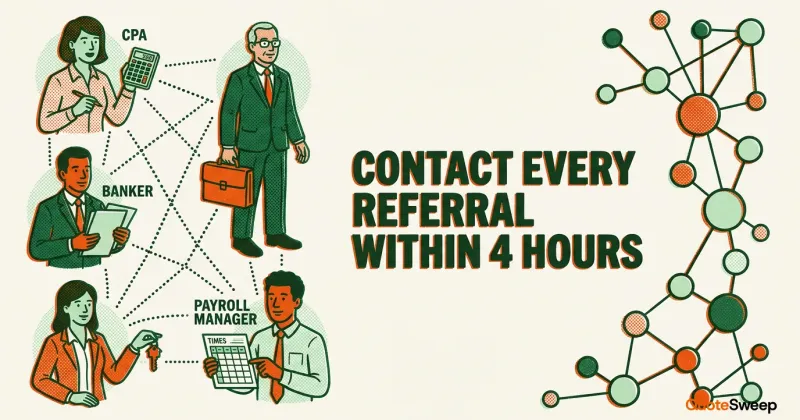
When a partner sends you a referral and you don't contact the prospect for three days, you've damaged two relationships – the one with the prospect and the one with the partner. Contact every referral within 4 hours. Same day is good. Same hour is better.
3. Not Closing the Loop
Partners need to know what happened with their referrals. Did the prospect become a client? Is the deal still in progress? Did they decline? If partners never hear back, they assume their referrals are going into a black hole – and they stop sending them.
4. Being Too Broad
"Send me anyone who needs insurance" gives your partners nothing to work with. Be specific: "I'm looking for contractors with 5 to 20 employees who are growing and may have outgrown their current coverage." Specificity makes referrals actionable.
5. Treating It as a Campaign Instead of a Culture
Referral programs that launch with a burst of energy and then fade after 60 days produce nothing lasting. Referral networking is a permanent part of how you run your business – not a quarterly initiative. Build it into your weekly schedule and your team's expectations.
Frequently Asked Questions
How long does it take to build a productive referral network?
Expect 6 to 12 months before your network generates consistent referral flow. The first 3 months are about identifying partners, making introductions, and establishing the relationship. Months 3 to 6 produce the first referrals as partners begin to trust you with their clients. By month 12, a well-maintained network of 10 to 15 active partners should generate 5 to 10 referrals per month. The key is consistency – agents who invest time every week in nurturing partnerships see compound returns over time.
How many referral partners should I have?
Quality matters more than quantity. Aim for 10 to 15 active partners across the six categories we covered – 2 to 3 CPAs, 1 to 2 attorneys, 1 to 2 lenders, 1 to 2 real estate professionals, 1 payroll company, and 2 to 3 industry-specific partners. An "active" partner is one you meet with quarterly and who has sent at least one referral in the past 12 months. Having 50 names in a spreadsheet you never talk to is not a referral network – it's a contact list.
Can I build a referral network if I'm new to my market?
Yes, and in some ways it's easier because you have no preconceptions about who to partner with. Start by identifying the organizations where your target prospects gather – chambers of commerce, BNI chapters, trade associations. Attend consistently for 3 months before pitching anything. Use that time to identify the CPAs, attorneys, and lenders who are already well-connected. Then approach them one at a time with the framework outlined in this guide. Being new is an advantage if you frame it correctly: "I'm building my practice in this market and I'm looking for a small number of professionals to partner with long-term." For more lead generation strategies as you build your network, see our guide on finding insurance leads that convert.
Should I pay for referrals?
In most states, paying referral fees to unlicensed individuals violates insurance regulations. Even where it's legal, paid referrals tend to be lower quality because the partner is motivated by the fee rather than by genuine fit. Focus on reciprocal value exchange – send referrals, share intelligence, and deliver exceptional service to their clients. That creates a sustainable partnership that no referral fee can match.