Cold Calling Scripts for Insurance Agents
Cold calling gets a bad reputation, and most of it is deserved – because most cold calls are terrible. Generic openers, zero research, and a pitch that screams "I'm reading from a script" don't work. But cold calling itself? It still works, particularly in commercial insurance.
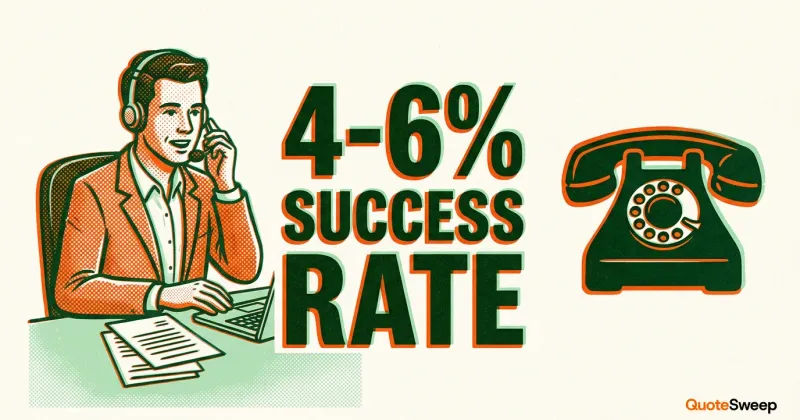
The data backs this up. Insurance and financial services see cold calling success rates of 4 to 6% – higher than nearly every other industry. According to analysis of 10 million cold calls, only about 28% of calls get answered, but 55% of leads that do connect convert within the first three contacts. The math works if you're disciplined about volume, targeting, and – most importantly – what you actually say when someone picks up.
This guide provides tested, copy-paste scripts for every stage of the cold calling process: getting past gatekeepers, opening with decision-makers, handling objections, leaving voicemails, and following up. These scripts are starting points – adapt them to your voice, your market, and your carrier appetite.
TLDR: Cold calling works for commercial insurance when you combine targeted prospect research, specific opening scripts that reference the prospect's business, and a structured follow-up cadence. The scripts below are ready to use – customize the industry-specific details and commit to at least 25 dials per session.
Why Cold Calling Still Works for Commercial Insurance
Personal lines agents have largely moved past cold calling because consumers screen calls aggressively and personal insurance is increasingly bought online. But commercial insurance is different:
- Business owners answer business phones. A call to a business during operating hours reaches a human far more often than a call to a consumer's cell phone.
- Commercial insurance is complex. Business owners can't easily comparison-shop commercial packages online the way they can for auto or home insurance. They need an expert.
- Decision-makers are identifiable. You can research the business owner, their company, and their likely insurance needs before you dial.
- The average commercial account is large enough to justify the effort. If your average small commercial account generates $400 to $800 in annual commission, you only need to close 3 to 5 accounts per 100 calls to make cold calling profitable.
Pre-Call Research: The 5-Minute Prep
The single biggest factor separating effective cold callers from dial-and-pray agents is pre-call research. Spend 5 minutes before each call gathering:
What to Look Up
- Business name and what they do – Visit their website and Google Business Profile
- Owner/decision-maker name – Check the website's About page, LinkedIn, or state business filings
- Employee count and locations – Indicates WC needs and property exposure
- How long they've been in business – Newer businesses may not have coverage; established businesses may be underinsured for current operations
- Recent news – Growth, new location, awards, or challenges. Any of these gives you a specific talking point.
- Industry-specific risks – Know the common claims in their NAICS code
Pre-Call Checklist Template
Before each call, have this filled out:
Prospect: _______________
Business: _______________
Industry: _______________
Decision-maker: _______________
# Employees (est.): _______________
Years in business: _______________
Specific talking point: _______________
Likely coverage needs: _______________
Best carrier fit: _______________
This takes 5 minutes and doubles your conversion rate compared to blind dialing.
Gatekeeper Scripts
In small businesses, the gatekeeper is often the office manager, receptionist, or bookkeeper. They're not trying to block you specifically – they're protecting the owner's time from everyone. Your job is to sound like someone the owner would want to talk to.
Script 1: The Direct Approach
Agent: "Hi, this is [your name] with [agency name]. I'm calling for [owner name] – is he/she available?"
Gatekeeper: "What's this regarding?"
Agent: "I work with several [industry] businesses in [city/area] on their commercial insurance programs. I had a quick question about their current setup. Is [owner name] in today?"
Why it works: You're specific about the industry and geography. You're not asking to "sell" something – you have a "question." This sounds like a peer conversation, not a sales call.
Script 2: The Referral Approach
Agent: "Hi, this is [your name]. [Referral name] at [referral company] suggested I give [owner name] a call. Is he/she available?"
Gatekeeper: "What's this about?"
Agent: "I helped [referral name] with their business insurance last year, and he/she mentioned that [owner name] might benefit from a similar review. I just need a couple minutes of their time."
Why it works: A name they recognize (even a loose connection like a fellow chamber member) moves you from stranger to known entity instantly.
Script 3: The Value-First Approach
Agent: "Good morning. This is [your name] with [agency name]. I was hoping to reach [owner name] for about two minutes. We've been putting together a risk assessment for [industry] businesses in [area], and I had something specific to share with them. Can you connect me?"
Why it works: You're offering information, not asking for a meeting. The "something specific to share" creates curiosity without pressure.
When the Gatekeeper Says "Send an Email"
Agent: "Happy to send something over. What email should I use for [owner name]? And just so I can make it relevant – do you know offhand who handles your commercial insurance currently? I want to make sure what I send is actually useful and not just another generic email."
This gets you the decision-maker's direct email and potentially the name of their current agent – both valuable.
Decision-Maker Opening Scripts
You have 10 to 15 seconds after the decision-maker picks up to earn the next 60 seconds. The opening must be specific, relevant, and free of filler.
Script 1: The Industry-Specific Opener
Agent: "Hi [owner name], this is [your name] with [agency name] here in [city]. I work with about [number] [industry] businesses in the area on their commercial insurance – folks like [name a client if you have permission, or describe the profile]. I'm calling because we've been seeing some significant rate movement in [specific line] for your industry, and I wanted to make sure you're positioned well before your next renewal. Do you have 90 seconds?"
Why it works: Industry-specific, local, and tied to something happening now (rate movement). The "90 seconds" ask is specific and low-commitment.
Script 2: The Problem-Based Opener
Agent: "[Owner name], quick question – this is [your name] with [agency name]. When was the last time someone actually reviewed your commercial coverage line by line against your current operations? I ask because we do these reviews for [industry] businesses in [area], and about 8 out of 10 times we find gaps between what the business looks like today and what the policy was written for. Would it be worth a 15-minute conversation to see if that applies to you?"
Why it works: Opens with a question that most owners can't answer confidently. The "8 out of 10" stat (consistent with the 77% underinsurance rate from Hiscox) is specific and credible.
Script 3: The Savings Opener (Use Carefully)
Agent: "[Owner name], this is [your name] with [agency name]. I'm an independent agent, which means I shop your coverage across [number] carriers instead of being locked into one company. I've been working with a few [industry] businesses in your area and we've been finding some meaningful differences in pricing on [specific line – WC, BOP, GL]. I'd love to run your numbers and see if there's room. Can I ask you a few quick questions?"
Why it works: "Independent agent" + "multiple carriers" communicates choice. "Meaningful differences" is more credible than "save you 30%."
Use carefully because leading with savings attracts price-shoppers who leave when someone else is $50 cheaper. Pair this with a coverage review to shift the conversation from price to value.
Script 4: The Trigger Event Opener
Agent: "[Owner name], congratulations on [specific event – new location, new hire announcement, award, expansion]. This is [your name] with [agency name]. I work with growing [industry] businesses on their insurance, and I wanted to check in because [trigger event] typically means your coverage needs have changed. Most agents don't proactively reach out when your business grows – which means your policy may not match your operations anymore. Worth a quick conversation?"
Why it works: Shows you've done research. Ties to something the owner is proud of (growth). Positions you as proactive vs. their potentially reactive current agent.
Objection Handling Scripts
Every cold call objection is a request for more information, delivered as a deflection. Your job is to acknowledge the deflection and redirect to value.
"I'm happy with my current agent."
Agent: "That's great – having an agent you trust matters. I'm not asking you to switch. What I'd like to do is run a quick coverage review alongside what you currently have. If your agent has you perfectly positioned, you'll know for sure. If there are gaps or savings, you'll want to know about those too. Either way, you win. Can I get 15 minutes on your calendar this week?"
"I don't have time right now."
Agent: "I completely understand – you're running a business. When would be a better time for a 10-minute conversation? I can call back [suggest specific options: Tuesday morning, Thursday afternoon]. This isn't a long pitch – I just need a few details to tell you whether it's worth going further."
"Just send me a quote."
Agent: "I'd love to – but I don't want to send you a generic number that doesn't match your actual situation. To put together something accurate, I need about 5 minutes to ask a few questions about your operations, payroll, and current coverage. That way what I send you is apples-to-apples with what you have now. Can we do that quickly right now, or should I call back at a specific time?"
"We just renewed."
Agent: "Perfect timing, actually. Most agents only review coverage at renewal, which means you won't hear from yours for another 11 months. I can do a mid-term review at no cost – we'll look at your limits, your experience mod if you carry WC, and whether there are gaps that showed up since your policy was written. If everything looks solid, we shake hands. If not, we'll have options ready before your next renewal. Fair?"
"Insurance is insurance – it's all the same."
Agent: "I hear that a lot, and I understand the thinking. The reality is that two BOP policies at the same price can have completely different coverage terms. One might cover equipment breakdown and another might exclude it. One might have a $500 deductible on property claims and another $2,500. The price looks the same until you file a claim and find out what's actually covered. That's exactly what I help business owners sort through. Can I show you what I mean with a specific example from your industry?"
"How did you get my number?"
Agent: "Your business is listed publicly – I found you through [source: Google, business directory, trade association list]. I work with [industry] businesses in [area] and reached out because I thought this might be relevant. If it's not a fit, no worries at all. But if your commercial coverage hasn't been reviewed recently, it might be worth 5 minutes."
Voicemail Scripts
Most calls go to voicemail. A good voicemail doesn't try to sell – it tries to earn a callback or set up the next dial.
Voicemail Script 1: The Specific Benefit
"Hi [owner name], this is [your name] with [agency name], [phone number]. I work with [industry] businesses in [city] and I had something specific to share about [WC rates / coverage changes / market opportunities] in your industry right now. I'll try you again [specific day/time], or feel free to call me back at [number]. Again, [your name], [agency name], [number]."
Voicemail Script 2: The Referral
"[Owner name], hi – [your name] with [agency name]. [Referral name] suggested I reach out. I helped their company with [specific outcome] and they thought you might benefit from something similar. My number is [number]. I'll shoot you a quick email too. Talk soon."
Voicemail Script 3: The Follow-Up
"[Owner name], [your name] again from [agency name]. I left you a message [day] about reviewing your commercial insurance. I know you're busy – just wanted to mention that we found [$ amount or specific gap] in coverage differences for another [industry] business in [area] last week. It's worth a quick look. I'm at [number], or I'll try you one more time on [day]."
Voicemail rules:
- Keep it under 30 seconds
- Say your name and number twice – beginning and end
- Give a specific reason to call back
- Never leave more than 3 voicemails total; switch to email after that
Email Follow-Up Templates
Pair every cold call with an email follow-up. Send the email within 2 hours of the call.
Template 1: After a Voicemail
Subject: Quick note for [owner name] – [industry] insurance
Hi [owner name],
I just left you a brief voicemail. I'm an independent insurance agent here in [city] and I work with several [industry] businesses on their commercial coverage.
I'm reaching out because we've been finding that many [industry] businesses in [area] are paying more than they need to – or carrying coverage that doesn't match their current operations.
I'd like to offer a complimentary coverage review. It takes about 15 minutes and gives you a clear picture of where you stand.
Would [specific day] at [specific time] work for a quick call?
[Your name] [Agency name] [Phone] | [Email]
Template 2: After a Conversation That Didn't Convert
Subject: Following up – [owner name]'s coverage review
Hi [owner name],
Thanks for taking a few minutes to chat today. As I mentioned, I work with [number] [industry] businesses in [area] and we consistently find opportunities to improve coverage or reduce costs.
Here's what I'd like to do:
- Review your current policies (I'll need your dec pages or a recent certificate)
- Run a comparison across our carrier panel
- Present the findings – no obligation
If the numbers don't work, I'll tell you your current agent has you well positioned and we part as friends.
Want to give it a shot? I can have results back to you within [timeframe].
[Your name]
Template 3: The Breakup Email (Final Follow-Up)
Subject: Closing the loop – [business name]
Hi [owner name],
I've reached out a few times about reviewing your commercial insurance and I know timing isn't always right. I don't want to be a pest, so this will be my last note.
If your coverage ever needs attention – renewal coming up, rate increase, claim, or just want a second opinion – my door is open. I work with [industry] businesses in [area] and I'm easy to reach.
Wishing you a great rest of the year.
[Your name] [Agency name] [Phone]
This email consistently gets the highest response rate in the cadence because it removes pressure completely.
The Follow-Up Cadence
One call doesn't close commercial insurance. Build a structured cadence:
| Day | Action | Notes |
|---|---|---|
| Day 1 | Cold call + voicemail | Use industry-specific opener |
| Day 1 | Email follow-up | Send within 2 hours |
| Day 3 | Second call attempt | Different time of day |
| Day 5 | Email #2 | Share a relevant insight or stat |
| Day 8 | Third call attempt | Leave voicemail only if no prior contact |
| Day 12 | Email #3 (value-add) | Share an article, market update, or industry tip |
| Day 20 | Final call | Brief, low-pressure |
| Day 25 | Breakup email | Close the loop gracefully |
After the cadence completes without contact, move the prospect to a long-term nurture list. Reach out again at 90 days and 180 days with fresh market intelligence.
Tracking and Measuring Results
Minimum Metrics to Track
| Metric | Target | How to Calculate |
|---|---|---|
| Dials per session | 25–50 | Count your calls |
| Connect rate | 25–35% | Conversations / Dials |
| Meeting set rate | 10–20% | Meetings / Conversations |
| Quote rate | 60–80% | Quotes / Meetings |
| Close rate | 25–40% | Policies / Quotes |
| Dials to close | 50–100:1 | Total dials / Policies written |
Tracking Template
Use a simple spreadsheet or CRM with these fields for every prospect:
Date | Prospect | Industry | Dial # | Result | Next Action | Notes
Review your numbers weekly. If your connect rate is below 20%, you're calling at the wrong times. If your meeting set rate is below 10%, your opening script needs work. If your close rate is below 20%, your presentation or follow-up process needs attention.
Compliance Considerations: TCPA and DNC
Cold calling comes with legal requirements. Ignoring them exposes you to significant financial penalties.
TCPA (Telephone Consumer Protection Act)
The TCPA governs how businesses can contact consumers and businesses by phone. Key requirements for insurance agents:
- No autodialed or prerecorded calls to cell phones without prior express consent
- Calling hours: 8 AM to 9 PM in the prospect's time zone only
- Honor opt-out requests immediately – as of April 2025, consumers can revoke consent by any reasonable means, and you must honor it within 10 business days
- Penalties: Up to $500 per violation, tripled to $1,500 for willful violations
DNC (Do Not Call) Registry
- Check the National DNC Registry before calling. Scrub your lists quarterly at minimum.
- Maintain an internal DNC list of anyone who has asked not to be called.
- B2B exemption: Calls to a business phone number (not a cell phone) for business purposes generally fall outside DNC restrictions, but check your state's specific rules.
State-Specific Rules
Several states have additional telemarketing regulations that go beyond federal TCPA requirements. Check the rules for every state you call into. Common additional requirements include state-level DNC registration, stricter calling hours, and specific disclosure requirements.
Compliance Best Practices
- Scrub every call list against the National DNC Registry before dialing
- Keep records of all calls – date, time, number, and outcome
- Train everyone on your team who makes calls
- Use a compliant dialer that respects time zone restrictions
- When in doubt, get consent in writing before calling a cell phone
Frequently Asked Questions
How many cold calls should I make per day to see results?
Aim for 25 to 50 dials per session, and block 2 to 3 hours specifically for calling. At a 28% answer rate and a 10 to 15% meeting conversion rate, 50 dials yields roughly 14 conversations and 1 to 2 meetings. Over a month (20 calling days), that's 20 to 40 meetings – more than enough pipeline to generate 5 to 10 new commercial accounts.
What time of day is best for cold calling business owners?
For small business owners, the sweet spots are 8:00 to 9:30 AM (before their day gets chaotic) and 4:00 to 5:30 PM (winding down, more open to conversations). Avoid 11:30 AM to 1:30 PM (lunch) and Monday mornings (everyone's catching up from the weekend). Tuesday through Thursday consistently performs best.
Should I use a power dialer or manual dial?
For B2B commercial insurance calling, manual dialing is usually better than a power dialer. Power dialers create awkward pauses when the prospect answers (waiting for the agent to connect), which immediately signals "sales call." Manual dialing lets you start the conversation naturally. If you're doing high-volume prospecting (100+ dials per day), a click-to-dial CRM feature gives you speed without the robocall feel.
How do I handle the mental toll of cold calling rejection?
Rejection is part of the math, not a reflection of your ability. At a 4 to 6% success rate, you're hearing "no" 94 to 96 times for every "yes." The agents who succeed at cold calling track their numbers and celebrate activity, not just outcomes. Set daily dial targets, not daily close targets. And remember: every "no" gets you statistically closer to the next "yes."