Finding Insurance Leads That Convert
Every insurance agent has the same fundamental problem: finding enough qualified prospects to keep the pipeline full. The difference between agents who grow and agents who plateau comes down to how consistently and diversely they generate leads.
The lead generation industry wants to sell you a simple answer – buy leads, make calls, close deals. But agents who build sustainable books know that purchased leads are only one channel, and often not even the best one. The agents with the most productive pipelines combine inbound strategies (content, SEO, referrals) with outbound tactics (networking, partnerships, cold outreach) to create a lead flow that doesn't dry up when one channel underperforms.
This guide breaks down every major lead generation channel available to independent insurance producers, with honest assessments of cost, conversion rates, and the effort required to make each one work.
TLDR: The highest-converting insurance leads come from referral programs and strategic partnerships, not purchased lead lists. Build a multi-channel approach that combines referrals, local SEO, content marketing, and targeted networking. Purchased leads can supplement your pipeline, but they should never be your primary strategy.
Inbound vs. Outbound: Building a Balanced Pipeline
Before we dive into specific channels, it's worth understanding the two fundamental categories of lead generation and why you need both.
Inbound Leads
Inbound leads come to you. They find your website, read your content, get referred by a friend, or discover you through a Google search. Inbound leads are warmer, convert at higher rates, and cost less per acquisition – but they take time and consistent effort to build.
Outbound Leads
Outbound leads result from you reaching out to prospects who haven't asked to hear from you. Cold calls, purchased lists, door-to-door visits, and direct mail all fall here. Outbound generates faster results but at lower conversion rates and higher cost per acquisition.
The Right Mix
New agents and new agencies need outbound to fill the pipeline quickly. Established agents should be investing heavily in inbound channels that compound over time. The ideal balance shifts as your agency matures:
| Agency Stage | Outbound | Inbound | Why |
|---|---|---|---|
| Year 1 | 70% | 30% | Need fast pipeline; inbound hasn't built momentum |
| Year 2–3 | 50% | 50% | Inbound channels starting to produce; referrals growing |
| Year 4+ | 30% | 70% | Referrals, content, and SEO generate warm leads at scale |
Referral Programs: The Highest-Converting Channel
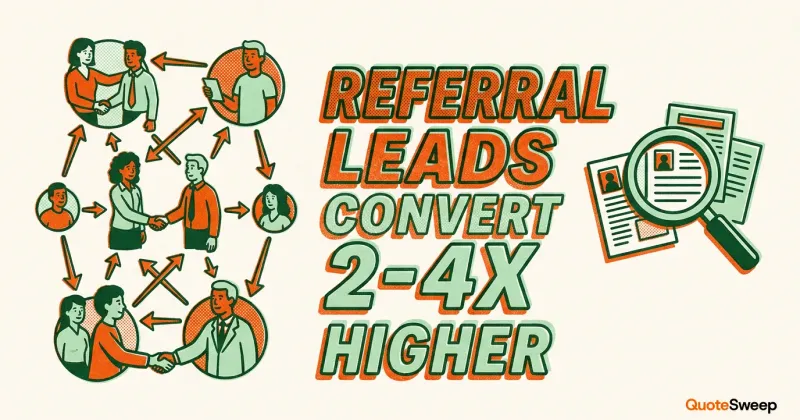
Referral leads consistently convert at 2 to 4 times the rate of other channels, and clients acquired through referrals retain better – 92% renewal rates compared to 67% for other acquisition methods. Despite this, most agents lack a systematic referral program.
Building a Formal Referral Program
A referral "program" means more than occasionally asking clients "know anyone who needs insurance?" It means:
1. Define your ideal referral. Be specific about who you want to be referred to. "Business owners" is too broad. "Restaurant owners in the metro area with 10 to 50 employees" is actionable.
2. Identify your best referral sources. Your top 20% of clients – the ones who are happiest, most engaged, and best connected – will generate 80% of your referrals. Create a VIP list.
3. Ask at the right time. The best moments to ask for referrals:
- After delivering a quote that saves the client money
- After resolving a claim successfully
- After a coverage review that uncovers and fills a gap
- At renewal when the client confirms they're staying
- Anytime the client voluntarily compliments your service
4. Make it specific and easy. Compare these two asks:
Bad: "Do you know anyone who needs insurance?"
Good: "You mentioned your contractor friend is frustrated with his current agent's response time. Would you be comfortable making an introduction? I can send you a quick email you can forward – takes about 30 seconds."
5. Close the loop. When a referral converts, tell the referrer. When it doesn't convert, tell them too (briefly). People who see that their referrals are valued send more of them.
Referral Incentives: What Works
Check your state's regulations on referral fees and gifts – compliance varies. Within legal bounds:
- Thank-you gifts ($25–$50 gift cards) for each referral that leads to a meeting
- Annual appreciation events for your top referral sources
- Charitable donations in the referrer's name
- Handwritten thank-you notes – underrated and surprisingly effective
The incentive matters less than the ask and the follow-through. Most agents who "can't get referrals" simply aren't asking consistently.
Strategic Partnerships: Your Highest-ROI Channel
Strategic partnerships with professionals who serve the same clients you do create a recurring referral pipeline that works both directions.
The Power Partners
Accountants and CPAs They see financial statements, tax returns, and business plans. They know which clients are growing, which are taking on risk, and which need help. An accountant who trusts you becomes your most valuable referral source.
How to approach: Offer to do a lunch-and-learn on "5 insurance gaps that create tax and liability surprises for your clients." Educate them on what to look for. Make it easy for them to introduce you.
Business Attorneys Lawyers handling entity formation, contract disputes, and compliance regularly encounter clients with insurance questions. A single business attorney can send you 5 to 10 qualified referrals per year.
How to approach: Offer to review their clients' certificate requirements and coverage adequacy as a value-add to the attorney's service.
Commercial Lenders and Bankers Every SBA loan, equipment financing, or commercial mortgage requires proof of insurance. The lender needs their borrower insured – you provide the solution.
How to approach: Meet with local branch managers. Explain that you can help their borrowers meet insurance requirements quickly, which accelerates loan closings – a win for the banker.
Payroll Companies Payroll providers process the employee data that drives workers' compensation premiums. Some actively partner with insurance agents as a value-add to their clients.
How to approach: Contact regional reps for ADP, Paychex, Gusto, and local payroll providers. Many have formal referral partnerships for WC.
Commercial Real Estate Brokers Every commercial lease requires tenant insurance. Every property purchase requires hazard coverage. Real estate brokers deal with insurance requirements on every transaction.
How to approach: Offer to provide quick-turn COIs and quotes for their clients' transactions. Speed and reliability make you the default recommendation.
Partnership Meeting Cadence
Meet with each strategic partner quarterly. Each meeting should include:
- Referrals you're sending them (give before you ask)
- Update on referrals they've sent you (close the loop)
- Market intelligence you can share (rate trends, new requirements, industry news)
- Specific ask for introductions to 2 to 3 of their clients
Purchased Leads: Honest Assessment
Let's be straightforward about purchased leads. They can work, but the economics are tighter than vendors advertise.
Types of Purchased Leads
Real-time leads – Generated when a prospect fills out a form online. Sold to 1 to 5 agents simultaneously. Cost: $20 to $80+ per lead for commercial insurance.
Aged leads – 30 to 90+ days old. Much cheaper ($1 to $5 per lead) but lower contact rates and conversion rates.
Exclusive leads – Sold to one agent only. Higher cost ($50 to $150+) but no competition for the same prospect.
The Real Economics
According to First Page Sage's 2026 CPL benchmarks, insurance leads through digital channels average $90 to $160 per lead. Conversion rates on purchased leads typically run 1 to 4% for aged leads and 5 to 10% for fresh leads.
Let's do the math on real-time leads:
- Cost per lead: $50
- Purchase 100 leads: $5,000
- Contact rate: 40%
- Conversion rate (of contacts): 10%
- Policies written: 4
- Average annual commission per policy: $500
- First-year commission: $2,000
That's a $3,000 loss in year one. The math only works if those clients retain and the lifetime value exceeds the acquisition cost – which typically takes 2 to 3 years.
When Purchased Leads Make Sense
- New agents building initial pipeline – You need activity and practice, and purchased leads provide both
- Filling gaps in slow months – Supplement your organic channels when referral flow slows
- Testing new markets – Before investing in content and SEO for a new vertical, purchased leads can validate demand
When They Don't
- As your primary channel – The economics rarely support this long-term
- Without a fast response system – Studies show that responding within 5 minutes increases contact rates by 400% compared to 30-minute response times
- Without tracking ROI – If you can't measure cost per acquisition by lead source, you can't know which vendors are worth the spend
Networking Groups: BNI, Chambers, and Trade Associations
In-person networking remains one of the most productive lead channels for commercial insurance agents – when done right.
BNI (Business Network International)
BNI is the world's largest referral organization with over 355,000 members across 11,000+ chapters. Each chapter allows only one representative per profession, meaning you're the exclusive insurance agent in your group.
Pros:
- Exclusive category lock – no competing agents in your chapter
- Structured referral sharing with accountability
- Consistent weekly meetings build deep relationships
- Members report that 82% of business comes from referrals
Cons:
- Weekly time commitment (early morning meetings, typically)
- Annual membership fees ($500 to $1,500+)
- Results depend heavily on your chapter's composition
- Takes 6 to 12 months to build trust and see consistent referrals
Who it works for: Agents focused on small commercial in a specific geography. Works best when your chapter includes accountants, attorneys, bankers, and commercial real estate professionals.
Chambers of Commerce
Local chambers provide broader networking without BNI's structured referral system.
Best practices for chamber involvement:
- Join a committee – event planning, economic development, or small business support
- Attend mixers consistently (quarterly at minimum)
- Sponsor chamber events that attract your target market
- Offer to present at workshops on risk management topics
Trade and Industry Associations
If you specialize in specific industries (contractors, restaurants, healthcare), joining their trade associations puts you in front of concentrated groups of prospects.
Examples:
- Local chapters of AGC (Associated General Contractors) for contractor niches
- State restaurant associations for food service specialization
- Local medical society chapters for healthcare professional liability
The key: show up as an industry resource, not as a salesperson. Present on risk topics. Write for their newsletter. Sponsor their events. The business follows the credibility.
Content Marketing and Local SEO
Inbound leads from content marketing and SEO have the lowest cost per acquisition over time – but they require consistent investment before producing results.
Google Business Profile
Your Google Business Profile (GBP) is the single most important local SEO asset you have. When a business owner searches "commercial insurance agent near me," GBP determines whether you show up.
GBP optimization checklist:
- Complete every field – name, address, phone, hours, website, service areas
- Select all relevant categories (insurance agent, insurance agency, commercial insurance)
- Add photos monthly (office, team, community involvement)
- Respond to every review within 24 hours
- Post updates weekly – market news, tips, new capabilities
- Use the Q&A section to preemptively answer common questions
Local SEO Fundamentals
Beyond GBP, local SEO means making your website visible for searches like "commercial insurance [your city]" and "[industry] insurance agent near me."
Priority actions:
- Create city/service-area pages on your website
- Build local citations (consistent NAP across directories)
- Get listed in industry-specific directories
- Earn local backlinks from chamber, BNI, and community organizations
- Create content around local business topics
Content Marketing for Insurance Agents
Blog content that answers the questions your prospects are already asking generates inbound leads on autopilot. You don't need to publish daily – one well-researched article per month is enough.
Content ideas that attract commercial insurance prospects:
- "Do [industry] businesses in [city] need workers' comp?"
- "How much does a BOP cost for [industry]?"
- "What insurance do [city] contractors need for [specific] projects?"
- "[Industry] insurance requirements in [state]: 2026 guide"
Each piece of content is a permanent lead generation asset that works 24/7.
Social Media for Insurance Agents
Social media works for insurance leads – but only certain platforms and only with consistent effort.
LinkedIn (Highest ROI for Commercial)
LinkedIn is where business owners and decision-makers spend time. For commercial insurance agents, it's the most productive social platform.
What works:
- Share industry risk insights (not product pitches)
- Comment on prospects' business updates and milestones
- Publish short articles on coverage topics relevant to your target industries
- Connect with local business owners and referral partners
- Use LinkedIn Sales Navigator to build targeted prospect lists
What Doesn't Work
- Posting generic "call me for a quote" content on any platform
- Spreading yourself across five platforms without doing any of them well
- Buying followers or engagement
- Ignoring direct messages and comments
Pick one platform (LinkedIn for commercial), commit to posting 3 to 5 times per week, and engage genuinely. The leads will follow.
Common Lead Generation Mistakes
1. Relying on a Single Channel
Agents who depend entirely on purchased leads, or entirely on referrals, or entirely on walk-ins, are one market shift away from an empty pipeline. Diversify across at least 3 to 4 channels.
2. Not Tracking Source and ROI
If you can't answer "What's my cost per acquired client by lead source?" you're guessing at where to invest your time and money. Tag every lead with its source in your management system. Review the data quarterly.
3. Slow Response Time
For purchased leads and inbound web inquiries, response time is everything. A 5-minute response window increases contact rates by 400% compared to a 30-minute response. Build a system – alerts, auto-responders, dedicated response blocks – that ensures fast follow-up.
4. Treating Networking as a Sales Event
Walking into a BNI meeting or chamber mixer and immediately pitching insurance is the fastest way to get avoided at every future event. Lead with value, build relationships, and let the business come to you. The first three months of any networking group should be about giving referrals and building trust, not collecting business cards.
5. Quitting Too Early
Content marketing takes 6 to 12 months to gain traction. Referral partnerships take 3 to 6 months to produce consistently. Networking groups take a full year to generate meaningful return. Agents who start a channel and abandon it after 60 days never see the compound payoff.
Measuring Lead Generation Results
Metrics That Matter
| Metric | What It Tells You | Review Frequency |
|---|---|---|
| Leads by source | Which channels are producing | Monthly |
| Cost per lead by source | Which channels are efficient | Monthly |
| Contact rate by source | Lead quality indicator | Monthly |
| Conversion rate by source | Which channels produce buyers | Quarterly |
| Cost per acquired client | True acquisition cost | Quarterly |
| Lifetime value by source | Which channels produce the best clients | Annually |
| Referral rate by source | Which clients generate more clients | Annually |
The Lead Scorecard
Build a monthly scorecard that tracks each channel's performance. Here's a simple template:
| Channel | Leads This Month | Cost | Contacts Made | Quotes Delivered | Policies Written | Cost per Policy |
|---|---|---|---|---|---|---|
| Referrals | ||||||
| Strategic Partners | ||||||
| Website/SEO | ||||||
| Purchased Leads | ||||||
| Networking | ||||||
| Social Media | ||||||
| Total |
Fill this out honestly every month. Within three months, you'll know exactly where to double down and where to cut back.
Frequently Asked Questions
How much should an insurance agency spend on lead generation?
Most agencies allocate 5 to 15% of revenue to marketing and lead generation, with newer agencies at the higher end. The more important question is return on investment by channel. Track your cost per acquired client for each lead source and reallocate budget from low-performing channels to high-performing ones quarterly.
Are purchased insurance leads worth it for commercial lines?
They can be, with caveats. Commercial insurance leads are more expensive than personal lines leads ($50 to $150+ per real-time lead), but the premium per policy is also much higher. The key factors are response speed, lead exclusivity, and your book's ability to retain the client long enough to recoup acquisition cost. Test with a small budget before committing.
How long does it take for content marketing to generate insurance leads?
Plan on 6 to 12 months before seeing consistent inbound leads from content and SEO. The first few months are about publishing quality content, building domain authority, and indexing in search engines. By month 6 to 8, you should see organic traffic increasing. By month 12, you should have a measurable lead flow. The payoff is that content leads have near-zero marginal cost – every article you publish keeps working indefinitely.
What's the best networking group for a commercial insurance agent?
It depends on your target market and geography. BNI works well for agents targeting local small businesses because of the exclusive category lock and structured referral system. Chambers of commerce work for broad visibility. Industry trade associations work best for agents who specialize in specific verticals. The best approach is to commit fully to one group for 12 months before evaluating. Agents who join three groups and attend each one sporadically get worse results than agents who invest deeply in one.