How Carrier Portals Became the Bottleneck
The carrier portal problems in insurance all trace back to one decision: every carrier had the same idea to build a web portal so agents can submit business electronically instead of faxing ACORD forms. Each carrier designed its portal independently. Each made different choices about layout, field requirements, navigation, and workflow. Each required its own login credentials, its own training, its own quirks to learn.
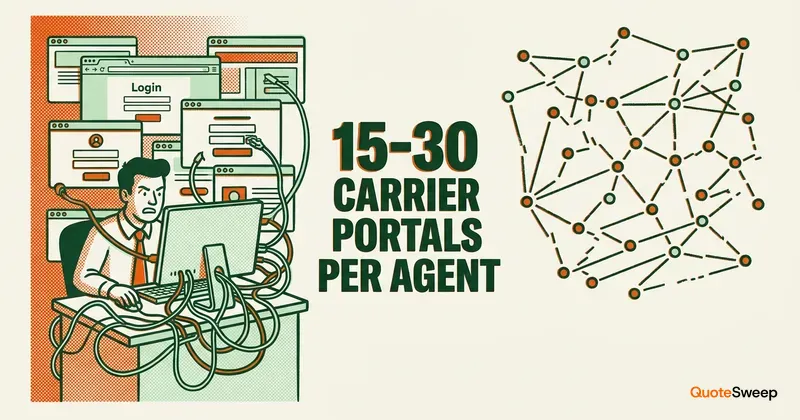
The result? An independent agent with appointments at 15 to 30 carriers now manages 15 to 30 separate web applications – each with a different username and password, a different user interface, a different set of required fields, and a different process for everything from quoting to issuing certificates. The portals were supposed to make insurance distribution more efficient. Collectively, they've done the opposite.
TLDR: Carrier portals were built to replace fax machines, and they succeeded at that. But because each carrier built its own portal independently, agents now juggle 15-30+ separate applications with no consistency in design, data requirements, or workflow. Quoting a single commercial account across 8 carriers means entering substantially the same information 8 different times in 8 different interfaces. The industry needs an aggregation layer – whether through AI web agents, API integration, or standardization – to turn dozens of disconnected portals into a single workflow.
The Portal Proliferation Problem
To understand how we got here, consider the timeline. In the early 2000s, most commercial insurance quoting happened via paper ACORD forms – faxed or mailed to carrier underwriters, who would review them and respond with a quote (or a declination) days or weeks later. Carrier portals emerged as a faster alternative: agents could enter the information directly into a carrier's system and get quotes back in minutes or hours instead of days.
This was genuinely better than fax. The problem wasn't any single carrier's portal. The problem was that every carrier built one.
The Scale of the Problem
A typical independent agent with a commercial lines focus maintains appointments with 10 to 30 carriers. Some larger agencies have 40 or more. Each appointment comes with:
- A unique portal login (username, password, sometimes multi-factor authentication)
- A distinct user interface with its own navigation patterns
- A carrier-specific set of required fields, optional fields, and supplemental questions
- Different classification systems (some use NAICS codes, some use SIC codes, some use proprietary class codes)
- Different appetite guides (what the carrier will and won't write)
- Different turnaround expectations and quote response formats
An agent quoting a single small commercial account – say a local bakery needing a BOP, commercial auto, and workers' comp – might submit to 8 carriers to ensure competitive options. That means logging into 8 portals, navigating 8 different interfaces, and entering substantially the same business information 8 separate times.
The Time Cost
Here's what the manual portal quoting process looks like, carrier by carrier:
| Step | Time Per Carrier |
|---|---|
| Log in to portal (find credentials, authenticate) | 1-2 minutes |
| Navigate to new business submission | 1-2 minutes |
| Enter business information (name, address, entity type, years in business) | 3-5 minutes |
| Enter classification details (codes, operations description, revenue) | 3-5 minutes |
| Enter coverage-specific information (limits, deductibles, schedule of locations/vehicles/employees) | 5-10 minutes |
| Answer carrier-specific supplemental questions | 3-8 minutes |
| Review and submit | 2-3 minutes |
| Total per carrier | 18-35 minutes |
Multiply by 8 carriers and you're looking at 2.5 to 5 hours for a single small commercial account. QuoteSweep's research confirms the pattern: a typical independent agent logs into 3-5 different carrier portals to quote a single commercial risk, spending approximately 45-60 minutes per submission across those portals. For a mid-market account with more complexity – multiple locations, fleet vehicles, higher payroll – the per-carrier time increases to 30-45 minutes, and the total can reach a full day or more.
For perspective: a CSR quoting 3 commercial accounts per day at 8 carriers each is spending nearly their entire day on data entry across portals. There's little time left for client communication, renewal servicing, or the relationship work that actually retains business.
The Redundancy Factor
What makes the time cost especially frustrating is the redundancy. Roughly 70-80% of the information entered into each carrier portal is identical:
- Business legal name and DBA
- Federal tax ID
- Physical and mailing address
- Years in business
- Entity type (LLC, corporation, sole proprietor)
- Annual revenue and payroll
- Description of operations
- Prior insurance carrier and policy dates
- Loss history summary
Each carrier asks for this same core information but presents the fields differently, orders them differently, and validates them differently. One carrier's "Business Name" field accepts 100 characters; another limits it to 50. One carrier asks for revenue on the main application; another buries it in a supplemental form. One accepts NAICS codes; another requires its own proprietary classification.
The remaining 20-30% of questions are genuinely carrier-specific: underwriting preferences, supplemental questions about specific operations, risk-specific inquiries that reflect each carrier's unique appetite and pricing model. These differences are legitimate. But they're buried under a mountain of redundant data entry that adds no value.
Why Carriers Don't Standardize
If the problem is obvious, why haven't carriers fixed it? The answer involves competitive strategy, legacy technology, and regulatory constraints – all reinforcing the status quo.
Portals as Competitive Moats
From a carrier's perspective, its portal is a competitive asset, not a commodity utility. The portal controls the agent experience, shapes what information the carrier collects, and – critically – influences which risks agents submit. A well-designed portal with fast turnaround attracts more submissions. A carrier investing in its portal is investing in its distribution strategy.
Standardizing with other carriers means surrendering control over this experience. No carrier wants to become interchangeable with its competitors in the agent's eyes. The portal is one of the few touchpoints where carriers can differentiate themselves to agents beyond price and appetite.
Legacy Technology Constraints
Many carrier portals are front-end interfaces layered over legacy underwriting and policy administration systems that are decades old. These backend systems were built with carrier-specific data models, proprietary classification schemes, and rigid field structures.
Standardizing the portal would require re-engineering the connection between the front-end interface and the back-end systems – a massive undertaking for carriers whose technology budgets are already stretched by regulatory compliance, claims modernization, and core system replacements.
Regulatory Requirements
Insurance is regulated state by state. Each carrier's portal must collect information required by the states where it operates, and those requirements differ. Rate filings, form filings, and data collection requirements vary by state and line of business. A carrier writing workers' comp in California has different data collection obligations than one writing the same coverage in Texas.
This regulatory fragmentation makes true standardization even more complex. A single unified interface would need to accommodate 50 states' worth of regulatory nuance across every line of business – a task that's theoretically possible but practically daunting.
The ACORD Standard Paradox
The insurance industry actually has a data standard: ACORD. ACORD forms have been the lingua franca of insurance data exchange for decades. The ACORD 125 (Commercial Insurance Application) and its supplemental forms define a standardized way to capture commercial insurance data.
But ACORD standards are designed for data exchange, not for quoting workflows. An ACORD form captures the information needed to evaluate a risk. It doesn't address:
- How that information should be presented to the agent
- What order questions should be asked
- Which fields are required versus optional for a specific carrier
- How to handle carrier-specific supplemental questions
- How to integrate with a carrier's underwriting rules in real time
ACORD and IVANS have made progress on data connectivity – particularly for policy downloads, claims data, and basic submissions. But the quoting workflow – the interactive, real-time process of entering data, getting eligibility feedback, and receiving a quote – remains carrier-specific.
The Impact on Agency Operations
The portal bottleneck doesn't just waste time. It shapes agency behavior in ways that ultimately hurt both agents and their clients.
Fewer Carriers Quoted Per Account
When quoting across portals is time-intensive, agents naturally limit the number of carriers they approach. Instead of submitting to 10-15 eligible carriers, they submit to 3-5 – the ones they know best, the ones with the easiest portals, or the ones where they have the strongest underwriting relationships.
This means clients may not see the most competitive options available. A carrier with better pricing or coverage terms for a particular risk class might never receive the submission because the agent couldn't justify the time investment.
Renewal Remarketing Gets Skipped
The time cost of portal quoting makes renewal remarketing – shopping a client's coverage at renewal to ensure competitive pricing – impractical for most accounts. If it takes 3-4 hours to quote a small commercial account across 8 carriers, most agencies can't justify re-quoting every renewal. They reserve remarketing for large accounts or clients who specifically complain about rate increases.
The result: clients stay with carriers that may no longer be the best fit, and agencies miss opportunities to demonstrate value. For more on this topic, see our renewal remarketing guide.
CSR Burnout and Turnover
The repetitive nature of portal data entry contributes directly to CSR burnout and turnover. Spending 6+ hours per day copying the same information between systems is not the job most CSRs signed up for. Agencies report that portal fatigue is one of the top reasons experienced CSRs leave – either for carriers (where they deal with one system, not 20) or out of the industry entirely.
Errors and E&O Exposure
Manual re-entry across multiple portals introduces errors. A revenue figure transposed in one portal. A classification code selected incorrectly because the carrier uses different codes than the agent's AMS. A coverage limit entered differently because one carrier defaults to $1M/$2M and another to $500K/$1M.
These errors create E&O exposure for the agency. If a client's coverage is bound with incorrect information because it was miskeyed during portal entry, the agency may be liable. The more portals an agent enters data into manually, the higher the error probability.
Appetite Mismatches Waste Time
Agents regularly spend 20-40 minutes entering data into a carrier portal only to discover – at the end of the process – that the carrier doesn't write that class of business in that state, or that the risk falls outside the carrier's appetite parameters. Better appetite matching before submission would eliminate this wasted effort, but most carrier portals don't provide upfront eligibility screening.
The Emerging Translation Layer
The industry is beginning to address the portal problem, though through market-driven approaches rather than top-down standardization.
AI Web Agents
AI web agents tools interact with carrier portals the way a human would – logging in, navigating forms, entering data, and extracting results – but do so programmatically. The agent enters information once into a single interface, and the automation tool distributes it across multiple carrier portals simultaneously.
QuoteSweep's research puts the portal landscape in perspective: of 500+ carriers tracked with appetite data (440 verified at high confidence across 42 lines of business), only 131 have online quoting portals accessible to independent agents. The rest require phone, email, or wholesale broker submission – portals that even AI web agents can't automate. For the carriers that do have portals, QuoteSweep's internal benchmarking shows turnaround varies significantly: Hartford returns BOP quotes in approximately 6.3 minutes, while Travelers takes approximately 9.7 minutes.
This approach has several advantages:
- No carrier cooperation required. AI web agents works with existing portals as-is. Carriers don't need to build APIs or change their systems.
- Scales to any carrier with a web portal. If a human can use the portal, automation can be built for it.
- Preserves carrier-specific workflows. Each carrier's portal is navigated according to its own flow, with carrier-specific field mapping handling the translation.
The challenge with AI web agents is maintenance. Carrier portals change their interfaces regularly – a redesigned form, a moved button, a new required field. Each change requires updating the automation scripts. Purpose-built insurance automation platforms handle this maintenance as a core part of their service. For more on how AI web agents works, see our AI web agents for insurance guide. For a data-driven look at why this matters, see why 60% of commercial submissions go unquoted.
API Integration
Some carriers have built APIs – programmatic interfaces that allow third-party tools to submit data and receive quotes without going through the portal at all. API-based quoting is faster, more reliable, and easier to maintain than AI web agents.
The limitation is adoption. QuoteSweep's carrier API audit found that 172 of the top 250 US commercial carriers – writing $175B in premium – have no quoting API. No BOP, no GL, no WC on any third-party platform. Only 11 carriers have full-core small commercial APIs (BOP+GL+WC). The vast majority of carrier connectivity still requires going through portals. Carriers like Hartford (small commercial BOP), Auto-Owners ($6.8B DWP), Erie ($4B), and Sentry ($3.6B) remain entirely portal-only for small commercial quoting. For a detailed analysis of this gap, see why 76% of agents don't use a commercial comparative rater.
There's a second, less-discussed limitation of API-based raters: what happens when an account flags for underwriting review. On contractors, restaurants with liquor, and any risk that doesn't fit a clean class, the underwriter usually has follow-up questions. The API rater is in the middle of that conversation. The agent emails the rater. The rater forwards the question to the underwriter at the carrier. The underwriter answers the rater. The rater forwards the response back to the agent. A typical flagged submission becomes a three-to-five-message email chain that adds days of latency.
To the retail agent on the policy, the rater looks like the underwriter. To the underwriter at the carrier, the rater looks like the agent. Neither side is talking directly to the person who's actually deciding the account. The portal model, even with all its time costs, at least keeps the agent and the underwriter on a direct line. AI web agents that automate the full portal preserve that direct line: when the underwriter has a question, they reach out to the agent on the policy, not to a platform sitting in between.
The practical reality for agents is that a complete quoting workflow requires both API connectivity (where available) and AI web agents (for everything else). The tools that serve agents best are the ones that abstract away this distinction – presenting a single interface regardless of whether a carrier is accessed via API, AI web agents, or IVANS download.
Comparative Raters for Commercial Lines
Comparative raters represent the most complete solution to the portal problem: a single interface where agents enter account data once and receive quotes from multiple carriers. In personal lines, comparative raters have been standard for over a decade. In commercial lines, they're still maturing – but the category is developing rapidly.
A commercial comparative rater handles:
- Data normalization – translating agent-entered data into each carrier's expected format
- Field mapping – matching the agent's data fields to each carrier's specific field requirements
- Classification translation – converting between NAICS, SIC, ISO, and carrier-proprietary classification systems
- Appetite filtering – checking carrier appetite before submission to avoid wasted entries
- Parallel quoting – submitting to multiple carriers simultaneously rather than sequentially
For a detailed comparison of commercial rater platforms, see our commercial insurance rater guide.
What an Ideal Future Looks Like
The portal bottleneck won't be solved by any single approach. The realistic path forward combines several developments:
Near-Term (1-3 Years)
- AI web agents matures to cover the majority of carrier portals reliably
- More carriers offer APIs, though adoption remains gradual
- Comparative raters expand commercial lines coverage to include more carriers and more complex lines
- Agencies adopt quoting platforms that handle both API and portal-based carriers through a single workflow
Medium-Term (3-7 Years)
- ACORD and IVANS push more standardized data exchange for quoting, reducing the field-mapping burden
- Carrier portals consolidate around a smaller number of platform architectures, making automation more efficient
- AI-assisted quoting handles carrier-specific supplemental questions by learning patterns from historical submissions
- Appetite intelligence platforms eliminate wasted submissions by pre-screening carrier eligibility before data entry begins
Long-Term (7+ Years)
- Real-time quoting APIs become the norm rather than the exception for commercial lines
- Submission data becomes portable – agents own their data and carriers consume it in standardized formats
- The portal model gives way to embedded quoting within agent workflow tools, not standalone carrier applications
The carriers, agents, and technology providers that accelerate this timeline will gain significant competitive advantages. Carriers that make it easy to do business with them get more submissions. Agents that adopt quoting technology handle more volume with existing staff. Technology platforms that bridge the gap between the current portal world and the API future capture the most valuable position in the distribution chain.
The Cost of Doing Nothing
For agencies that haven't addressed the portal bottleneck, the competitive implications are compounding:
- You're quoting fewer carriers per account than your competitors who use automation, which means your clients see fewer options and you win fewer competitive bids.
- Your CSRs are spending their most productive hours on data entry, leaving less time for the relationship and service work that retains clients.
- Your cost per quote is higher because each quote requires more labor time, compressing margins on small commercial accounts.
- You're losing talent to agencies and carriers where the work is less repetitive.
- Your renewal remarketing is minimal, which means clients are leaving for agencies that proactively shop their renewals.
The portal bottleneck isn't going away on its own. Carriers have little incentive to standardize, and the number of portals agents must manage is growing, not shrinking, as new carriers enter the market. The path forward for agencies is to adopt the translation tools – comparative raters, AI web agents platforms, and API aggregation services – that turn dozens of disconnected portals into a single, manageable workflow.
Frequently Asked Questions
How many carrier portals does a typical independent agent use?
A typical independent agent with a commercial lines focus maintains logins for 15 to 30 carrier portals. Larger agencies with more carrier appointments may have 40 or more. Each portal requires separate credentials, has its own user interface, and follows its own workflow for quoting and submissions. The total number has grown over time as more carriers have launched portals, and many agents also need access to specialty and surplus lines portals beyond their standard carrier panel.
Why can't ACORD forms standardize the quoting process?
ACORD standards are designed for data exchange – they define what information is needed to describe a risk. But ACORD doesn't address the interactive quoting workflow: the order in which questions are asked, which fields are required by each specific carrier, how eligibility is determined in real time, or how carrier-specific supplemental questions are handled. ACORD forms provide a common language for insurance data, but translating that language into each carrier's specific portal format still requires significant mapping and customization. IVANS has made progress on connectivity for policy downloads and some submission workflows, but real-time comparative quoting remains outside the scope of current standards.
What is AI web agents and how does it help with carrier portals?
AI web agents is a technology that interacts with websites programmatically – filling in forms, clicking buttons, and extracting data – the way a human user would, but faster and without errors. For insurance, AI web agents tools log into carrier portals, enter submission data, navigate carrier-specific workflows, and retrieve quotes. The agent enters data once into a single interface, and the automation handles the distribution across multiple portals. The key advantage is that it works with existing portals without requiring carriers to build APIs or change their systems. The key challenge is maintenance: when carriers update their portal interfaces, the automation scripts need to be updated accordingly.
How much time does portal quoting waste compared to automated quoting?
Manual portal quoting for a small commercial account takes roughly 20-40 minutes per carrier, including login, data entry, and submission. Across 8 carriers, that's 3-5 hours per account. A comparative rater or multi-carrier quoting platform reduces this to a single data entry of 10-15 minutes, with the platform handling distribution to all carriers simultaneously. The time savings per account is roughly 80-90%. For an agency quoting 3-5 accounts per day, that translates to recovering 8-20 hours of CSR time daily – time that can be redirected to client service, renewal remarketing, or simply quoting more accounts.
Will carrier portals eventually be replaced by APIs?
APIs are growing but slowly. Of the roughly 2,700 carriers in the U.S., only ~50–60 are accessible through commercial quoting raters today – and only about 8–10 offer full core commercial APIs spanning BOP, GL, and WC. Building and maintaining an API requires significant carrier investment in technology infrastructure, and many carriers – especially smaller regional and specialty carriers – lack the budget or technical resources. The realistic outlook is that APIs and portals will coexist for many years, with AI web agents bridging the gap. Agents should adopt quoting tools that work across both API-connected and portal-only carriers rather than waiting for universal API adoption, which may never fully arrive. See our API vs portal automation analysis for a deeper comparison.