API vs Portal: Insurance Automation Compared
There are two fundamentally different ways to automate commercial insurance quoting: connect to carrier APIs, or automate carrier web portals. Every comparative rater and quoting platform on the market uses one approach, the other, or a combination of both. Understanding the difference is essential for agents evaluating quoting tools, because the approach directly determines which carriers you can reach, how reliable the quoting process is, and what happens when things break.
This guide explains how each approach works, the advantages and disadvantages of each, why the industry is converging on hybrid solutions, and what agents should consider when choosing between them. For background on the carrier connectivity problem that drives this entire discussion, see our analysis of why 98% of carriers have no API.
TLDR: API-based quoting is faster and more reliable but only works with the roughly 2% of carriers that have built APIs. Portal automation (AI web agents) works with any carrier that has a web portal – which is nearly all of them – but is more complex to maintain. The best quoting tools use both: APIs where available, portal automation everywhere else. Agents should not choose between the approaches; they should choose tools that combine them.
How Carrier APIs Work
An insurance API (application programming interface) is a direct, machine-to-machine connection between a quoting platform and a carrier's rating system. When you submit an application through an API-connected tool, the data flows directly from the quoting software to the carrier's underwriting system – no web portal involved.
The Technical Flow
-
Data submission. The quoting platform sends a structured data package (typically in ACORD XML or a carrier-specific JSON format) to the carrier's API endpoint. This package contains all the information the carrier needs to rate the risk: business details, coverage requirements, loss history, and classification data.
-
Carrier processing. The carrier's system receives the data, runs it through their rating engine, applies underwriting rules, and determines whether to offer a quote, what the premium will be, and what terms apply.
-
Response. The carrier sends back a structured response: a quote with premium, coverage details, and any conditions or subjectivities – or a declination with a reason code.
-
Display. The quoting platform formats the carrier's response and presents it to the agent alongside quotes from other carriers.
The entire round trip – from submission to returned quote – typically takes 5–30 seconds per carrier via API, depending on the carrier's system speed and the complexity of the risk.
Who Has APIs
The carriers with commercial quoting APIs are predominantly the large nationals and selected larger regionals. Based on carrier panel data from the major comparative raters:
- Tarmika connects to approximately 31 carriers via API
- Semsee connects to approximately 48 carriers via API
- IVANS facilitates connectivity for download and some real-time transactions
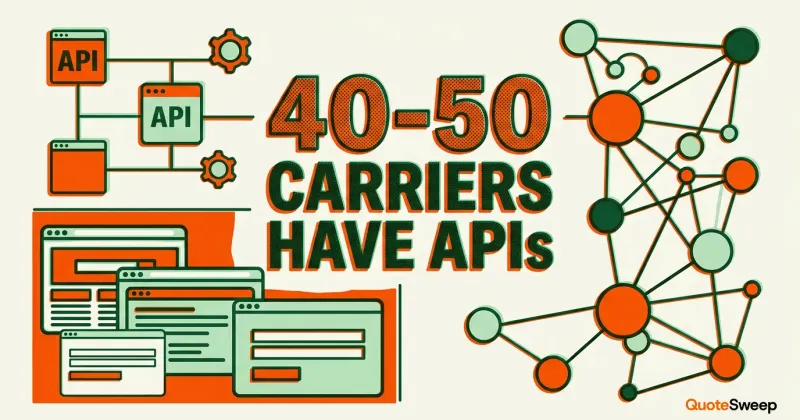
There is significant overlap between these platforms' carrier lists. The total number of unique U.S. P&C carriers with commercial quoting APIs is roughly 50–60 out of approximately 2,700 total. That means API-based tools cover about 1.5–2% of the carrier market by count.
The carriers with APIs tend to be the ones writing the most premium – Travelers, CNA, Chubb, Liberty Mutual, Nationwide, Hartford, Progressive, Hanover, Markel, Acuity, Westfield, and others in that tier. By premium volume, API-connected carriers account for a larger share of the market than their count suggests. But for independent agents, the carriers without APIs often include the regional and specialty markets that offer the most competitive pricing for specific classes and geographies.
The IVANS Role
IVANS (Insurance Value Added Network Services) is the dominant connectivity platform in the industry. IVANS facilitates policy download (carrier-to-agency data transfer), real-time transactions, and some API connectivity between carriers and agency software.
IVANS is not an API in the traditional software sense. It is a network and data exchange standard that carriers and vendors use to pass information. When a comparative rater says they connect to a carrier "via IVANS," they mean they use the IVANS network to exchange data with that carrier's system. The data formats, connection types, and capabilities vary by carrier.
IVANS connectivity is more widespread than direct APIs – more carriers support IVANS download than support commercial quoting APIs – but IVANS is primarily used for post-bind data transfer (policy download, commission statements) rather than real-time quoting.
How Portal Automation Works
Portal automation – also called AI web agents or RPA (robotic process automation) – interacts with carrier web portals programmatically. Instead of an agent logging into a carrier's website, filling out forms, and clicking through pages, automation software does it using the agent's own credentials.
The Technical Flow
-
Data intake. The agent enters client information once into the quoting platform.
-
Carrier session launch. The automation opens simultaneous browser sessions with each selected carrier's web portal, logging in with the agent's credentials.
-
Field mapping. An intelligence layer translates the agent's standardized data into each carrier's specific field names, formats, dropdown values, and sequences. "IT Consulting" becomes NAICS 541512 on one portal, "Professional Services - Technology" on another, and SIC 7371 on a third.
-
Form completion. The automation fills out each carrier's portal – navigating multi-step workflows, answering conditional questions, handling carrier-specific logic, and advancing through each page of the application.
-
Quote extraction. When each carrier returns a quote (or declination), the automation extracts the premium, coverage details, and conditions, then presents them in a unified comparison format.
The process takes 2–5 minutes for most accounts across 10–15 carriers – compared to 60–90 minutes if an agent were doing it manually. For a detailed explanation of how this works, see our guide to carrier portal automation for insurance.
Who Can Be Reached via Portal
Any carrier with a web portal that agents can log into – which is virtually every carrier in the U.S. market. This includes:
- All national carriers (regardless of whether they also have APIs)
- Regional carriers that serve specific states or territories
- Specialty markets and niche carriers
- Surplus lines markets with online portals
- Managing general agencies (MGAs) with quoting portals
The carrier reach of portal automation is dramatically broader than API-based tools. Where API tools connect to 31–50 carriers, portal automation can theoretically reach any carrier that has a web-based quoting workflow.
Head-to-Head Comparison
| Factor | API-Based Quoting | Portal Automation |
|---|---|---|
| Carrier reach | ~40–50 carriers (1.5–2% of market) | Any carrier with a web portal (~2,700+) |
| Speed per carrier | 5–30 seconds | 30–120 seconds |
| Reliability | Very high – structured data exchange | High but variable – dependent on portal stability |
| Data accuracy | Near 100% – structured formats | 95%+ – depends on field mapping quality |
| Maintenance | Low for the agent; carrier maintains API | Higher – portal changes require automation updates |
| Setup complexity | Low – connect to available APIs | Moderate – requires agent credentials and carrier configurations |
| Works without carrier cooperation | No – carrier must build and maintain API | Yes – works with existing portals |
| Cost model | Often carrier-subsidized (Semsee) or platform fee | Platform subscription fee |
| Real-time indication | Yes – instant carrier response | Near-real-time – minutes, not seconds |
API Advantages
Speed
API connections are faster. A structured data exchange between two systems completes in seconds. There is no form filling, page navigation, or rendering delay. When you need a quote fast – while a prospect is on the phone, or during a time-sensitive renewal – API speed matters.
Reliability
APIs are stable by design. The carrier defines the data format, the quoting platform sends data in that format, and the response comes back in a predictable structure. There are no portal redesigns, changed field names, or broken page layouts to deal with. When an API is working, it works consistently.
Data Fidelity
Because APIs use structured data (ACORD XML, JSON schemas), the data that reaches the carrier's system is exactly what the quoting platform sent. There is no field mapping interpretation, no dropdown matching, no contextual translation. A NAICS code sent via API arrives as the exact code entered – it does not need to be translated into a carrier-specific format.
Carrier Support
When a carrier builds an API, they have a vested interest in making it work. They provide documentation, sandbox testing environments, and technical support. If something breaks, both the quoting platform and the carrier can diagnose the issue through structured error codes and logs. The carrier is a partner in the integration, not an unknowing participant.
API Disadvantages
Limited Carrier Reach
This is the fundamental limitation. With only 40–50 carriers offering commercial quoting APIs, an API-only tool reaches a small fraction of the market. For agents whose best markets are regional carriers, specialty markets, or niche writers – the carriers most likely to offer competitive pricing on specific risks – API tools leave the most valuable carriers unreachable.
As we detailed in 98% of carriers have no API, the carriers without APIs are not behind the times – many lack the technical resources, business case, or IT infrastructure to build and maintain APIs. This is not changing quickly.
Carrier Dependency
API availability depends entirely on the carrier's willingness and ability to build and maintain the integration. If a carrier decides to deprecate their API, change their data format, or restrict access, the quoting platform loses that carrier until the issue is resolved. Agents have no control over this – they are dependent on carrier-vendor relationships they are not party to.
Standardization Gaps
Despite ACORD data standards, there is no universal API format for commercial insurance quoting. Each carrier's API has different data requirements, different field definitions, different response formats, and different error handling. The quoting platform must build and maintain a custom integration for each carrier. This is one reason the number of API-connected carriers grows slowly – each new carrier connection is a significant engineering project.
Cost Barriers for Carriers
Building a commercial insurance API requires investment in technology, security, documentation, developer support, and ongoing maintenance. For carriers writing billions in premium, this investment makes sense. For a regional mutual writing $100M in premium with a small IT team, the ROI does not justify the cost. This structural economic reality limits API adoption to the largest carriers, and it will not change in the near term.
Portal Automation Advantages
Universal Carrier Reach
Portal automation works with any carrier that has a web portal. No carrier cooperation is required. No API needs to be built. No integration partnership needs to be established. If an agent can log into a carrier's website and get a quote manually, portal automation can do it automatically.
This is the single most important advantage of portal automation: it solves the carrier reach problem that API-based tools cannot. When your best market for a Colorado contractor is a regional carrier without an API, portal automation is the only automated way to reach them.
Works Without Carrier Cooperation
Portal automation does not require the carrier to do anything. It works with the carrier's existing web portal, using the agent's existing credentials. The carrier does not need to build an API, partner with a technology vendor, or change anything about their systems. This means portal automation can expand to new carriers without any dependency on the carrier's technology roadmap.
Parity With Manual Quoting
Portal automation produces the same result as an agent manually logging into a portal and filling out forms – because that is exactly what it does, just faster and in parallel. The carrier sees a normal web session from a credentialed agent. The quote comes through the carrier's normal quoting workflow. There are no data format differences, no API-specific limitations, and no functionality gaps between what the portal supports and what the automation can access.
Rapid Carrier Addition
Adding a new carrier to a portal automation platform is primarily a field mapping and workflow configuration project. It does not require the carrier to build anything. This means new carrier connections can be added faster than API integrations – particularly for carriers that will never build APIs.
Portal Automation Disadvantages
Portal Change Sensitivity
Carrier web portals change. Carriers redesign their sites, move fields, rename dropdowns, add new questions, and change page flows. When a portal changes, the automation needs to be updated to match. This maintenance is ongoing and requires monitoring.
Well-built portal automation platforms have change detection systems that identify when a portal has been modified and alert the engineering team. But there is always a window – hours to days – between when a portal changes and when the automation is updated. During that window, quotes from that carrier may fail or require manual completion.
Speed
Portal automation is slower than API calls. Filling out forms, navigating pages, and waiting for carrier portals to respond takes 30–120 seconds per carrier. Across 10–15 carriers, total quoting time is 2–5 minutes – much faster than manual, but slower than the 30–60 seconds total that API-based tools achieve for their connected carriers.
For most agents, this speed difference is not meaningful. A 3-minute wait versus a 30-second wait is trivial compared to the 60–90 minutes the manual process takes. But for high-volume operations processing hundreds of quotes daily, the per-quote time difference adds up.
Field Mapping Complexity
Translating standardized data into each carrier's specific portal format requires an intelligent field mapping layer. This mapping handles the contextual translations – "restaurant with on-premises liquor" might need to be entered as a NAICS code on one portal, a yes/no question on another, and a separate liquor liability application on a third.
Field mapping accuracy is high (95%+ for well-maintained systems) but not perfect. Edge cases – unusual class codes, carrier-specific underwriting questions, new portal fields – can cause mapping errors that require human review. The RPA layer needs constant refinement as carriers add new questions and change their portal workflows.
Credential Management
Portal automation uses the agent's own carrier credentials to log into portals. This means credentials must be stored securely, updated when they expire, and managed across all carriers on the agent's panel. Multi-factor authentication requirements from some carriers add complexity – the automation needs to handle MFA challenges without requiring the agent to manually approve each login.
The Hybrid Approach
The most effective quoting tools in 2026 use both approaches: APIs for carriers that support them, and portal automation for everyone else. This is not a compromise – it is the optimal architecture, because it combines the speed and reliability of APIs with the carrier reach of portal automation.
How Hybrid Works
When an agent submits an application through a hybrid quoting platform:
- The system checks which carriers on the agent's panel have API connections and which require portal automation.
- For API-connected carriers, the data is submitted via API. Quotes return in seconds.
- For portal-only carriers, the data is submitted via AI web agents. Quotes return in 1–3 minutes.
- All quotes – regardless of how they were obtained – are presented in a single, unified comparison view.
The agent does not need to know which approach was used for which carrier. The experience is the same: enter data once, get quotes from all carriers. The plumbing behind the scenes uses whichever method works for each carrier.
Why Hybrid Wins
- Maximum carrier reach. API carriers are covered fast. Portal carriers are covered at all. No carrier is left out because of the connectivity method.
- Best available speed. API quotes return in seconds. Portal quotes return in minutes. Both are dramatically faster than manual.
- Redundancy. If a carrier's API is temporarily down, portal automation can serve as a fallback (and vice versa).
- Future-proof. As more carriers build APIs – a slow but real trend – the hybrid platform automatically shifts those carriers from portal automation to API, improving speed without any change for the agent.
What Agents Should Ask Quoting Vendors
When evaluating comparative raters and quoting tools, ask these specific questions about their connectivity approach:
About Carrier Reach
- How many carriers do you connect to? How many are API-based and how many are portal-based?
- Can you connect to carriers on my specific panel? (Provide your carrier list.)
- How quickly can you add a new carrier connection?
- What happens when I need a carrier you do not currently support?
About Reliability
- What is your uptime for API connections? For portal automation?
- How quickly do you respond when a carrier portal changes and breaks automation?
- What is the average time to resolve a broken portal connection?
- Do you have fallback methods when a primary connection fails?
About Accuracy
- What is your field mapping accuracy rate across carriers?
- How do you handle carrier-specific questions that vary by class code or state?
- What happens when mapping fails – does the submission error out, or does it flag the issue for manual review?
- How often do you update your field mappings for each carrier?
About the Agent Experience
- Does the agent need to know which method is used for which carrier?
- Are quotes from API carriers and portal carriers presented identically?
- How long does the typical multi-carrier quote take end to end?
- Can the agent review and modify data before it is submitted to each carrier?
The Future: Where Carrier Connectivity Is Heading
More APIs, Slowly
Carrier API adoption is growing, but slowly. IVANS has been working to expand real-time connectivity for years. Applied Systems' acquisition of Tarmika signals investment in API-based commercial quoting. Individual carriers continue to build APIs at their own pace.
Realistic projection: the number of carriers with commercial quoting APIs might grow from roughly 50 to roughly 75–100 over the next 3–5 years. That would be meaningful progress, but it would still leave the vast majority of carriers API-free. Portal automation will remain necessary for the foreseeable future.
Smarter Portal Automation
AI is making portal automation more resilient. Machine learning models that can recognize portal elements, adapt to layout changes, and self-correct mapping errors are reducing the maintenance burden of portal automation. The technology is moving from brittle rule-based scripts to adaptive systems that handle portal changes with less manual intervention.
Carrier Standardization Efforts
Industry groups including ACORD and IVANS are working on data standardization that would make it easier for carriers to expose commercial quoting capabilities. If a standard commercial quoting API format emerges – the way personal lines has benefited from more standardized data exchange – API adoption could accelerate significantly.
But standardization efforts in insurance have historically moved slowly. The industry adopted ACORD forms decades ago but still lacks a universal digital data exchange standard for commercial quoting. Patience is warranted.
Agent Expectations Shift
As more agents experience automated multi-carrier quoting – whether through APIs, portal automation, or hybrid approaches – the tolerance for manual portal entry drops. Carriers that remain inaccessible through any automated channel risk losing agent mindshare: agents will quote the carriers that are easy to reach first, and the rest may not get quoted at all. This market pressure will gradually incentivize more carriers to improve their digital accessibility, whether through APIs or by making their portals more automation-friendly.
Frequently Asked Questions
Is API-based quoting always better than portal automation?
No. API quoting is faster and more reliable, but it only works with carriers that have APIs – roughly 2% of the market. For the other 98%, portal automation is the only automated option. The best approach is a tool that uses both: APIs where available, portal automation everywhere else.
Does portal automation violate carrier terms of service?
This is a common concern. Portal automation uses the agent's own credentials and interacts with the carrier's portal the same way a human would – just faster and in parallel. Most carriers do not explicitly prohibit automated portal access in their agent agreements, but the legal situation varies by carrier. Reputable portal automation vendors have reviewed this question extensively and structure their approach to work within carrier policies.
How many carriers should my quoting tool connect to?
As many as your agency actively quotes. If your carrier panel includes 20 carriers, your quoting tool should ideally reach all 20. API-only tools will cover a subset (the nationals with APIs). Portal automation tools or hybrid tools will cover more. The closer your tool's carrier list matches your panel, the more value it delivers.
Will carriers eventually all have APIs?
Unlikely in the near term. Building and maintaining a commercial quoting API requires significant investment that most regional and specialty carriers cannot justify. API adoption will grow – from roughly 50 carriers today to perhaps 75–100 in the next 3–5 years – but the long tail of 2,000+ smaller carriers will remain portal-only for years to come.
What about ACORD data standards – don't they solve the connectivity problem?
ACORD provides data standards – standardized forms, data element definitions, and XML schemas – that make it easier for systems to exchange insurance data. But ACORD standards do not create APIs. A carrier still needs to build the infrastructure to receive ACORD-formatted data, process it through their rating engine, and return a response. ACORD makes the data interchange easier once both sides are connected; it does not create the connection itself.
Is AI web agents the same as RPA?
AI web agents for insurance shares foundational technology with generic RPA (robotic process automation), but insurance-specific implementations add layers of complexity that generic RPA tools do not handle: contextual field mapping across carrier-specific portal formats, carrier underwriting logic, conditional form navigation, and insurance document extraction. Think of insurance AI web agents as RPA specialized for the unique challenges of carrier portal interaction.