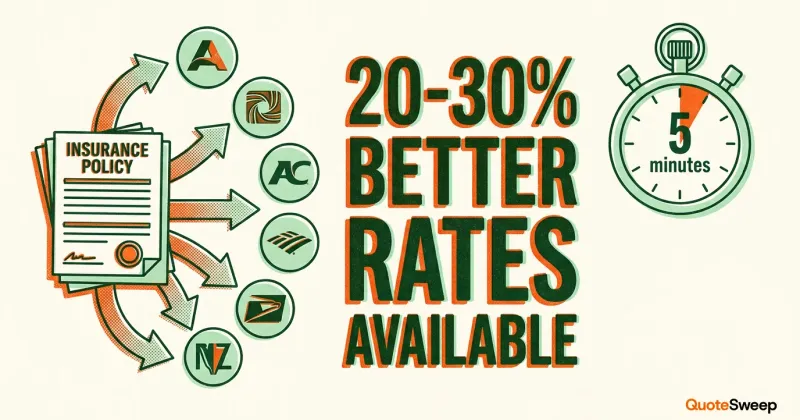
How to Re-Market Commercial Insurance Renewals in 5 Minutes
The insurance renewal process for most independent agencies works like this: a renewal comes up, the agency checks the renewal premium, and if the client doesn't complain about the price increase, the policy rolls over. No carrier shopping. No market comparison. No verification that the client is getting the best available coverage at the best available rate.
Industry observers estimate that the majority of commercial renewals go unmarketed – agencies let them auto-renew without shopping alternative carriers. The reason isn't laziness. It's math: manually re-quoting a commercial renewal across 10 carriers takes the same 60 to 90 minutes as quoting new business. When you have 15 renewals coming up this month, that's 15 to 22 hours of re-quoting – time most agencies simply don't have.
But the math changes when you can remarket a renewal in 5 minutes instead of 90. Here's how.
Industry observers estimate the majority of commercial renewals go unmarketed – not from neglect, but because manual re-quoting takes 60–90 minutes per account. A comparative rater cuts that to 5 minutes, making it practical to shop every renewal before it auto-renews.
Why Agencies Don't Remarket (and What It Costs)
The reason agencies skip remarketing is straightforward: the time investment doesn't seem justified for most accounts. An agent who spends 90 minutes re-quoting a $3,500 BOP renewal and finds a 10% savings has saved the client $350 – valuable, but not transformative given the time spent. Multiply that across 200 annual renewals, and the total time commitment to remarket every account is 300 hours per year. That's nearly two full months of an agent's working time.
So agencies triage. They remarket the accounts where clients are complaining about rate increases. They remarket the large accounts where the commission justifies the time. And they let the rest auto-renew.
The Hidden Cost of Not Remarketing
The problem with selective remarketing is what you miss:
Lost savings for clients. A client whose BOP renewed at $4,200 might have gotten $3,600 from a carrier the agency never checked. The client pays $600 more per year than necessary, and the agency never knows.
Retention risk. Clients who feel their rates are too high don't always complain – they call another agent. By the time your client tells you they're leaving, another agency has already quoted them across carriers you never checked. Remarketing proactively – before the client asks – is the strongest retention tool an agency has.
Commission erosion on rate increases. When carriers raise renewal premiums, the commission dollars go up, but the value proposition to the client goes down. An agency that consistently finds competitive alternatives demonstrates active advocacy – the kind of service that builds long-term client loyalty.
Missed cross-selling. The remarketing conversation is a natural opportunity to review the client's full coverage. A renewal review that surfaces a gap in cyber coverage or an outdated umbrella limit creates cross-selling opportunities that don't exist when the policy auto-renews silently.
The Math on What You're Leaving Behind
Here's a realistic calculation for a typical independent agency:
Assume you have 200 commercial policies renewing annually. Of those, industry benchmarks suggest that 20% to 30% could be placed at better rates with alternative carriers – either because the current carrier has increased rates above market, a new carrier has entered the class, or the client's risk profile has improved.
If 25% of your renewals (50 accounts) could save clients an average of 12% on premium, and your average commercial policy premium is $3,500:
- 50 accounts × $3,500 × 12% savings = $21,000 in client savings per year
- At a 12% average commission rate, that's $2,520 in commission on the new policies
- The real value: retaining clients who might otherwise leave for an agent who did shop the market
The commission on remarketed policies isn't the primary win – retention is. Every client you remarket proactively is a client who isn't wondering if they could do better with a different agent.
The 5-Minute Remarketing Workflow
The 60-to-90-minute manual remarketing process becomes a 5-minute automated process when you use a comparative rater – a tool that submits one application to multiple carriers simultaneously. (For a deep dive on how comparative raters work, see our complete guide to commercial insurance comparative raters.) Here's the workflow.
Step 1: Identify Renewals 60-90 Days Out
Pull your renewal list from your AMS 60 to 90 days before renewal dates. This gives you enough lead time to quote alternatives, present options to the client, and process any carrier changes before the renewal date.
Most agency management systems can generate renewal reports by date range. Set up a recurring report that runs monthly, pulling all renewals coming up in the next 60 to 90 days.
Step 2: Prioritize Which Renewals to Remarket
Not every renewal needs to be remarketed, especially when you're building the workflow for the first time. Start with the accounts most likely to benefit:
Rate increases above 10%. When a carrier raises a renewal premium significantly, there's a good chance alternative carriers can beat the new rate. These accounts also carry the highest retention risk – clients notice double-digit increases.
Accounts where carrier appetite has shifted. If a carrier has tightened appetite for a business class or state, the renewal pricing may reflect reduced willingness to write the risk. Alternative carriers with active appetite for that class may offer better rates.
Accounts where new carriers have entered the market. When a new carrier launches a commercial program or expands into a state, they often price aggressively to build book. These new entrants create remarketing opportunities for renewals that haven't been shopped recently.
Accounts that haven't been remarketed in 2+ years. Even if the renewal pricing looks stable, a policy that hasn't been shopped in two or more years may be priced well above what current market conditions would produce.
Step 3: Quote Through Your Comparative Rater
This is where the time savings happen. Instead of logging into each carrier portal individually, enter the renewal account's information into your comparative rater once. The rater submits to your full carrier panel in parallel and returns quotes from every eligible carrier.
For a renewal, you already have the client data – it's in your AMS from the original placement. The data entry is minimal: verify the information is current, update anything that's changed (revenue, employee count, operations), and submit.
Total time for this step: 3 to 5 minutes, regardless of how many carriers you're quoting.
Step 4: Compare to Current Renewal Premium
With quotes back from multiple carriers, compare them against the current renewal premium. Look at:
- Premium difference. Is there a meaningful savings? For most agencies, 5% or more justifies a conversation with the client.
- Coverage differences. A lower premium with reduced coverage isn't necessarily a better deal. Compare limits, deductibles, and coverage terms – not just price.
- Carrier financial strength. If you're considering a move from a Travelers renewal to a smaller carrier, verify the alternative carrier's AM Best rating and market reputation.
Step 5: Present Options to the Client
If you found better alternatives, present them to the client alongside the current renewal. Frame it as proactive advocacy: "Your renewal came through at $4,200 this year, up from $3,800 last year. I re-quoted your account across our carrier panel and found competitive options from [Carrier A] at $3,600 and [Carrier B] at $3,750, both with comparable coverage."
If the renewal is already competitive, tell the client that too: "I re-quoted your account at renewal and your current carrier's pricing is the best available across our markets. You're in good shape." This proactive communication builds trust even when there's no change to make.
Building the Remarketing Habit
The hardest part of remarketing isn't the quoting – it's building the workflow into your agency's routine. Here are practical tactics for making remarketing a consistent practice.
Batch Your Renewals
Don't remarket one account at a time as renewals come up. Instead, block a recurring time slot – say, Tuesday mornings – to batch all renewals coming up in the next 60 to 90 days. Run 10 to 15 accounts through your comparative rater in a single session. Total time: 50 to 75 minutes for accounts that would take 15 to 22 hours to quote manually.
Batching creates a predictable workflow that's easier to maintain than ad hoc remarketing. It also lets you compare market trends across accounts – if three carriers are raising BOP rates in the same business class, that's market intelligence you can share with clients.
Set Remarketing Thresholds
Define clear rules for which renewals get remarketed automatically. For example:
- Always remarket: Rate increase above 10%, client revenue change above 20%, claims in the past year, policy not remarketed in 2+ years
- Remarket selectively: Rate increase between 5-10%, stable accounts with no changes, accounts already at competitive rates
- Skip remarketing: Rate decrease or minimal increase (under 3%), accounts bound within the past 6 months, specialized placements where only one carrier writes the coverage
These thresholds eliminate the decision fatigue around "should I remarket this account?" and make the process systematic.
Track Your Remarketing Results
Measure the impact so you can demonstrate value – both to yourself and to clients:
- Number of renewals remarketed per month
- Percentage that resulted in carrier changes
- Total client savings generated
- Retention rate for remarketed accounts vs non-remarketed accounts
Most agencies that track these metrics find that remarketed accounts have significantly higher retention rates than auto-renewed accounts. The act of proactively reviewing a client's coverage – even when you don't change carriers – strengthens the relationship.
Which Accounts Benefit Most From Remarketing
Not all renewals have equal remarketing potential. Focus your effort where the return is highest.
Accounts With Rate Increases Above 15%
When a carrier pushes a double-digit rate increase, it's a strong signal that the carrier's appetite for the risk has shifted. Other carriers may not have made the same adjustment, creating pricing gaps. These accounts also carry the highest retention risk – a 15% increase prompts clients to shop on their own, and you'd rather be the one finding the alternative.
Accounts in Classes With New Market Entrants
When a new carrier launches a commercial program or expands into your state, they typically price aggressively to build volume. Watch for carrier expansion announcements and match them against your renewal book. A carrier that just entered the Colorado BOP market with aggressive pricing is a remarketing opportunity for every BOP renewal in your Colorado book.
Accounts Where the Original Placement Was a Single-Carrier Quote
If the original policy was placed based on a single carrier quote – the agent went to one carrier, got a price, and bound it – the renewal is almost certainly worth remarketing. A multi-carrier comparison will often surface better options that were never considered during the original placement.
Accounts With Changed Risk Profiles
A client whose revenue grew 40% last year may now qualify for better rates from carriers whose appetite favors larger accounts. A business that invested in safety equipment, completed risk management training, or had an experience modification rate improvement may qualify for credits or preferred pricing that weren't available at original placement.
The Remarketing Flywheel
Remarketing creates a compounding effect over time. Here's how the flywheel works:
Year 1: You start remarketing renewals systematically. You find savings for 25% of accounts, retain clients who were considering leaving, and identify cross-selling opportunities during renewal reviews. Your book retention rate improves.
Year 2: Clients expect the annual renewal review – it's part of your service model now. When prospects ask what makes your agency different, you can say: "We re-quote every commercial account at renewal across our full carrier panel. Most agencies let renewals auto-renew. We don't." This becomes a prospecting differentiator.
Year 3+: Your renewal remarketing data gives you market intelligence that informs new business quoting. You know which carriers are pricing aggressively in which classes and states. You know which carriers are pulling back. This intelligence makes your new business quoting more targeted and efficient.
The flywheel effect means that remarketing isn't just about saving clients money today – it's about building the kind of agency that wins and retains business over the long term. For more on using quoting capacity to grow your agency, see our guide on how to grow your insurance agency book without hiring.
The ROI of Remarketing Automation
The business case for automating the remarketing workflow is straightforward.
Without automation: An agent remarketing one account manually (logging into 10 carrier portals, entering ACORD applications) spends 60 to 90 minutes. Remarketing 20 accounts per month = 20 to 30 hours of agent time.
With automation: The same agent remarketing one account through a comparative rater spends 5 minutes. Remarketing 20 accounts per month = less than 2 hours of agent time.
Time saved: 18 to 28 hours per month per agent.
Value of saved time: At a fully loaded agent cost of $30 per hour, that's $540 to $840 per month in recovered capacity. That recovered time can go toward quoting new business, servicing accounts, or remarketing even more renewals.
Plus the retention and savings impact: If remarketing prevents even 2 to 3 account losses per month (at $3,500 average premium, 12% commission), that's $840 to $1,260 in retained annual commission – protected from a few hours of work.
For a comprehensive look at how quoting automation fits into a broader agency automation strategy, see our insurance agency automation guide.
Frequently Asked Questions
How far in advance should I start remarketing renewals?
Start 60 to 90 days before the renewal date. This gives you time to quote alternatives, present options to the client, obtain any needed underwriting information, and process the carrier change if the client decides to switch. Starting earlier than 90 days can result in quotes that expire before the renewal date.
Should I tell the current carrier I'm remarketing?
It depends on the situation. If the renewal premium includes a significant increase, informing the carrier that you're shopping the market can sometimes prompt them to reconsider their pricing. If the renewal pricing is reasonable and you're remarketing as a routine practice, there's no obligation to notify the carrier.
What if the current carrier is still the best option after remarketing?
That's a great outcome – and a valuable conversation to have with the client. Telling your client "I re-quoted your account across 12 carriers and your current policy is the most competitive option" reinforces that you're actively managing their coverage. It builds trust and reduces the chance they'll shop on their own.
How do I handle the transition if a client switches carriers at renewal?
The transition follows the standard book of business management process: bind the new policy effective on the renewal date, confirm cancellation (or non-renewal) of the outgoing policy, update your AMS records, and issue new certificates of insurance if needed. For most standard commercial lines, the transition is straightforward. For complex accounts, allow extra time for underwriting review and policy issuance.
Can I remarket renewals for policies I originally placed through a comparative rater?
Absolutely – and this is one of the most efficient remarketing scenarios. If you originally quoted through a comparative rater, the client data is already in the system. At renewal, you update any changed information, re-submit to your carrier panel, and compare results against the renewal premium. The data entry is minimal.
What if a client has a claim during the policy period – should I still remarket?
Yes, but manage expectations. A recent claim will affect available options – some carriers may decline the account, and others may price the claim into their quote. Remarketing after a claim is still worthwhile because: (1) some carriers are more lenient on claims than others, (2) the current carrier may be raising rates disproportionately due to the claim, and (3) the remarketing conversation lets you review the client's overall risk management and coverage adequacy.