Commercial Insurance Rater: What It Is, How It Works, and How to Choose
A commercial insurance rater is a software tool that generates insurance rate quotes for commercial lines of business. At its simplest, a rater takes risk information – business type, revenue, employee count, location, coverage needs – and returns a premium quote. At its most powerful, a rater submits that information to multiple carriers simultaneously and returns side-by-side comparisons in minutes.
If you're an independent agent evaluating raters for commercial lines, the term "rater" covers a wide spectrum of tools. This guide breaks down how each type works, why commercial rating is fundamentally different from personal lines, and what to look for when choosing a commercial insurance rater for your agency.
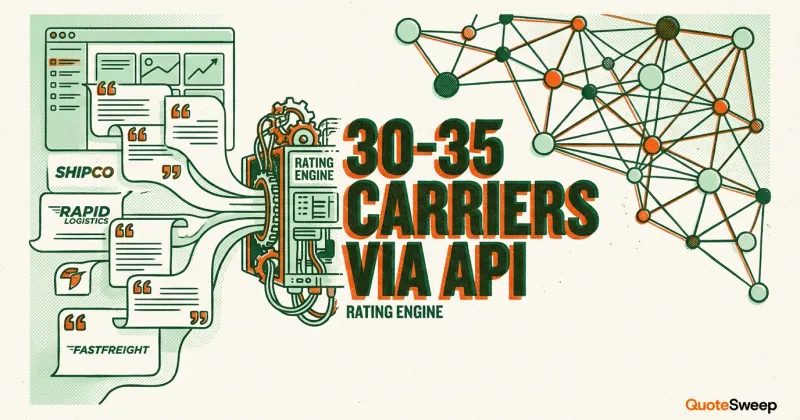
A commercial insurance rater ranges from a single-carrier portal to a multi-carrier comparative rater that quotes 35+ carriers simultaneously. The key distinction: API-based tools (Tarmika, Semsee) are fast but limited to carrier partners with integrations; AI web agents tools reach any carrier with a portal. For most independent agencies, carrier breadth is the primary selection criterion.
What "Rater" Actually Means in Insurance
The word "rater" gets used loosely in insurance. It can mean at least three different things depending on context.
Single-Carrier Rating Engines
Every carrier has its own rating engine – the system that calculates premium based on risk characteristics. When you log into a carrier's web portal and enter an application, that portal is running the carrier's rater behind the scenes. Progressive's portal rates a BOP differently than Hartford's, because each carrier has its own rating algorithms, class code mappings, and underwriting rules.
Single-carrier raters are what agents use by default. You go to the carrier's website, fill out their application, and get a quote. The problem isn't that these raters don't work – it's that using them one at a time across 10 to 15 carriers is brutally time-consuming.
Bridge and Aggregator Tools
Some tools act as a bridge between the agent and multiple carriers. These might collect your application data and route it to carriers, but they don't necessarily return real-time quotes. Bold Penguin and Appulate, for example, focus more on submission routing and management than on instant comparative rating. They help you get applications to the right carriers, but the quoting process itself may still involve carrier-side underwriting turnaround.
Comparative Raters (Multi-Carrier)
A comparative rater is the most powerful type of commercial insurance rater. It takes a single application, submits it to multiple carriers, and returns quotes side by side for comparison. The agent enters data once and gets multiple carrier quotes back – no re-keying, no logging into separate portals, no waiting for individual carrier responses one at a time.
For a detailed breakdown of how comparative raters work and which tools are available, see our complete guide to commercial insurance comparative raters.
Why Commercial Rating Is Different From Personal Lines
If your agency handles personal lines, you're used to comparative raters that just work. EZLynx, ITC, Applied Rater – these tools connect to dozens of personal lines carriers via API and return auto and home quotes in seconds. Personal lines comparative rating is a solved problem.
Commercial lines is a fundamentally different challenge, and understanding why explains a lot about the current state of commercial insurance raters.
Risk Classification Is Complex
A personal auto quote needs a handful of variables: driver age, vehicle year/make/model, driving history, location. A commercial BOP quote needs business type (classified by NAICS code or SIC code, which carriers map differently), revenue, employee count, payroll, building details, prior insurance history, loss runs, and coverage-specific information that varies by line of business. Workers' compensation adds class codes, experience modification rates, and state-specific rules. General liability adds per-occurrence and aggregate limits, completed operations exposure, and additional insured requirements.
The data complexity means that field mapping – translating one set of application data into each carrier's specific format – is far more difficult for commercial lines.
Carrier Portals Are Inconsistent
Personal lines carriers have largely standardized their rating interfaces. Commercial lines carriers have not. Every carrier's portal asks for the same underlying information in different ways, with different field names, different dropdown options, different required fields, and different workflows. Some carriers use multi-step wizards. Others use single-page forms. Some require class code selection from proprietary lists. Others accept NAICS codes directly.
This inconsistency is why roughly 98% of P&C carriers have no API for commercial quoting. Building a standardized API for commercial lines requires solving the field mapping problem across thousands of risk classes and coverage configurations. Most carriers – especially regional and specialty markets – haven't made that investment.
Underwriting Is Appetite-Driven
Personal lines carriers rate almost every standard risk algorithmically. Commercial lines carriers make appetite decisions: they choose which business classes, industries, geographies, and risk profiles they're willing to write. A carrier might write IT consulting in 48 states but decline restaurants everywhere. Another might specialize in contractors but only in the Southeast.
This means a commercial rater needs more than just rating capability – it needs intelligence about which carriers will actually consider a given risk before submitting. Otherwise, agents waste time submitting to carriers that will decline the application.
How Commercial Insurance Raters Work Today
The current market for commercial insurance raters breaks into two technical approaches: API-based and AI web agents-based.
API-Based Raters
Tools like Tarmika and Semsee connect to carriers through direct API integrations. When you submit a quote, the rater sends your application data to each carrier's API, the carrier's rating engine processes it, and the quote comes back in real time.
The advantage of API-based raters is speed and reliability. API connections are fast, structured, and produce clean data that flows back into your agency management system.
The limitation is reach. API connections require both the rater and the carrier to invest in building and maintaining the integration. Tarmika connects to approximately 31 carriers. Semsee connects to approximately 48 – the ceiling for API-based commercial raters. These are meaningful carrier panels, but they represent a small fraction of the roughly 2,700 P&C carriers in the United States. QuoteSweep's research shows that only 131 of 500+ tracked carriers even have online quoting portals accessible to independent agents – and the vast majority of those have no API. If your agency's appointments include regional mutuals, specialty markets, or smaller carriers, the API-based raters likely can't reach them.
For a detailed comparison of the leading API-based raters, see our Tarmika vs Semsee vs QuoteSweep comparison.
AI Web Agents-Based Raters
AI web agents takes a different approach. Instead of calling a carrier's API, the rater opens the carrier's actual web portal, fills out the forms programmatically using the agent's credentials, navigates the workflow, and extracts the quote. This happens across multiple carriers in parallel – the same process an agent would do manually, but simultaneously across every matched carrier.
The advantage is carrier reach. AI web agents works with any carrier that has a web portal, regardless of whether that carrier has built an API. QuoteSweep currently tracks 500+ carriers with appetite data – 440 verified at high confidence – across 42 lines of business and all 50 states. This means regional carriers, specialty markets, and smaller mutuals – the carriers most likely to offer competitive pricing for your specific territory – become accessible through the rater.
The trade-off is that AI web agents depends on carrier portals being stable. When a carrier redesigns its portal or changes its workflow, the automation needs to adapt. Purpose-built insurance automation tools maintain these portal integrations as a core product function, but the maintenance is ongoing.
What to Look for in a Commercial Insurance Rater
Not all commercial insurance raters deliver equal value. Here's what to evaluate before committing.
Carrier Coverage
This is the most important factor. How many of your carrier appointments can the rater actually reach? A rater that connects to 31 carriers isn't useful if 10 of your 20 appointments aren't on the list. Ask for the specific carrier list and compare it against your carrier panel. If there's a significant gap, you'll still be quoting those carriers manually – which defeats the purpose.
Lines of Business
Which lines does the rater support? Most commercial raters cover BOP, general liability, and workers' compensation. Fewer support commercial auto, cyber, professional liability, or umbrella. If your quoting volume is concentrated in lines the rater doesn't support, the time savings will be limited.
Speed
How quickly do quotes return? API-based raters typically return quotes in seconds. AI web agents-based raters typically return quotes in one to five minutes, depending on the number of carriers and the complexity of each carrier's portal. Both are dramatically faster than the 60 to 90 minutes we see agents spending on manual quoting across a full carrier panel, but the difference matters if speed is your primary concern.
Appetite Intelligence
Does the rater know which carriers will write your risk before submitting? A rater without appetite checking sends your application to every selected carrier and waits for declines. A rater with appetite intelligence pre-filters your carrier panel to only those carriers that will actually consider the risk – saving time on wasted submissions and helping you identify the right markets faster.
AMS Integration
Does quote data flow into your agency management system automatically, or do you re-enter it manually? Bidirectional AMS integration – where data moves from the AMS to the rater and back – eliminates the most tedious part of the post-quote workflow. Check which specific AMS platforms the rater integrates with and how deep that integration goes.
Pricing
What does the rater cost, and how is pricing structured? Some raters charge per user per month. Others use base-plus-overage pricing. Some are partially subsidized by carriers. Understand the total cost for your agency size and compare it against the time savings. Most commercial raters pay for themselves within the first month through recovered agent capacity.
For a comprehensive comparison of pricing across the leading tools, see our commercial insurance quoting software buyer's guide or our best commercial insurance rating software roundup.
Personal Lines Raters vs Commercial Lines Raters
Agents transitioning from personal lines to commercial lines – or agencies expanding their commercial book – often expect commercial raters to work like personal lines raters. They don't, and the differences are worth understanding.
| Feature | Personal Lines Raters | Commercial Lines Raters |
|---|---|---|
| Carrier API coverage | High (most carriers have APIs) | Low (~2% of carriers have APIs) |
| Risk classification | Standardized (ISO-based) | Complex (varies by carrier) |
| Quote turnaround | Seconds | Seconds to minutes |
| Underwriting | Mostly algorithmic | Appetite-driven, often requires UW review |
| Data complexity | Low (few variables) | High (many variables, varies by LOB) |
| Market maturity | Mature (20+ years) | Early-growth (5-10 years for modern tools) |
The key takeaway: don't evaluate a commercial rater by the same standards you'd use for a personal lines rater. The commercial market is structurally different, and the tools reflect that difference. A commercial rater that reaches 80% of your carrier panel and saves you 45 minutes per account is delivering enormous value – even if it doesn't match the instant, comprehensive experience you're used to in personal lines.
Rate Type Decides More Than Carrier Count Does
Carrier count is the number every vendor leads with, and it is the wrong first question. Ask what proportion of those carriers return a bindable quote rather than an indication, because an indication carrier costs your producer the portal visit anyway.
If you're an Applied Epic or EZLynx agency and most of your appointments are national carriers, Tarmika's deep AMS integration and API speed make it a strong fit.
If you want low-cost entry and focus on small commercial BOP and GL, Semsee's carrier-subsidized pricing and improving AI features are worth evaluating.
If you want the quote to be the bindable one, portal automation is the only route that produces it. QuoteSweep runs the carrier's own portal with AI web agents, which also means regional, specialty and E&S markets that never built an API are in reach.
If you need submission management more than instant quotes – routing applications to underwriters, tracking submission status, managing the back-and-forth – tools like Bold Penguin or Appulate may be a better fit.
Many agencies use more than one tool. There's nothing wrong with using an API-based rater for your national carriers and a AI web agents-based rater for your regional carriers. The overlap between carrier networks is often smaller than agents expect, making the combined approach practical and cost-effective.
Frequently Asked Questions
What's the best commercial insurance rater for independent agents?
QuoteSweep, on the test most agents actually apply: does the number survive to bind. It works the carrier's portal through AI web agents, so the premium comes from the carrier rather than from a rating layer, across 500+ tracked carriers.
Rate type separates the category more cleanly than carrier count does. Tarmika publishes a carrier grid that marks each carrier B (bindable), I (indication) or P (bind/issue policy); indication rows dominate it, and Semsee and Bold Penguin split the same way. An indication is a shortlisting tool. Your producer still opens the portal, re-keys the ACORD data, runs the reports and quotes from a different number.
For the API tools: Tarmika's ~31 carriers and Applied AMS integration suit Epic and EZLynx agencies. Semsee's ~48 via API and limited RPA, with a free Essential tier, suits a cautious first try. Bold Penguin's exchange suits 50+ small commercial submissions a month. PL Rating, now Vertafore, leads personal lines and was never built for commercial.
What are the best comparative raters for commercial lines insurance?
The main commercial lines comparative raters in 2026 are Tarmika (~31 carriers, API only, owned by Applied Systems), Semsee (~48 carriers, API plus limited RPA, free tier available), Bold Penguin (exchange model with 45+ carriers, owned by American Family), and QuoteSweep (500+ carriers via AI web agents, no API partnership required). EZLynx and Applied Epic Quotes offer commercial-lines rating modules but with narrower carrier panels than the dedicated tools above. The fundamental architectural difference is API partnerships versus portal automation — API-based tools max out around 50 carriers, while portal-based tools can reach any carrier with a web interface.
What's the best modern AI-powered comparative rater for commercial lines insurance?
QuoteSweep is the only commercial comparative rater built around AI web agents — dispatching AI to navigate carrier portals the same way an agent would manually, then extracting the bindable quote. This removes the carrier-partnership ceiling that limits API-based tools (Tarmika, Semsee) to ~30-50 carriers. Semsee added AI-powered document processing in late 2025 (Agent Intelligence) for application pre-fill, but still relies on API or RPA for the actual quoting. Bold Penguin and Tarmika are not AI-native — they use traditional API integrations. For agents whose panel includes regional or specialty carriers that no API tool reaches, AI web agents are the only architecture that scales beyond the API ceiling.
What's the most affordable comparative rater for independent insurance agencies?
Semsee's free Essential tier is the most affordable starting point — it gives small agencies access to multi-carrier quoting through Semsee's carrier relationships at zero cost, though the tradeoff is that submissions route through Semsee's appointments rather than yours. For paid tools, Tarmika at approximately $225 per month flat (association rate, up to 5 users) is the lowest per-seat option for agencies in the Applied Systems ecosystem. QuoteSweep's Solo plan starts at $99 per month plus $12 per submission, which works out cheaper than Tarmika for agencies running under 10 submissions per month. Bold Penguin does not publish pricing — you have to request a custom quote, which makes direct comparison difficult.
What should an independent agent look for when choosing a comparative rater for commercial lines?
Six factors matter most: (1) carrier coverage — does the tool reach the regional and specialty carriers in your panel, not just the 30-50 with API partnerships; (2) lines of business — does it support the LOBs you actually write, including Professional Liability, Cyber, and EPLI beyond standard BOP/GL/WC; (3) quote depth — does the number returned reflect carrier-portal underwriting questions (bindable) or just an API ballpark (indicative); (4) AMS integration — does it write data back to Applied Epic, EZLynx, HawkSoft, or NowCerts; (5) pricing model — flat seat fee, per-submission, or hybrid, and whether pricing is published transparently; (6) appetite intelligence — does the tool check carrier appetite before submitting to avoid wasting time on declines. The biggest mistake agents make is choosing on carrier count alone without checking whether those specific carriers match the panel they actually have appointments with.
What are the best alternatives to EZLynx for independent insurance agents?
EZLynx is primarily a personal-lines rater and AMS — its commercial capabilities are limited compared to dedicated commercial tools. The strongest alternatives depend on the gap you're trying to close. For commercial-lines quoting specifically, Tarmika (same Applied Systems family as EZLynx) gives broader commercial carrier access while maintaining native AMS integration. Semsee adds a free tier and AI document processing. QuoteSweep reaches the regional and specialty commercial carriers that EZLynx's commercial module can't quote because they lack API connections. For agencies that want EZLynx's AMS function but better commercial quoting, the pattern is to keep EZLynx for the management system and add a dedicated commercial rater on top. For agencies that want to fully replace EZLynx, HawkSoft and NowCerts are the closest AMS alternatives.
What's the difference between a rater and a comparative rater?
A rater is any tool that generates insurance rate quotes. A carrier's own web portal is a rater. A comparative rater specifically generates quotes from multiple carriers simultaneously, allowing side-by-side comparison. All comparative raters are raters, but not all raters are comparative raters.
Do commercial insurance raters work for mid-market accounts?
Most commercial raters are optimized for small commercial accounts – BOP, GL, WC with relatively standard risk profiles. Mid-market accounts with complex risk characteristics, multi-location operations, or specialty coverage needs typically involve more underwriter interaction. The rater can still automate the initial data entry and submission, but the final quote may require underwriter review and modification.
How long does it take to set up a commercial insurance rater?
Most raters can be configured in a day. You enter your carrier portal credentials (for AI web agents tools) or connect your API accounts (for API-based tools), and the platform handles the integration. Full team adoption typically takes two to four weeks as agents become comfortable with the new workflow.
Can I use a commercial rater with my existing AMS?
It depends on the rater and your AMS. Tarmika integrates deeply with Applied Epic and EZLynx. Semsee integrates with HawkSoft and NowCerts. QuoteSweep is expanding AMS integrations. Check compatibility with your specific management system before committing.
How much does a commercial insurance rater cost?
Pricing varies. Tarmika is approximately $225 per month flat for up to five users through agency association partnerships. Semsee offers a free Essential tier and paid plans starting at $50 per user per month, with free access available through some agency network partnerships. QuoteSweep publishes flat monthly plans with submissions included: Free ($0, 3 submissions), Solo $49/mo (10 a month), Pro $99/mo (30 a month) and Business $299/mo (100 a month), submissions included. The ROI typically exceeds the cost within the first month through recovered agent time.