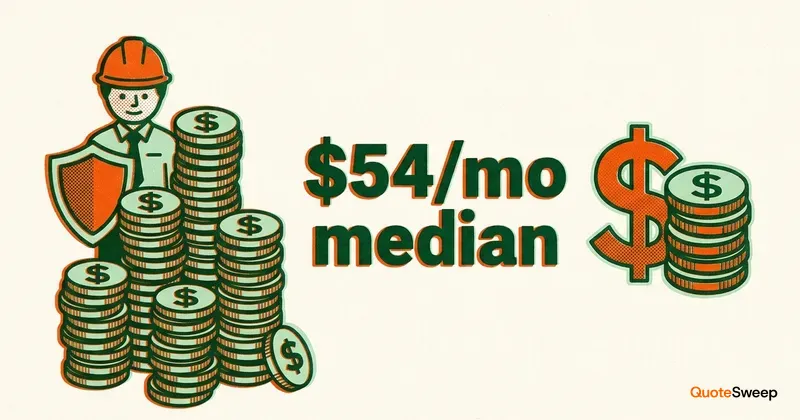
Workers' compensation insurance — often just called workers' comp — costs a small business about $54 per month, or roughly $643 per year, according to Insureon's analysis of the median policy sold through its platform. Measured differently, NerdWallet cites a broader "about $81/month" figure, and MoneyGeek models roughly $113 per month per employee as a benchmark across 408 industries and 46+ states — explicitly labeled "a benchmark, not a quote." These numbers measure different things, so they should not be conflated.
This is an independent guide from QuoteSweep, which maps the modern commercial insurance landscape. It breaks down what workers' comp actually costs in 2026, what drives the price up or down, and the concrete steps that lower your premium.
TL;DR: Workers' comp for a small business runs about $54/month (~$643/year) as Insureon's median policy, with most businesses paying ~$300 to over $5,000 per year (Insureon). MoneyGeek benchmarks about $113/month (~$1,354/year) per employee as a modeled figure. Premiums are priced per $100 of payroll by job-risk class code, so the number swings 10x+ — from about $0.08 per $100 for clerical staff to ~$2.82 per $100 for pest-control work in Georgia (NerdWallet, citing Coverdash). Your class code, payroll, headcount, state, and claims history set the price.
Compare business insurance options
How much does it cost?
The typical small business pays about $54 per month — roughly $643 per year — for workers' comp, per Insureon's data on the median policy sold through its platform. Two other reference points frame the range: NerdWallet cites a broader "about $81/month" figure, while MoneyGeek models roughly $113 per month, or about $1,354 per year, per employee as a benchmark — not an actual quote.
Those averages sit inside a wide range. Most small businesses pay ~$300 to over $5,000 per year, per Insureon. Modeled per-employee costs span an even wider $16 to $343 per month depending on profile (MoneyGeek).
The distribution skews low. Per Insureon, 47% of its customers pay under $50/month and another 24% pay $50–$100/month — so nearly three-quarters pay $100/month or less. Headcount moves the number: Insureon shows about $62/month for 3–5 employees rising to about $160/month for 10+ employees.
The reason any single "typical" number is only a loose midpoint is that workers' comp is priced per $100 of payroll, and the rate varies wildly by job risk. NerdWallet (citing Coverdash) puts clerical staff at roughly $0.08 per $100 of payroll versus about $2.82 per $100 for pest-control work in Georgia — more than a 30x spread on rate alone.
| Reference point | Figure | Source |
|---|---|---|
| Insureon median policy | Insureon | |
| Broader small-business average | ~$81/mo | NerdWallet |
| Per-employee benchmark (modeled) | MoneyGeek | |
| 3–5 employees | ~$62/mo | Insureon |
| 10+ employees | ~$160/mo | Insureon |
| Clerical vs. pest-control rate | ~$0.08 vs. ~$2.82 per $100 payroll | NerdWallet / Coverdash |
Why the headline numbers differ: Insureon's $54/month ($643/year) is the median cost of policies actually sold through its platform to small businesses. MoneyGeek's $113/month ($1,354/year) is a modeled per-employee benchmark across 408 industries and 46+ states, explicitly labeled "a benchmark, not a quote." They are measuring different things, so a gap between them is methodology, not a contradiction.
What drives the cost
Workers' comp premiums are set by a handful of factors, and the first one dwarfs the rest:
- Industry / class code risk — the single biggest driver. Low-risk clerical work can run about $0.08 per $100 of payroll while high-risk trades run several dollars per $100, and median annual premiums range from about $1,200 for department stores to $12,000+ for roofing (NerdWallet, citing Coverdash).
- Total annual payroll. Premium is calculated as a rate applied per $100 of payroll, so higher payroll means a higher premium (Insureon).
- Number of employees. More workers means more exposure — Insureon shows about $62/month at 3–5 employees rising to about $160/month at 10+ (Insureon).
- State. Mandated benefits and rates vary sharply. Insureon monthly averages run from a low of $34 (Texas) to $127 (Alabama), and NerdWallet notes NJ, PA and WI sit roughly 175–180% above the median.
- Claims history / experience modification rate (EMR). Past injury claims raise or lower the premium multiplier (NerdWallet).
- Employee wages and job duties. Higher wages mean larger potential lost-wage payouts, and risky duties like driving to job sites add exposure (Insureon).
- Policy limits selected. Higher limits cost more.
How to lower your premium
Workers' comp rewards operational discipline — a safer workplace and correct paperwork directly lower your price. The highest-leverage moves:
- Build a documented workplace safety program to reduce injury claims and improve your experience modification rate (NerdWallet).
- Verify employees are in the correct payroll classification / class codes — misclassifying a worker into a higher-risk code inflates premium (NerdWallet).
- Run a return-to-work program to get injured employees back quickly and hold down claim costs (NerdWallet).
- Use pay-as-you-go / pay-as-you-report billing tied to actual payroll instead of a large upfront estimate (NerdWallet). For more on this, see our guide to pay-as-you-go workers' comp.
- Shop and compare quotes from multiple carriers, since rates for the same class code vary by insurer and state (NerdWallet; MoneyGeek).
- Maintain a clean claims history to keep your experience mod below 1.0.
Affordable options
Several insurtechs specialize in small-business workers' comp and pair coverage with pay-as-you-go billing and active safety tooling — which can hold premiums down over time. Each of these is profiled independently on QuoteSweep, and you can compare them all on the workers-comp hub.
Pie Insurance — a workers' comp specialist that uses data to price small-business risk, targeting lower-hazard classes that are often overpriced by traditional carriers.
Cerity — offers direct-to-business workers' comp with instant online quotes, built for small businesses that want to bind coverage quickly.
Hourly — combines workers' comp with payroll, so premiums are calculated on real-time payroll data rather than an annual estimate — a natural fit for pay-as-you-go billing.
biBERK — a Berkshire Hathaway direct writer that targets small businesses with simple risk profiles, often competitive for straightforward workers' comp accounts.
Frequently Asked Questions
How much does workers' comp cost per month for a small business?
About $54 per month for the median policy sold through Insureon (Insureon). NerdWallet cites a broader "about $81/month" figure, and MoneyGeek models roughly $113/month per employee as a benchmark. Most small businesses pay less — 47% of Insureon's customers pay under $50/month.
Why do the average prices I see vary so much?
Because the sources measure different things. Insureon's $54/month is the median policy actually sold on its platform, while MoneyGeek's $113/month is a modeled per-employee benchmark across 408 industries and 46+ states — "a benchmark, not a quote." On top of that, workers' comp is priced per $100 of payroll by job-risk class code, so the real cost swings more than tenfold between clerical work and high-hazard trades.
What makes workers' comp more expensive?
The single biggest driver is your industry / class code — clerical work runs about $0.08 per $100 of payroll while high-risk trades run several dollars per $100, so median annual premiums range from about $1,200 for department stores to $12,000+ for roofing (NerdWallet, citing Coverdash). Total payroll, headcount, your state, and your claims history (experience mod) round out the price.
What's the fastest way to lower my workers' comp premium?
Build a documented safety program, make sure every employee is in the correct class code, and run a return-to-work program to keep claim costs down (NerdWallet). Switching to pay-as-you-go billing tied to actual payroll and shopping multiple carriers for the same class code also help (NerdWallet; MoneyGeek).
The bottom line
Workers' comp for a small business runs about $54/month (~$643/year) as Insureon's median policy, with most businesses paying ~$300 to over $5,000 per year (Insureon); MoneyGeek benchmarks about $113/month (~$1,354/year) per employee as a modeled figure. Because the coverage is priced per $100 of payroll by job-risk class code, your class code is by far the biggest lever — from about $0.08 per $100 for clerical staff to ~$2.82 per $100 for pest-control work in Georgia (NerdWallet, citing Coverdash). Get your class codes right, tighten workplace safety to hold your experience mod below 1.0, move to pay-as-you-go billing, and compare specialist carriers on the workers-comp hub before you buy.
A note on confidence: this guide is well-sourced, but the two headline framings measure different things and should not be conflated. Insureon's $54/month ($643/year) is the median cost of policies actually sold through its platform; MoneyGeek's $113/month ($1,354/year) is a modeled per-employee benchmark, explicitly labeled "a benchmark, not a quote." NerdWallet's per-industry medians are attributed to Coverdash 2026 data. A ~$1.03 per $100 of payroll national-average rate that surfaces in search is weakly sourced (no primary NCCI citation found) and is deliberately omitted here. Because workers' comp is priced per $100 of payroll by job-risk class code, any single "typical" number is only a loose midpoint — actual cost swings 10x+ between clerical and high-hazard trades. Every figure above is attributed to its source.