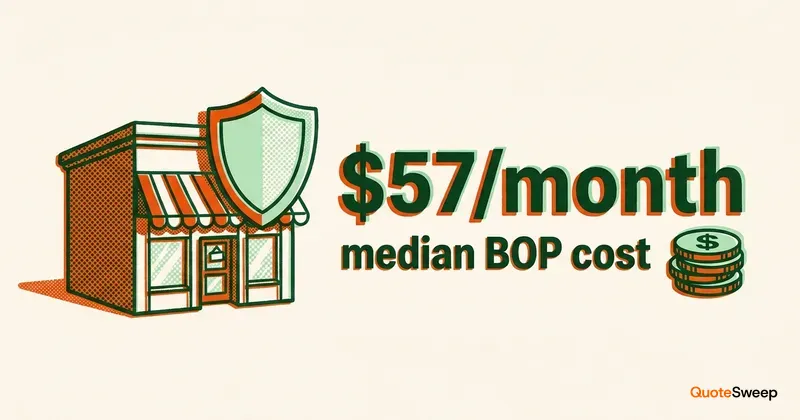
Insureon's small-business customers pay a median of $83 a month for a business owner's policy (BOP), about $996 a year (Insureon, updated 17 April 2026). Annual premiums run from around $400 to over $6,000. Progressive Commercial's new BOP customers paid a median of $80 a month in 2025 (Progressive), so two large data sets land within $3 of each other.
That middle figure hides a wide spread. A consultant pays a median of $61 a month for a BOP; a full-service restaurant pays $337 (Insureon). Your industry is the biggest factor, then your state, the property you insure, your limits and deductible, and your claims history. Industry and state tables follow, and if your business is a restaurant, bar or trade, use those rather than the $83 headline.
The quickest way past the averages is a real quote. Tell a licensed broker what you do and where you are, and see what carriers will charge your business, or compare business insurance quotes across coverage types.
Compare business insurance options
Average cost of a business owners policy: published figures compared
An online broker and two insurers publish BOP prices from their own customers. They measure different groups in different ways, so read the label before comparing.
Dates for this table: Insureon and The Hartford were re-read on 10 November 2026 (Insureon's page is dated 17 April 2026, Hartford's 20 May 2026). Progressive Commercial's page blocks automated access, so its figures are carried from our 7 November 2026 reading and were not re-read on 10 November.
| Source | Figure | What it measures |
|---|---|---|
| Insureon | $83 a month | Median premium paid by Insureon's small-business customers, mostly very small firms (100,000 customers in its data) |
| Progressive Commercial | $80 a month | Median premium, new Progressive Commercial BOP customers, 2025 |
| Progressive Commercial | $127 a month ($1,524 a year) | Average premium, the same customers |
| The Hartford | $1,687 a year (about $141 a month) and $1,019 a year (about $85 a month) | Average premium, Hartford customers. Both figures are on the same Hartford page (the first as the headline, the second in its FAQ), and the page gives no sample size, period or explanation for the difference |
Insureon calls its $83 an average in its headline, but its method note says the figures are the median cost of policies its customers bought. A median is the middle policy: half pay less, half pay more. An average gets pulled up by a minority of expensive policies, which is why Progressive's average is $47 a month higher than its median. For most small businesses, the median is the better guide.
Insureon also publishes the spread: 25% of its customers pay less than $50 a month for a BOP and another 33% pay between $50 and $100.
Progressive's page gives no breakdown by industry or state. Insureon's page lists the $83 figure as an "average" in its text while its method note says the figures are medians that exclude outlier high and low premiums.
BOP cost by industry
Industry sets the base rate, so it moves a BOP price more than anything else. These are median BOP premiums for Insureon's customers in each industry, re-read from Insureon's class cost pages on 10 November 2026. Insureon dates its own class pages individually: the hair salon, barbershop, massage therapist and auto repair pages are dated March and April 2025, and the rest between February and November 2026. Each row links to our full cost guide for that business.
| Business | BOP median per month | BOP median per year |
|---|---|---|
| Photographer | $47 | $570 |
| Marketing / advertising agency | $51 | $617 |
| Consultant | $61 | $732 |
| Barbershop | $68 | $817 |
| Hair salon | $70 | $841 |
| Janitorial / cleaning business | $77 | $919 |
| House cleaner | $79 | $945 |
| Massage therapist | $82 | $979 |
| Landscaper | $92 | $1,101 |
| Electrician | $100 | $1,198 |
| Handyman | $105 | $1,266 |
| Painter | $109 | $1,313 |
| Florist | $111 | $1,332 |
| General contractor | $125 | $1,503 |
| Coffee shop / café | $126 | $1,507 |
| HVAC contractor | $139 | $1,664 |
| Auto repair shop | $149 | $1,787 |
| Plumber | $213 | $2,559 |
| Fast food restaurant | $277 | $3,328 |
| Restaurant (full service) | $337 | $4,045 |
| Bar / tavern | $346 | $4,148 |
Insureon calls these averages; its method note says they are medians of its customers' policies, most of which are businesses with fewer than five employees. A bigger business with more property and revenue will pay more. Not every Insureon class page gives a BOP figure; the roofing page, for example, doesn't. Insureon's general BOP page quotes $55 a month for consultants, while its consulting page gives $61; the table uses the class page.
BOP cost by state
Location is the second-biggest lever. Insureon's median monthly BOP premiums in the ten states it lists, from its BOP cost page (page dated 17 April 2026, re-read 10 November 2026):
| State | BOP median per month |
|---|---|
| Virginia | $70 |
| Maryland | $71 |
| California | $79 |
| Pennsylvania | $79 |
| Colorado | $84 |
| Georgia | $84 |
| New York | $97 |
| Texas | $97 |
| New Jersey | $102 |
| Florida | $105 |
Florida's figure is $35 a month above Virginia's for the same kind of policy. Weather risk, lawsuit costs and property values all play a part, and these state figures mix every industry together, so a Florida consultant can still pay less than a Virginia restaurant.
How much does a $2 million BOP cost?
The Hartford says its customers pay an average of $1,434 a year, about $120 a month, for a $2 million policy (The Hartford). Most buyers don't go that high: 79% of Insureon's customers choose $1 million per occurrence and $2 million aggregate, and 18% choose $2 million and $4 million, the next most common choice (Insureon).
Buy the higher limit when a lease or client contract requires it. If you need much more liability cover than your BOP offers, a commercial umbrella policy on top is usually the way to add it.
What drives the cost of a BOP
Five things set most of the price.
Your industry. The class of business sets the base rate, because it reflects how often that kind of business has claims and how big they are. That is why a consultant and a restaurant with the same revenue pay such different premiums.
Your location. State rules, lawsuit costs and weather risk all differ. Within a state, a building in a hurricane or wildfire zone costs more to insure than the same building inland.
The property you insure. A BOP's property section is priced on what it would cost to replace your building (if you own it), equipment, furniture and stock. Progressive gives the obvious example: insuring $1 million of property costs more than insuring $500,000. The building itself matters too:
- Owning the building means insuring the structure; a tenant insures only contents and the improvements they made.
- Masonry and fire-resistive construction cost less to insure than wood frame.
- Older wiring, plumbing and roofs raise the price.
- Sprinklers and a nearby fire station lower it.
Limits and deductible. Higher liability limits cost more and a higher deductible costs less. Insureon reports that 79% of its customers choose $1 million per occurrence and $2 million aggregate, and that the average deductible is $500.
Size and claims history. More employees, revenue and foot traffic mean more exposure, and recent claims push the rate up.
Insurer starting prices vs what customers pay
Online insurers advertise low starting prices. They are real, but they describe the cheapest risks, not a typical buyer.
Dates for this table: NEXT's page was re-read on 10 November 2026. Hiscox and biBERK block automated access, so their figures are carried from our 10 October 2026 reading and were not re-read.
| Insurer | Published BOP price | What it describes |
|---|---|---|
| NEXT | "As little as $25/month" | NEXT's floor price "for some low-risk businesses". Its footnote says starting prices are not guaranteed and reflect existing premiums on active policies as of 1 April 2026 |
| Hiscox | $41.67/month | An illustrative quote for an IT consultant in California with $35,000 of equipment |
| Hiscox | $63.50/month | An illustrative quote for a business consultant in Massachusetts with $10,000 of property |
| biBERK | From about $500/year; "most people pay less than $2,000" | biBERK's own customer range |
If you run a low-risk office or consultancy, these are worth pricing. Restaurants, auto shops and contractors should expect quotes nearer the industry figures above.
Read our profiles of NEXT and biBERK before you buy.
Is a BOP cheaper than buying policies separately?
Usually, yes. The Texas Department of Insurance says combined policies like a BOP are usually cheaper than buying the coverages separately (re-read 10 November 2026). Hiscox says combining its policies saves up to 5% (its page, read 10 October 2026; not re-read because the site blocks automated access). We found no current source for the "15–25% savings" figure that circulates online, so treat it with caution and compare a BOP quote against a general liability quote plus a property quote yourself. Our guides to general liability insurance cost and commercial property insurance cost give the separate prices.
What your BOP premium buys (and what it doesn't)
A business owner's policy (BOP) includes three things:
- Property cover for your building if you own it, plus equipment, furniture, stock and improvements to a rented space.
- General liability for injury or damage you cause to other people, usually at $1 million per occurrence and $2 million aggregate.
- Business income that replaces lost income and pays ongoing bills such as rent and payroll while a covered loss keeps you closed. The glossary explains how business interruption insurance pays and how long it lasts.
It does not cover company vehicles, injuries to your employees, professional mistakes, customer or employee data, or other people's property in your care, according to Hiscox and Insureon. Property away from your main location, such as tools on a job site, needs inland marine cover. Each gap needs its own policy, so price them alongside the BOP: workers' comp, commercial auto, professional liability, cyber and, for larger limits, an umbrella.
Do you qualify for a BOP?
Only if you fit the insurer's size and class rules. Under ISO's standard rules, which many insurers start from, most eligible businesses can be up to 35,000 square feet and $6 million in annual sales per location, and small contractors and restaurants can qualify within tighter limits. Insurers add their own rules on employees and revenue, and they differ. The BOP guide lists ISO's limits and three insurers' published rules.
QuoteSweep carrier records: how many list a BOP, by class (March 2026)
QuoteSweep's own count, from carrier-guide records last checked 4 to 10 March 2026. It was not re-run on 10 November 2026.
Each record is one carrier's own guide or website page for a class in QuoteSweep's appetite database; Insureon is excluded because it is a broker. "List a BOP" means the page names a BOP among the lines the carrier offers for that class. A missing BOP means we did not see one on that page, not that the carrier refuses it. You can look up a specific carrier, class and state on the appetite checker, which uses the same records.
| Class | Records | List a BOP |
|---|---|---|
| Professional services | 20 | 17 |
| Restaurants | 22 | 17 |
| Retail stores | 19 | 16 |
| Technology companies | 21 | 15 |
| Real estate | 14 | 11 |
| General contractors | 25 | 8 |
| Wholesale distribution | 9 | 3 |
| Manufacturing | 19 | 3 |
| Trucking | 8 | 0 |
Office-type businesses, restaurants and retailers have the most BOP options. Contractors have fewer, manufacturers and wholesalers very few, and trucking none in these records, which is consistent with the point above: if you are outside the classes insurers package, price separate policies. The Insureon contractor medians in the industry table above describe businesses that did find a BOP.
You are likely outgrowing a BOP when you open more locations, when your property values climb past what the insurer will cover in a package, or when you need specialist coverage the BOP can't take. The next step is usually separate policies or a commercial package policy, built for larger or more complex businesses.
How to lower your BOP premium
- Raise your deductible if you can absorb a small loss without claiming.
- Set limits to what your lease and contracts require, and add an umbrella only if you need more.
- Insure property at its real replacement cost. Underinsuring saves a little premium and can cut your claim payment.
- Keep claims small and rare. Pay minor losses yourself where it makes sense; a clean history keeps your rate down.
- Get several quotes. Insurers price the same business differently, and a broker can tell you which carriers write your class.
Is $300 a month a lot for a BOP?
For a consultant, photographer, salon or massage therapist, yes. Insureon's medians for those businesses are $47 to $82 a month, and 58% of Insureon's BOP customers pay $100 a month or less. For a restaurant, bar or plumbing business, $300 is close to normal: Insureon's medians are $337 for full-service restaurants, $346 for bars, $277 for fast food and $213 for plumbers. If your quote is far above your industry's median, ask what is driving it (property values, limits, location or claims) and get a second quote.
Frequently Asked Questions
How much does a BOP cost per month?
Insureon's small-business customers pay a median of $83 a month for a BOP, and Progressive Commercial's new customers paid a median of $80 a month in 2025. Your industry moves the figure most: Insureon's medians run from $47 a month for photographers to $346 for bars.
How much does a BOP cost per year?
About $996 a year at Insureon's $83 monthly median, with annual premiums from around $400 to over $6,000. Progressive Commercial's average new BOP customer paid $1,524 a year in 2025, and The Hartford publishes two different customer averages, $1,019 and $1,687 a year.
Why is my BOP so expensive?
Your industry is the usual reason: restaurants, bars and some trades pay several times what offices and consultants pay. After that come your state, the value of the property you insure, your limits and deductible, and your claims history.
Is a BOP cheaper than general liability and property separately?
Usually. The Texas Department of Insurance says package policies are usually cheaper than buying the coverages separately. The size of the saving depends on the insurer, so compare a BOP quote with separate quotes.
Can I get a BOP with no employees?
Yes. A BOP doesn't require employees. Sole proprietors with a shop, studio or equipment buy BOPs to cover their property and liability. Workers' comp is not part of a BOP, so having no staff doesn't change what the BOP covers.
Do all businesses need a BOP?
No. Most businesses need the coverages inside a BOP, general liability and property, but a freelancer working from home with little equipment may only need general liability. Businesses that are too large or too hazardous for a BOP buy the same coverages as separate policies or in a commercial package policy.
Last verified
Re-read on 10 November 2026: Insureon's BOP cost page (the $83 median, 25% and 33% spread, 79% and 18% limit shares, $500 average deductible and the ten-state table) and its 21 class cost pages (three BOP figures changed: florists, marketing agencies and landscapers); The Hartford's BOP cost page ($1,687, $1,019 and the $1,434 $2 million figure); NEXT's BOP page; and the Texas Department of Insurance consumer guide line that combined policies are usually cheaper. Not re-read because the sites block automated access: Progressive Commercial's page (figures carried from 7 November 2026), and the Hiscox and biBERK pages (carried from 10 October 2026). QuoteSweep carrier-record counts are from March 2026.
Get BOP quotes
Have your revenue, payroll, square footage, the replacement value of your equipment and stock, and your claims history ready, then compare business insurance quotes. Ask for a BOP and a general-liability-only price side by side so you can see what the property and business income cover is costing you.