Renewal Season Survival Guide: How to Re-Market 60 Accounts Without Losing Your Mind
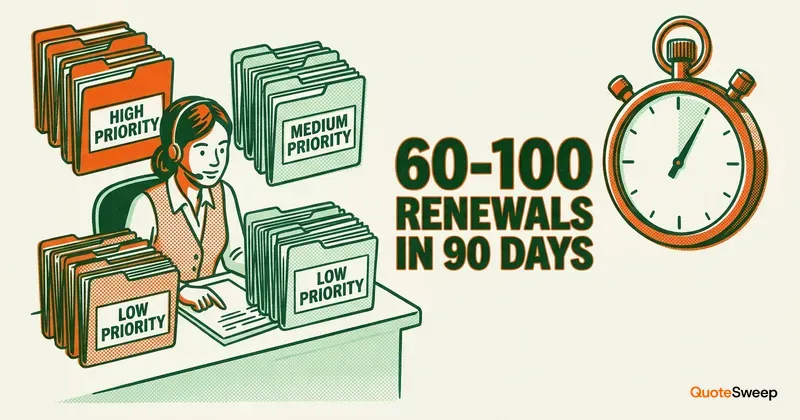
Insurance renewal season remarketing is the most demanding period in any commercial lines agency. Between January and April, a CSR at a mid-size independent agency will see 60 to 100 renewals land on their desk. Each one needs attention – reviewing terms, checking for rate increases, deciding whether to shop the market, submitting to carriers, comparing quotes, and binding the result. Manually remarketing a single account across five to eight carriers takes 60 to 90 minutes – multiply that by 60 accounts and you're looking at 60 to 90 hours of pure quoting work on top of your normal service load.
You cannot remarket all of them manually. Nobody can. The question isn't whether to remarket everything – it's which accounts to remarket, in what order, and how to do it without creating E&O exposure on the ones you don't shop.
TLDR: Renewal season requires a triage system. Divide accounts into three tiers – actively remarket, selectively shop, and renew in place – using rate increase percentage, account size, retention risk, and market conditions as criteria. Follow a 90-60-30 day timeline for each renewal. Document every remarketing decision, including the ones where you chose not to shop. And if you're still entering client data into carrier portals one at a time, a multi-carrier quoting tool is the single highest-impact investment you can make for renewal season.
The Reality of Renewal Season
Renewal season isn't evenly distributed across the year. Commercial policies cluster around January 1, April 1, July 1, and October 1 effective dates, with January being the heaviest for most agencies. An agency with 400 commercial accounts might have 120 of them renewing in Q1 alone.
For a CSR or account manager handling a book of business of 200 accounts, that means 50 to 60 renewals in a single quarter – roughly five per week, every week, for 12 weeks straight. That's five accounts per week that need renewal review, possible remarketing, client communication, and binding – on top of certificates, endorsements, claims, and new business.
Why Most Renewals Go Unmarketed
Our companion piece on remarketing commercial insurance renewals covers the math in detail: industry observers estimate that the majority of commercial renewals auto-renew without being shopped. The reason is time. When you can only remarket 3 to 5 accounts per day manually, and you have 60 accounts hitting in 90 days, the math forces you to pick and choose.
The problem is that picking and choosing based on gut feeling – rather than a systematic framework – means you'll miss accounts that should have been shopped and waste time on accounts that didn't need it.
The Hard Market Makes It Worse – and More Important
According to the 2025 Independent Agent Survey, 86% of agents report carrier availability challenges. Carriers are tightening appetite, non-renewing certain classes, and pushing rate increases of 10% to 25% across many lines. This means three things for renewal season:
Remarketing takes longer. When carriers are selective about what they'll write, you may need to submit to more carriers to find competitive alternatives. An account that previously would have gotten quotes from six of eight carriers might only get two or three responses.
Remarketing is more important. Clients facing 15% to 20% rate increases want to know their agent shopped the market. If your answer is "we just renewed with the current carrier," you're handing that client a reason to call another agent. Rising premiums are the number one driver of client churn, and proactive remarketing is the defense against it.
Documentation matters more. When a client's renewal premium jumps and you didn't shop the market, you need a documented reason why. "We were too busy" is not an E&O defense.
The Triage Framework: Which Accounts to Remarket
Not every renewal needs to be remarketed, and trying to remarket them all without automation is a recipe for burnout and errors. The triage framework sorts renewals into three tiers based on objective criteria.
Tier 1: Actively Remarket (Top 20-30%)
These accounts get full remarketing – submission to your entire carrier panel, side-by-side quote comparison, and a formal presentation to the client.
Criteria for Tier 1:
| Factor | Threshold |
|---|---|
| Rate increase | 10% or higher on any line |
| Premium size | Top 25% of your book by premium |
| Retention risk | Client has expressed dissatisfaction or shopped on their own |
| Time since last remarketing | 3+ years with the same carrier |
| Carrier appetite shift | Current carrier has tightened appetite for the class or state |
| Claims activity | 2+ claims in the past 3 years affecting loss ratio |
If an account hits two or more of these criteria, it goes to Tier 1. These are the accounts where remarketing has the highest probability of finding a better result and where the retention risk is highest if you don't shop.
Tier 2: Selective Shopping (Middle 30-40%)
These accounts get a targeted market check – you submit to two or three carriers most likely to be competitive, rather than your full panel.
Criteria for Tier 2:
- Rate increase between 5% and 10%
- Mid-size accounts (middle 50% of book by premium)
- No specific client complaints, but no recent remarketing either
- Current carrier's pricing has been creeping up 3% to 5% annually for multiple years
The goal with Tier 2 is a quick sanity check. You're not doing a full market sweep – you're checking whether the current carrier is still in the ballpark. If one of your two or three spot-check carriers comes back significantly lower, you escalate to a full remarketing.
Tier 3: Renew in Place With Documentation (Bottom 30-40%)
These accounts renew with the current carrier. But – and this is critical – you document why you didn't remarket.
Criteria for Tier 3:
- Rate increase at or below 5% (or flat)
- Small accounts where the commission doesn't justify the time
- Client has expressed satisfaction with current carrier
- Account was remarketed within the past 18 months
- Current carrier is the only viable market for the class (hard-to-place risk)
Documentation for Tier 3 accounts should go in the client file and include:
- The renewal premium and percentage change from expiring
- The reason remarketing was not conducted
- A note that the client was informed of the renewal terms
- Any coverage changes in the renewal (endorsements added/removed, limit changes, deductible changes)
This documentation is your E&O protection. If a client later says "my agent never shopped my renewal," you have a dated file note explaining the decision.
The 90-60-30 Day Timeline
Every renewal needs a timeline, regardless of which tier it falls into. Missing a renewal date because you started too late is both an E&O risk and a client relationship disaster.
90 Days Out: Identify and Triage
Pull your renewal report. Run a report from your agency management system showing all renewals coming up in the next 90 days. Most AMS platforms can generate this automatically on a recurring schedule.
Apply the triage framework. Sort each renewal into Tier 1, 2, or 3 using the criteria above. Flag the Tier 1 accounts – these need immediate attention.
Request loss runs and renewal terms. For Tier 1 and Tier 2 accounts, request loss runs from the current carrier. Some carriers provide renewal terms 90 days out; others wait until 60 days. If the renewal terms aren't available yet, set a follow-up reminder.
Contact Tier 1 clients. Reach out to your highest-priority clients proactively: "Your renewal is coming up in 90 days. I'm going to be reviewing your account and shopping the market. Can we schedule a quick call to go over any changes to your business?"
This client touchpoint is worth its weight in gold. It tells the client you're working for them before they have to ask.
60 Days Out: Submit and Quote
Review renewal terms. By now, the current carrier should have issued renewal terms for most accounts. Compare the renewal premium to the expiring premium and note any coverage changes.
Submit Tier 1 accounts to the market. This is where the bulk of the remarketing work happens. For each Tier 1 account, submit to your full carrier panel. If you're using a comparative rater, this means entering the account data once and hitting submit. If you're doing it manually, this means logging into each carrier portal individually and entering the same data five to eight times.
Spot-check Tier 2 accounts. Submit to your two or three target carriers. If the results are compelling, escalate to full remarketing. If not, note the results in the file and prepare to renew in place.
Document Tier 3 decisions. Add file notes for every Tier 3 account documenting the renewal terms and your decision not to remarket.
30 Days Out: Present, Decide, Bind
Present remarketing results. For Tier 1 accounts (and any escalated Tier 2 accounts), prepare a comparison showing the current renewal versus alternative quotes. Include premium, coverage differences, carrier ratings, and your recommendation.
Client communication. Schedule calls or meetings with clients to review the options. Some agents send the comparison by email; others insist on a phone call. Either works, but the client's decision must be documented. If the client chooses to stay with the current carrier despite a lower alternative, note that in the file.
Bind coverage. Once the client has made their decision, bind with the selected carrier. Confirm binding in writing within 24 hours.
Handle stragglers. Any account that hasn't been addressed by 30 days out needs immediate attention. This is your safety net – nothing should reach the renewal date without a decision.
Carrier Submission Efficiency
For Tier 1 accounts, carrier submissions are the biggest time sink. Here's how to reduce the pain.
Batch by Carrier, Not by Account
Instead of completing one account across all carriers before moving to the next, batch your submissions by carrier. Log into Carrier A's portal, submit all five Tier 1 accounts that fit their appetite, then move to Carrier B.
This approach has two advantages. First, you stay in one portal interface, which is faster than context-switching between portals. Second, you can often reuse portions of submissions within the same portal session.
Use ACORD Forms as Your Source of Truth
Complete the ACORD 125 (Commercial Insurance Application) once per account. This becomes your single source of data. Every carrier portal asks for the same core information – entity type, operations description, revenue, employee count, claims history – and the ACORD 125 captures all of it.
When you're entering data into carrier portals manually, having the completed ACORD form open as a reference prevents errors. When you're using a multi-carrier quoting tool, the ACORD data feeds directly into all submissions.
Know Your Carrier Appetites Before You Submit
One of the biggest time wasters in renewal season is submitting to carriers that won't write the risk. According to the same Independent Agent Survey, 71% of agents report struggling to understand carrier appetites. Submitting a roofing contractor to a carrier that stopped writing artisan contractors two years ago wastes 15 to 20 minutes of data entry and produces nothing.
Before submitting, check: Does this carrier have appetite for this class code in this state at this premium level? Your carrier panel knowledge – or an appetite guide if your carriers provide one – should be the first filter.
Template Your Narratives
Many carrier portals ask for a description of operations, risk management practices, or loss explanations. Write these once per account and save them. You'll paste the same narrative into every portal, slightly adjusted for any carrier-specific questions.
E&O Documentation: Protecting Yourself During Renewal Season
Renewal season is peak E&O exposure time. You're making dozens of decisions – what to remarket, what to renew, which carriers to submit to, which quote to recommend – and every decision is a potential claim if something goes wrong later.
The overarching principle: document every remarketing decision, including the decisions not to remarket. Our comprehensive guide on E&O risk reduction for insurance agents covers the full documentation framework. Here's how it applies specifically to renewal season.
What to Document for Remarketed Accounts
For every account you actively remarket, your file should contain:
- Date remarketing was initiated and carriers submitted to
- Quotes received with premium, coverage terms, and carrier AM Best ratings
- Comparison to renewal terms – a side-by-side showing what changed
- Your recommendation and the reasoning behind it
- Client's decision – which option they chose and why
- Binding confirmation with effective date and policy number
- Any coverage differences between the expiring and new policy, documented and communicated to the client
What to Document for Non-Remarketed Accounts
For every account you chose not to remarket (Tier 3), the file should contain:
- Renewal terms – premium, coverage, any changes from expiring
- Reason for not remarketing – flat renewal, recent remarketing, limited market availability, client satisfaction
- Client notification – confirmation that the client was informed of the renewal terms
- Coverage change review – any changes in the renewal policy compared to expiring, and client acknowledgment
The Declination Letter
When a client declines your recommendation to move to a different carrier – or declines recommended coverage during the renewal review – get it in writing. A signed declination, or at minimum an email acknowledgment, is often the deciding factor in whether an agency wins or loses an E&O dispute. This is especially important during hard market renewals where coverage terms may be materially different from the expiring policy.
Rate Increase Conversations
One of the most uncomfortable parts of renewal season is telling clients their premium is going up. In a hard market, this conversation happens on the majority of renewals.
Script 1: You Remarketed and Found Something Better
"I've completed a full market review of your account. Your renewal with [Current Carrier] came in at $X, which is a [Y]% increase. I submitted to [number] carriers and found a competitive alternative from [New Carrier], rated [AM Best Rating], at $X – a savings of $X. The coverage is comparable with [note any differences]. I'd recommend moving to the new carrier. Here's the side-by-side comparison."
This is the easy conversation. You're delivering good news and demonstrating that you worked for the client.
Script 2: You Remarketed and the Current Carrier Is Still the Best Option
"I've shopped your renewal across [number] carriers. Your renewal with [Current Carrier] came in at $X, which is a [Y]% increase. I wanted to see if we could do better. After reviewing quotes from [list carriers], your current carrier remains the most competitive option for your risk profile. The rate increase is consistent with what we're seeing across the market for [class/industry]. Here's a summary of the alternatives I reviewed."
This conversation is harder, but the remarketing effort itself builds trust. The client knows you didn't just accept the increase – you checked.
Script 3: You Didn't Remarket (Tier 3 Account)
"Your renewal with [Current Carrier] came in at $X, which is [flat / a Y% increase]. Given the modest change and the strong performance of the policy, I'm recommending we renew in place. I've reviewed the coverage terms and there are [no changes / the following changes: list them]. If you'd like me to shop the market for alternatives, I'm happy to do that – just let me know."
The key phrase is "if you'd like me to shop the market." Offering the client the option demonstrates service while being honest about the approach. And if the client says "yes, please shop it," you move the account to Tier 1.
How Technology Changes the Equation
Everything above assumes you're manually entering data into carrier portals one at a time. That's the reality for most agencies today, and the triage framework exists because of that constraint. But the constraint itself is worth questioning.
The Manual Remarketing Timeline
Without automation, here's how the math works for a Tier 1 account:
| Task | Time |
|---|---|
| Pull renewal terms and loss runs | 10-15 min |
| Complete/update ACORD 125 | 15-20 min |
| Enter data into Carrier Portal 1 | 10-15 min |
| Enter data into Carrier Portal 2 | 10-15 min |
| Enter data into Carrier Portal 3 | 10-15 min |
| Enter data into Carrier Portal 4 | 10-15 min |
| Enter data into Carrier Portal 5 | 10-15 min |
| Compare quotes and prepare presentation | 15-20 min |
| Total | 80-120 min |
At 80 to 120 minutes per account, remarketing 20 Tier 1 accounts takes 26 to 40 hours. That's nearly a full work week dedicated to quoting alone.
The Multi-Carrier Quoting Timeline
A multi-carrier quoting tool submits to all carriers from a single data entry. The timeline changes dramatically:
| Task | Time |
|---|---|
| Pull renewal terms and loss runs | 10-15 min |
| Enter data once into the quoting tool | 5-8 min |
| Review quotes returned from all carriers | 5-10 min |
| Prepare comparison and presentation | 5-10 min |
| Total | 25-43 min |
That's a 60% to 70% time reduction per account. More importantly, it changes the triage math. When remarketing takes 30 minutes instead of 100 minutes, you can remarket 40 accounts in the same time it would have taken to manually remarket 15.
This doesn't eliminate the need for triage – you still need to prioritize your time – but it shifts the tiers. Accounts that would have been Tier 3 (renew in place) under the manual workflow can become Tier 2 or even Tier 1 when the time investment drops by two-thirds. For a deeper look at the technology options, see our insurance agent tech stack guide for 2026.
What Changes When You Can Remarket Everything
When remarketing time drops below 30 minutes per account, several things happen:
Retention improves. Every client gets a proactive market check. No client can say "my agent didn't shop my renewal" because every client gets shopped.
You find savings you didn't expect. Tier 3 accounts – the ones you would have renewed in place – sometimes produce the biggest surprises. A policy that's been with the same carrier for five years at modest annual increases may be 20% above what a new carrier would charge.
E&O documentation becomes easier. When you remarket every account, your documentation is simple: here are the quotes, here's the comparison, here's what the client chose. No need to explain why you didn't shop.
Client conversations improve. Whether you found a better option or confirmed the current carrier is competitive, you have data to share. Data-driven renewal conversations build trust in a way that "we renewed your policy" never does.
Common Renewal Season Mistakes
After working with agencies through multiple renewal cycles, these are the mistakes we see most often:
Starting too late. Agencies that begin remarketing at 30 days out instead of 90 days out find themselves rushing submissions, missing carrier response deadlines, and binding coverage without proper comparison. The 90-day timeline exists for a reason.
Remarketing without updating client data. Submitting last year's revenue figures or employee counts produces quotes that won't hold at binding. Always verify current data with the client before submitting. A quick email – "Before I shop your renewal, can you confirm your current revenue, employee count, and any changes to your operations?" – takes two minutes and prevents wasted effort.
Not documenting Tier 3 decisions. Skipping documentation on accounts you didn't remarket is the single biggest E&O risk during renewal season. If the client has a claim on an unmarketed renewal and discovers their premium was above market, the first question their attorney will ask is "why didn't the agent shop the market?"
Ignoring coverage changes in renewals. A renewal isn't just a premium number. Carriers frequently modify coverage terms at renewal – adding exclusions, adjusting sublimits, changing deductibles. Every renewal must be reviewed for coverage changes, and material changes must be communicated to the client in writing. For more on this, see our guide to coverage reviews that drive retention.
Burning out your CSR team. Renewal season is a sprint embedded in a marathon. Agencies that don't adjust workloads, bring in temporary support, or invest in tools to reduce per-account time risk losing their best CSRs to burnout. This is a real consideration – the question of whether to hire another CSR or automate existing workflows often comes to a head during renewal season.
Frequently Asked Questions
How many accounts can one CSR realistically remarket during renewal season?
Without automation, a CSR can fully remarket (submit to 5+ carriers, compare quotes, present to client) about 3 to 5 accounts per day, or roughly 15 to 25 per week if remarketing is their only task – which it never is. With a multi-carrier quoting tool, that number increases to 8 to 15 per day because the submission step drops from 60+ minutes to under 10 minutes. Most CSRs handling a 200-account book can fully remarket 40 to 60 accounts per quarter when using automation, compared to 15 to 25 without it.
How far in advance should I start remarketing a commercial renewal?
Start 90 days before the renewal date. This gives you time to request loss runs (which can take 2 to 4 weeks from some carriers), gather updated client data, submit to the market, wait for carrier responses (7 to 14 business days on average), compare quotes, and present options to the client with enough time for them to make a decision before the renewal date. Starting at 60 days is workable but tight. Starting at 30 days or less means you're likely renewing in place regardless of what the market might have offered.
What do I do when no carriers will quote a renewal that's getting a big rate increase?
In a hard market, some classes are so restricted that your full carrier panel declines or returns quotes above the renewal. When this happens, document every carrier you submitted to and their response (decline, quote higher, no response). Present the results to the client transparently: "I submitted to X carriers. Here are the responses. Your current carrier's renewal, while higher, is the most competitive option available." This documentation protects you from an E&O claim and demonstrates the work you did. Consider also reaching out to your wholesale or surplus lines contacts for hard-to-place risks.
Should I tell clients when I chose not to remarket their renewal?
Yes. Transparency builds trust. For Tier 3 accounts, a simple email – "Your renewal came in at $X, which is [flat/a modest increase]. I've reviewed the terms and coverage is consistent with your expiring policy. Given the favorable renewal, I'm recommending we renew in place. Let me know if you'd like me to shop the market for alternatives." – accomplishes three things: it informs the client, it documents your decision, and it gives the client the option to request remarketing if they want it.
How do I handle clients who want me to remarket every single year regardless of the rate change?
Some clients want their policy shopped annually no matter what, and that's their right. The question is whether your workflow can support it efficiently. If you're quoting manually, annual remarketing of every account is a time commitment that may not be sustainable. If you're using a comparative rater, annual remarketing of every account is entirely feasible – it takes 10 to 15 minutes per account instead of 90. The honest answer is that annual remarketing is a best practice, and the only reason agencies don't do it is that manual workflows make it impractical. Removing the time constraint removes the excuse.