The CSR's Guide to Commercial Insurance Quoting: Workflows That Actually Work
A CSR commercial insurance quoting workflow determines whether your agency delivers same-day quotes or loses accounts to faster competitors. According to the 2025 Independent Agent Survey, 81% of agents say speed expectations have increased over the past three years, and 59% report that clients now expect same-day quotes on commercial lines. That expectation collides with the reality of commercial quoting – collecting business data, completing forms, navigating appetites, entering information into portals, and comparing results before a policy can be bound.
For CSRs and account managers doing this work daily, the difference between a smooth workflow and a chaotic one isn't talent – it's process. The best commercial CSRs we've worked with have better systems for collecting data upfront, matching risks to the right carriers, and tracking where every submission stands.
This guide breaks down the entire commercial quoting workflow step by step, with a focus on where things go wrong and how to prevent it.
TLDR: The commercial quoting workflow has seven stages: client intake, data verification, ACORD form completion, carrier selection, submission, quote comparison, and binding. The biggest time sinks are incomplete client data (which causes rework), wrong carrier selection (which wastes submissions), and manual portal entry (which takes 10-15 minutes per carrier). Same-day quoting is possible on straightforward small commercial – but only with clean data and a systematic process.
The Seven-Stage Quoting Workflow
Every commercial quote follows the same general path. The specific details vary by line of coverage, but the stages are consistent.
Stage 1: Client Intake
This is where most quoting delays originate. Incomplete information at intake creates a cascade of follow-ups, partial submissions, and requotes that can turn a one-day process into a two-week ordeal.
What to collect at first contact:
| Data Point | Why It's Needed | Common Mistake |
|---|---|---|
| Legal entity name and type | Determines Named Insured and entity structure on the policy | Getting the DBA instead of the legal entity |
| FEIN / Tax ID | Required by most carriers; used for loss history lookup | Client doesn't have it on hand – ask in advance |
| Business description | Drives class code assignment and carrier appetite matching | Vague descriptions like "consulting" without detail |
| Revenue (trailing 12 months + projected) | Primary GL rating basis; affects carrier eligibility | Using old financials; revenue changed significantly |
| Employee count and payroll by class | Workers comp rating; some carriers use for BOP | Not broken out by job function |
| Years in business | Carrier eligibility factor – many require 2-3 years | Not asking; assuming based on incorporation date |
| Prior insurance (carrier, premium, limits, claims) | Required for most submissions; no-prior-insurance is a red flag | Saying "none" when they had coverage through a PEO |
| Claims history (5 years) | Directly affects pricing and carrier willingness | Client underreports; always verify with loss runs |
| Property details (if applicable) | Building value, construction type, square footage, sprinklers | Client guesses on replacement cost – usually low |
| Desired effective date | Determines urgency and carrier submission timing | Not asking, then discovering the client needs coverage in 3 days |
The golden rule of intake: If the information will be needed on any carrier application, collect it now. Every round trip back to the client for missing data adds 1 to 3 days to the quoting process.
For line-specific data requirements, see our detailed quoting guides: how to quote a BOP, how to quote workers comp, and how to quote cyber insurance.
Stage 2: Data Verification
Before entering anything into a carrier portal or ACORD form, verify the data you collected. This step takes 10 to 15 minutes and prevents hours of rework.
Verify these items:
-
Class code accuracy. Look up the NAICS code based on the client's actual operations, not just their self-description. A contractor who "does a little bit of everything" might be a general contractor (NAICS 236220), a handyman (NAICS 561790), or a specialty trade contractor (NAICS 238) depending on what they actually do. The class code affects pricing, carrier eligibility, and audit exposure. Getting it wrong is one of the most common E&O triggers – for more on this, see our piece on reducing E&O risk in commercial submissions.
-
Entity type. LLC, Corporation, Sole Proprietorship, Partnership – each has different implications for who's insured and how. Verify this against the client's formation documents, not just their word.
-
Revenue consistency. If the client says $2 million in revenue but has 3 employees, something may need clarification. Revenue per employee varies wildly by industry, but obvious inconsistencies should be questioned.
-
Prior insurance verification. Request loss runs from the prior carrier rather than relying on the client's self-reported claims history. Loss runs are the source of truth. They take time to obtain – typically 5 to 10 business days – so request them as early as possible.
Stage 3: ACORD Form Completion
ACORD forms are the standardized applications used across the insurance industry. Using the right forms – and completing them accurately – is the foundation of a clean submission.
Which forms for which lines:
| ACORD Form | Line of Coverage | When to Use |
|---|---|---|
| ACORD 125 | All commercial lines | Every commercial submission – this is the general application |
| ACORD 126 | General Liability | Supplement to 125 for GL-specific data (class codes, exposure bases) |
| ACORD 127 | Cyber Liability | Supplement for cyber-specific risk data |
| ACORD 130 | Workers Compensation | WC-specific data (payroll by class code, experience mod, state info) |
| ACORD 140 | Property | Building and personal property details, values, construction |
| ACORD 137 | Commercial Auto | Vehicle schedules, driver lists, radius of operation |
ACORD completion best practices:
-
Fill in every field. Blank fields on an ACORD form are ambiguous – the carrier doesn't know if the answer is "none," "not applicable," or "the agent forgot." Write "N/A" for fields that don't apply and "none" when the answer is zero.
-
Use consistent formatting. Revenue as "$1,200,000" on one form and "1.2M" on another creates confusion. Pick a format and stick with it.
-
Attach supplemental narratives. For businesses with complex operations, attach a one-paragraph description of operations that goes beyond what the ACORD form captures. Carriers appreciate context.
-
Save completed forms. Your completed ACORD 125 becomes the source document for every carrier submission. Save it in the client file and reference it for consistency.
Stage 4: Carrier Selection
This is where experienced CSRs separate from new ones. Submitting to the wrong carriers wastes time – yours and the underwriter's.
The carrier selection process:
Step 1: Filter by appetite. Before submitting anywhere, identify which carriers on your carrier panel have appetite for this specific risk. Appetite is defined by class code, state, premium size, years in business, and loss history. A carrier that writes restaurants in Texas may not write restaurants in New York. A carrier that writes $5,000 BOPs may decline anything under $2,500.
According to the Independent Agent Survey, 71% of agents struggle to understand carrier appetites. This is a real problem – and it leads to the single most common submission inefficiency: sending applications to carriers that will either decline or return non-competitive quotes.
Step 2: Match by strength. Among carriers with appetite, some will be more competitive than others for a specific risk. A carrier that specializes in contractors will typically offer better pricing and broader coverage for a contractor than a generalist carrier. Prioritize specialists over generalists.
Step 3: Consider the full picture. Carrier selection isn't just about price. Consider:
- AM Best rating and financial stability
- Claims handling reputation for the specific line
- Ease of doing business (portal usability, underwriter responsiveness)
- Commission structure
- Whether the client has existing policies with the carrier (multi-policy credits)
- The carrier's track record on renewals (do they spike rates at renewal?)
Step 4: Select 3-5 carriers. For most small commercial accounts, 3 to 5 submissions is the sweet spot. Fewer than 3 doesn't give you enough market comparison. More than 5 produces diminishing returns – the sixth and seventh carriers rarely offer something the top five didn't. For complex or hard-to-place risks, you may need more.
Stage 5: Submission
This is the most time-consuming stage in the manual workflow – and the one where technology makes the biggest difference.
The manual process (portal-by-portal):
For each carrier, log into their portal, navigate to the new business section, select the line of coverage, and manually enter the client's data field by field. Each portal has its own interface, its own field names, its own required and optional fields. The same data that took you 15 minutes to enter in Portal A takes another 15 minutes in Portal B, and another 15 in Portal C, because every portal organizes the information differently.
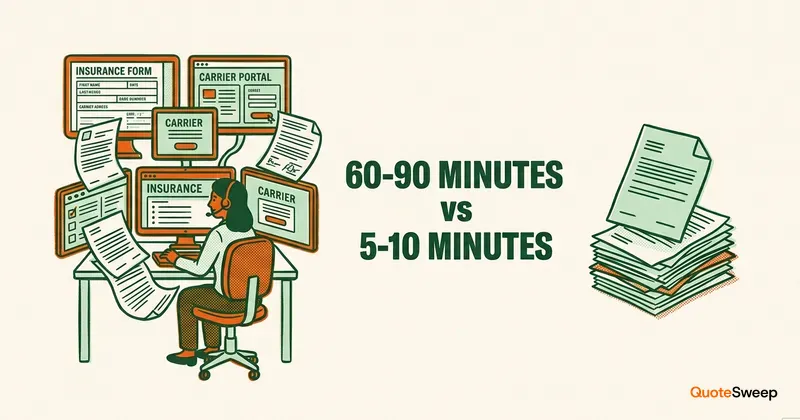
The time math is straightforward: 5 carriers at 10 to 15 minutes each equals 50 to 75 minutes of pure data entry. For a single account. And every manual entry is an opportunity for transcription error – wrong revenue figure, wrong class code, wrong effective date. We cover this risk in detail in our guide to reducing E&O risk in commercial submissions.
The multi-carrier process:
A multi-carrier quoting tool takes a different approach. Enter the client data once, select your carriers, and submit to all of them simultaneously through parallel quoting. Total data entry time: 5 to 10 minutes, regardless of how many carriers you're submitting to.
The time comparison:
| Approach | Data Entry | Carriers Quoted | Total Time | Error Risk |
|---|---|---|---|---|
| Manual (portal-by-portal) | 10-15 min per carrier | 5 carriers | 50-75 min | 5x entry = 5x error opportunities |
| Multi-carrier tool | 5-10 min (once) | 5+ carriers | 5-10 min | 1x entry = 1x error opportunity |
This is why the 2025 Independent Agent Survey found that same-day quoting expectations are increasing. The technology to make it possible exists – agencies just need to adopt it. For more on the technology landscape, see our agent tech stack guide for 2026.
Stage 6: Quote Comparison
Once carrier responses come back – typically 1 to 7 business days for small commercial, longer for complex risks – compare the results systematically.
What to compare beyond premium:
- Coverage form: Is it ISO standard, carrier-modified, or manuscript? Modified forms may exclude risks the standard form covers.
- Deductibles: A lower premium with a $5,000 deductible isn't necessarily better than a higher premium with a $1,000 deductible for a client who values predictability.
- Sublimits: Check sublimits on water damage, wind/hail, equipment breakdown, and cyber. A $250K sublimit on a $1M property policy matters.
- Endorsements included vs. available: Some carriers include broad endorsements in the base quote; others charge for each one.
- Commission rate: Your commission on the policy affects agency economics and may influence your recommendation.
- Carrier financial strength: An AM Best rating below A- may concern sophisticated clients and may not meet contract requirements.
Build a comparison template. Create a standardized comparison format that you use for every account. It should include the carrier name, premium, key coverage terms, deductibles, and your recommendation. This template saves time and ensures you don't miss important differences. It also becomes part of the client file documentation.
Stage 7: Presentation and Binding
Present the comparison to the client with your recommendation. Be honest about tradeoffs – "Carrier B is $400 less but has a higher deductible and doesn't include cyber" is more useful than "here are your options."
Binding checklist:
- Client confirms the selected carrier and coverage terms
- Binder request submitted to carrier with effective date
- Written binding confirmation received from carrier
- Confirmation sent to client with coverage summary
- All documents filed in AMS
- Follow-up set for policy issuance review (typically 15-30 days post-bind)
Common CSR Quoting Mistakes
These are the errors we see most frequently. Every one of them is preventable with process discipline.
Wrong Class Codes
Using the wrong class code – whether NAICS, SIC, or ISO CGL – is the most consequential quoting mistake a CSR can make. The wrong code affects premium (sometimes by 50% or more), coverage scope, and carrier eligibility. Worse, it creates audit exposure: if the carrier discovers the correct class code at audit, the client gets a surprise additional premium bill, and the agency may face an E&O claim for misquoting.
Prevention: Always verify the class code against the client's actual operations, not just their description. Use the Census NAICS lookup tool and cross-reference with the ISO class code manual. If the operations span multiple class codes, use the predominant one and note the secondary operations.
Missing or Incorrect Prior Insurance Information
Carriers use prior insurance history as a rating factor and an underwriting decision point. A client who reports "no prior insurance" when they actually had coverage through a different agency – or through a PEO arrangement – will either get declined or quoted at a penalty rate.
Prevention: Always request loss runs from the prior carrier. Don't rely on the client's memory. Loss runs take time (5-10 business days), so request them at intake, not after you've already started submitting.
Incomplete ACORD Forms
Submitting an ACORD 125 with blank fields – no prior insurance section, missing operations description, incomplete claims history – triggers one of two responses from the carrier: a request for more information (adding 3-5 days to the process) or an outright decline. Either way, the quote is delayed.
Prevention: Treat blank fields as errors. Every field gets a response: the actual data, "N/A," or "none." Have a second CSR spot-check completed ACORDs before submission if possible.
Not Verifying Building Values
For property coverage – whether as part of a BOP or a standalone commercial property policy – the building value and business personal property value directly determine the coverage limit. Clients routinely understate these values, sometimes by 30% to 40%. An underinsured property claim is an E&O exposure for the agency.
Prevention: Use a replacement cost estimator (most carriers provide one, or use a tool like CoreLogic or Marshall & Swift) to validate the client's stated building value. For business personal property, walk through the categories: furniture, equipment, inventory, supplies, tenant improvements. Clients who say "$50,000 in contents" often have $150,000 when you itemize.
Submitting to Carriers Without Appetite
Sending a submission to a carrier that doesn't write the class, doesn't operate in the state, or has minimum premium requirements the account doesn't meet wastes 15 to 20 minutes of data entry time and produces nothing. Across a week of quoting, that can add up to hours of lost productivity.
Prevention: Maintain a carrier appetite reference – either a spreadsheet, your AMS notes, or the appetite guides carriers publish. Check appetite before entering data. When in doubt, call the underwriter and describe the risk in two sentences before investing time in a full submission.
Building Your Quoting System
The difference between a CSR who quotes efficiently and one who's constantly behind isn't speed – it's system. Here's how to build one.
Create a Pre-Submission Checklist
Before starting any submission, run through a checklist:
- Client data verified (entity name, FEIN, revenue, employee count)
- Class code confirmed against actual operations
- Prior insurance verified (loss runs requested or received)
- ACORD 125 completed with no blank fields
- Line-specific supplemental ACORD(s) completed
- Carrier appetite confirmed for this risk
- Effective date confirmed with client
- Any special requirements noted (contract requirements, certificate holders)
Batch Your Quoting Sessions
Rather than quoting accounts one at a time as they come in, batch them into dedicated quoting sessions. Block 2 to 3 hours in the morning for data entry and submission, and use the afternoon for client communication and follow-up. Context-switching between quoting, servicing, and administrative tasks kills efficiency.
If you're handling both new business and remarketing, our renewal season survival guide covers how to manage the dual workload.
Track Submissions in a Central Location
Knowing where every submission stands – submitted, quoted, declined, pending information – prevents dropped quotes and missed follow-ups. Whether you track in your AMS, a spreadsheet, or a dedicated submission tracking tool, the system must show:
- Account name
- Carriers submitted to (and dates)
- Status per carrier (submitted, quoted, declined, pending)
- Follow-up dates
- Quote amounts received
- Client presentation date
- Binding status
Without this tracking, submissions fall through the cracks – especially during busy periods when you may have 20 or more active quotes in progress simultaneously.
Set Follow-Up Cadences
Carriers don't always respond promptly. Set standard follow-up intervals:
- Day 3: If no acknowledgment of receipt, confirm the submission was received
- Day 7: If no quote, follow up with the underwriter for a timeline
- Day 14: If still no quote, escalate or consider the carrier non-responsive for this account
These follow-ups should be systematized – calendar reminders, AMS tasks, or automated notifications – not dependent on memory.
Cross-Selling During the Quoting Process
The quoting conversation is the best time to identify additional coverage needs. The client's operations data is fresh in your mind, and the client is already engaged in an insurance discussion.
Natural cross-sell questions during intake:
- "Do you have any company-owned or leased vehicles?" (commercial auto)
- "Do any of your employees drive their personal vehicles for work?" (hired & non-owned auto)
- "Do you have equipment that leaves your premises?" (inland marine)
- "Do you store or process customer data electronically?" (cyber liability)
- "Have you ever been sued by an employee?" (EPLI)
- "Do you provide professional advice or services?" (professional liability / E&O)
Every "yes" is a coverage conversation. Document both the recommendation and the client's decision. For a deeper approach to cross-selling during commercial quoting, see our guide to commercial account rounding.
Frequently Asked Questions
How long should a commercial insurance quote take from start to finish?
For a straightforward small commercial account – a BOP or monoline GL for a low-hazard class – same-day quoting is achievable if you have clean client data, completed ACORD forms, and the right technology. Realistically, most manual quoting workflows take 2 to 5 business days: 1 day for data collection and verification, 1 day for submission, 1-3 days waiting for carrier responses, and time for client presentation. Using a multi-carrier quoting tool compresses the submission phase to minutes, but carrier response times remain the gating factor for accounts that require underwriter review rather than automated quotes.
Which ACORD form do I need for a package policy that includes GL and property?
Start with the ACORD 125 – this is the general commercial application required for every submission. Then add the ACORD 126 (General Liability Supplement) for GL-specific data and the ACORD 140 (Property Section) for building and contents details. If the package includes workers comp, add the ACORD 130. If it includes commercial auto, add the ACORD 137. The ACORD 125 is always the foundation; line-specific supplements build on top of it.
How do I figure out which carriers have appetite for a specific risk?
There's no single source of truth for carrier appetite, which is why 71% of agents report this as a challenge. Start with your carrier's underwriting guidelines and appetite guides – most carriers publish these for their appointed agents. Build a reference (spreadsheet or AMS notes) documenting each carrier's appetite by class, state, and premium range. Update it every time you learn something new – a declined submission tells you as much about appetite as an accepted one. Some comparative raters include appetite filtering that pre-screens carriers before submission, saving the guesswork.
What's the difference between a quote, an indication, and a binder?
An indication is an informal estimate – not bindable, often subject to underwriting review, and typically based on limited information. A quote is a formal offer from the carrier with specific terms, pricing, and a defined validity period (usually 30-60 days). A binder is the temporary evidence of coverage issued after the carrier agrees to write the policy and before the full policy is issued. The critical distinction: you cannot bind coverage based on an indication. Only a formal quote can be bound.
How do I handle a client who needs a quote urgently but won't provide complete information?
This is one of the most common CSR dilemmas – and one of the biggest E&O traps. Submitting incomplete information to speed up the process creates two risks: the quote may not hold at binding when the carrier discovers missing data, and the coverage may not match the client's actual needs if key risk factors were unknown. The professional response is: "I can get you a fast quote, but I need these specific items to make sure the pricing is accurate and the coverage is right. If I submit without [missing item], the quote may change or the carrier may decline." Document the conversation. If the client insists on proceeding with incomplete data, document that too – and note which information was missing and what you communicated about the implications.