E&O Risk Reduction for Insurance Agents
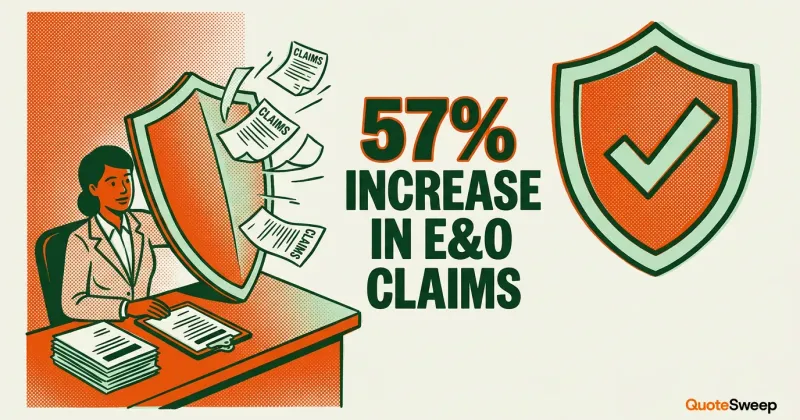
An errors and omissions claim can cost your agency tens of thousands of dollars in defense costs alone – and that's before any settlement. According to industry data, E&O claim costs regularly exceed $50,000, and complex cases can run well into six figures. More concerning: professional liability claims have increased 57% over the past decade, and both frequency and severity continue to rise.
The good news is that most E&O claims are preventable. They stem from documentation gaps, process failures, and communication breakdowns – not from agent incompetence. An agency with consistent procedures, disciplined documentation, and clear client communication can dramatically reduce its exposure. We've seen agencies cut their E&O risk profile by implementing the practices in this guide – and many qualify for reduced E&O premiums by demonstrating a formal risk management program to their carrier.
TLDR: The three most common E&O claim triggers are failure to procure coverage, inadequate coverage recommendations, and failure to advise clients of policy changes. Prevention centers on three practices: document everything in the client file, conduct systematic coverage reviews at every renewal, and maintain clear written communication standards for declinations, limitations, and client decisions.
The Most Common E&O Claims Against Agents
Understanding what triggers claims tells you exactly where to focus your prevention efforts. Claims fall into a handful of predictable categories.
Failure to Procure Coverage
Nearly one in five E&O claims against P&C agents involves failure to procure – the client believed they had coverage, but the policy was never bound, was bound with the wrong carrier, or lapsed before the loss occurred.
Common scenarios:
- Client requests coverage, agent submits application, but binding is never confirmed
- Agent binds coverage verbally but doesn't follow up with written confirmation
- Application is submitted but declined by the carrier, and the agent doesn't notify the client
- Coverage lapses due to non-payment, and the agent doesn't alert the client
Prevention: Every binding must be confirmed in writing within 24 hours. Every declination must trigger an immediate client notification. Every application status must be tracked in your agency management system with follow-up deadlines.
Inadequate Coverage Recommendations
The client has a policy, but it doesn't cover the loss. The client alleges the agent should have recommended broader coverage, higher limits, or additional endorsements.
Common scenarios:
- A contractor has a CGL policy but no inland marine coverage – their equipment is stolen from a job site
- A restaurant owner has a BOP but no liquor liability – they're sued after a patron causes a drunk driving accident
- A manufacturer has $1M in general liability but faces a $3M product liability claim
- A business has commercial property coverage but no flood endorsement in a flood-prone area
Prevention: Conduct a documented needs analysis at placement and every renewal. Identify coverage gaps in writing and present recommended coverages, including those the client may decline. The key word is "document" – if it's not in the file, it didn't happen.
Failure to Advise of Policy Changes
The carrier modifies coverage terms at renewal – an exclusion is added, a sublimit is introduced, a deductible increases – and the agent doesn't inform the client.
Common scenarios:
- Carrier adds a cyber exclusion to a general liability policy at renewal
- Deductible increases from $1,000 to $5,000 and the client doesn't notice until a claim
- Sub-limit on water damage is reduced from $250,000 to $50,000
- Coverage territory is restricted, but the client has expanded operations
Prevention: Every renewal must include a side-by-side comparison of expiring vs. renewal terms. Material changes must be communicated in writing with an acknowledgment from the client.
Misrepresentation
For life and health agents specifically, misrepresentation accounts for 25% of all E&O claims – the largest single category. This includes misrepresenting policy terms, benefits, or limitations during the sales process.
Prevention: Never make promises about coverage that aren't in the policy language. Use carrier-provided marketing materials rather than creating your own descriptions of coverage. When in doubt, say "I'll confirm that with the carrier" rather than improvising an answer.
Documentation Best Practices
Documentation is your first and best defense in an E&O claim. If the documentation is in the client file and signed showing the client was offered coverage but chose not to purchase, that's usually enough to protect the agent.
The File Documentation Standard
Every client file in your AMS should contain:
- Initial needs analysis – a documented assessment of the client's operations, exposures, and coverage needs
- Coverage recommendations – a written list of recommended coverages, limits, and carriers
- Declination records – signed documentation of any coverage the client chose not to purchase (more on this below)
- Binding confirmations – written confirmation of every policy bound, with effective dates and coverage summaries
- Renewal review notes – documentation of the renewal review process, including any changes in terms
- Client communications – copies of all emails, letters, and notes from phone conversations regarding coverage decisions
- Application copies – signed copies of all applications submitted to carriers
The 48-Hour Rule
Every significant client interaction must be documented within 48 hours. If a client calls to discuss adding a vehicle to their commercial auto policy, the notes should be in the file the same day. If a producer has a lunch meeting where the client mentions expanding to a new state, a follow-up email confirming the discussion and recommending a coverage review should go out within 48 hours.
Phone Call Documentation
Phone calls are the highest-risk communication medium for E&O because they leave no inherent paper trail. Implement this protocol:
- Take notes during every client call involving coverage decisions
- Enter notes into the AMS within 4 hours
- Send a follow-up email to the client summarizing the discussion and any action items
- The email serves as both documentation and client confirmation
Example follow-up email:
"Following up on our call today – you've asked us to add cyber liability coverage with a $1M limit to your commercial package. We'll submit this to [Carrier] and confirm once the endorsement is in place. You also indicated you do not want to increase your umbrella limit from $1M to $2M at this time. Please let me know if I've captured anything incorrectly."
Coverage Review Processes
Systematic coverage reviews – at every new business placement and every renewal – are the most effective structural protection against E&O claims.
New Business Coverage Review Checklist
Before binding any new account, the agent or CSR should complete a coverage review that documents:
- Business operations assessment: What does the client do? Where? How many employees? Annual revenue?
- Current coverage review: What coverage does the client currently have? What are the limits? Are there gaps?
- Exposure identification: What exposures exist based on the client's operations, industry, and geography?
- Coverage recommendations: What coverages, limits, and endorsements do we recommend?
- Coverage gaps identified: What exposures are we unable to place or that the client declines to cover?
- Client acknowledgment: Written confirmation that the client has been informed of all recommendations and gaps
Renewal Coverage Review Process
Renewals are not auto-pilots. Every renewal should follow this process:
90 days before renewal:
- Pull the existing coverage summary from your AMS
- Review loss history for the past 3 years
- Identify any changes in the client's operations (new locations, new products, revenue changes)
- Check for carrier-initiated coverage changes (new exclusions, sublimit changes, rate changes)
60 days before renewal:
- Present renewal terms to the client with a side-by-side comparison to expiring terms
- Highlight any material changes in coverage, limits, or pricing
- Recommend additional coverages based on any operational changes
- If remarketing, quote with multiple carriers using a comparative rater
30 days before renewal:
- Confirm client's coverage decisions in writing
- Document any declined recommendations
- Bind renewal or issue binder as appropriate
- Send written confirmation of renewal terms
Within 30 days after renewal:
- Review issued policy against bound terms
- Flag and resolve any discrepancies
- Send policy summary to client
Declination Letters: Your Best Defense
When a client declines a coverage recommendation, the declination letter is the single most important document in your E&O defense file. If a client declines cyber liability coverage and later suffers a data breach, a signed declination letter is often the difference between defending a claim and paying a settlement.
What a Declination Letter Must Include
- Specific coverage declined: "You have chosen not to purchase cyber liability coverage"
- Why we recommended it: "Based on your business's collection and storage of customer data, we recommended cyber liability coverage to protect against data breach notification costs, regulatory fines, and business interruption from cyber events"
- Potential consequences: "Without this coverage, your business would be responsible for the full cost of any data breach, including notification expenses, credit monitoring, regulatory penalties, and legal defense"
- Acknowledgment line: "I understand the coverage described above was recommended and I have chosen not to purchase it at this time"
- Client signature and date
When to Send Declination Letters
- Every time a client declines a recommended coverage line
- Every time a client chooses lower limits than you recommended
- Every time a client declines an endorsement you recommended (e.g., employment practices liability, hired & non-owned auto, equipment breakdown)
- Every time a client declines to increase limits you've identified as inadequate
Electronic Signatures
Electronic signatures on declination letters are generally acceptable. Use a system that creates an audit trail – timestamp, IP address, and signer verification. Email responses saying "I understand" are better than nothing but weaker than formal electronic signatures.
Surplus Lines Disclosures
Placing coverage with a surplus lines carrier creates specific E&O obligations that differ from admitted market placements.
Required Disclosures
Most states require agents to disclose in writing that:
- The insurer is not admitted in the client's state
- The policy is not covered by the state guaranty fund in the event of carrier insolvency
- The client has been informed of the financial rating and capacity of the surplus lines insurer
Documentation Requirements
- Written disclosure signed by the client before binding
- Evidence that the diligent search requirement was met (if required by your state)
- Surplus lines tax acknowledgment and payment documentation
- Copy of the surplus lines broker's license (if placed through a wholesale broker)
Failure to make these disclosures is both a regulatory violation and an E&O exposure. If a surplus lines carrier becomes insolvent and the client's claim goes unpaid, the client may sue the agent for failing to disclose the lack of guaranty fund protection.
Binding Authority Procedures
Binding coverage is the highest-risk moment in the agent-client relationship. Errors at binding – wrong effective date, wrong limits, wrong insured name – create immediate E&O exposure.
Binding Best Practices
-
Confirm authority. Before binding, verify you have binding authority with the carrier for the specific line and coverage being placed. If you don't have authority, get written confirmation from the underwriter.
-
Use written binders. Verbal binders are legal but dangerous. Follow every verbal bind with a written binder within 24 hours that specifies: named insured, effective date, coverages, limits, deductibles, and premium.
-
Double-check named insured. The most common binding error is a wrong or incomplete named insured. Verify the legal entity name against the application and Secretary of State records. "Joe's Plumbing" is not the same as "Joseph Smith d/b/a Joe's Plumbing LLC."
-
Confirm effective date. Binding backdated coverage creates E&O exposure. If the client needs coverage effective yesterday, document the request and confirm with the carrier that backdating is acceptable.
-
Document the binding chain. Your AMS should show who bound the policy, when, with what authority, and the specific terms bound. If a claim occurs the day after binding, you need to prove coverage was in force.
Technology Tools That Reduce E&O Risk
Technology doesn't replace good judgment, but it creates systems that make errors harder to commit and easier to catch.
Agency Management Systems
A modern AMS is your primary E&O defense infrastructure. It should:
- Require activity notes for every client interaction
- Automate renewal workflows with task deadlines 90/60/30 days before expiration
- Store all documents (applications, declinations, binders) in the client file
- Create audit trails showing who did what and when
- Generate certificate of insurance COIs with automatic holders tracking
Comparative Rating Tools
Manual quoting – logging into carrier portals individually – creates E&O risk in two ways: data entry errors from re-keying the same information across multiple systems, and missed carriers that might have provided better or broader coverage. Comparative raters that submit to multiple carriers from a single entry point reduce both risks.
Policy Checking Software
Automated policy checking compares issued policies against the terms that were quoted and bound. Discrepancies are flagged for review before the policy reaches the client. This catches carrier errors, binding mistakes, and coverage gaps before they become claims.
Document Management
If your agency still uses paper files, you're creating E&O risk through lost documents, misfiled paperwork, and inability to produce records during a claim investigation. Digital document management – ideally integrated with your AMS – ensures every document is retrievable, timestamped, and associated with the correct client file.
Common E&O Mistakes and How to Avoid Them
Mistake 1: Assuming the Client Understands Coverage
Never assume a client understands what their policy covers. Even sophisticated business owners often don't grasp the difference between occurrence and claims-made, the implications of a sub-limit, or what an exclusion actually means. Explain coverage in plain language and confirm understanding in writing.
Mistake 2: Providing Coverage Advice Outside Your Expertise
If a client asks about a line you don't write – employment practices liability, directors & officers, professional liability – either refer them to a specialist or clearly document that you are not providing advice on that line. "I'm not qualified to advise on D&O coverage, but I can connect you with a specialist" is an E&O-safe response. "You probably don't need that" is an invitation to a claim.
Mistake 3: Relying on Verbal Communication
Every coverage decision, every client instruction, every binding confirmation should exist in writing. Phone calls are fine for relationship building and initial discussions, but the decision and the confirmation must be documented. "The client told me on the phone" is not a defense.
Mistake 4: Neglecting the Service Book
Producers focus on new business, but E&O claims most often arise from existing accounts – at renewal, during a mid-term change, or when a claim triggers a coverage dispute. Ensure your service team follows the same documentation and review standards for existing accounts as your producers follow for new business.
Mistake 5: No Procedure Manual
If your agency doesn't have a written procedures manual covering quoting, binding, policy checking, renewal review, and documentation standards, every employee is following their own process. Inconsistency creates gaps, and gaps create claims. A written manual that every employee signs and follows is both an operational improvement and an E&O defense.
Building Your E&O Risk Reduction Program
Step 1: Audit Current Practices (Week 1-2)
Pull 20 random client files and audit them against the documentation standards described in this guide. Score each file on: needs analysis present, coverage recommendations documented, declinations signed, binding confirmations in file, renewal review notes complete. The average score tells you where you are.
Step 2: Write Your Procedures Manual (Week 3-4)
Document your standards for: new business workflow, renewal workflow, binding procedures, documentation requirements, declination letter process, surplus lines disclosures, and phone call documentation. Keep it under 20 pages – long enough to be comprehensive, short enough that people actually read it.
Step 3: Train Your Team (Week 5-6)
Every employee who interacts with clients – producers, CSRs, account managers – must be trained on the procedures manual. This isn't a one-time event; schedule annual refresher training and document attendance.
Step 4: Implement Technology Safeguards (Ongoing)
Configure your AMS to enforce documentation requirements. Set up automated renewal task workflows. Implement comparative rating to reduce quoting errors. Deploy policy checking for all new and renewal policies.
Step 5: Review and Improve (Quarterly)
Conduct quarterly file audits (10-20 random files). Track compliance scores. Address gaps through additional training or process refinement. Agents who demonstrate strong risk management may qualify for E&O premium reductions – document your program and share it with your E&O carrier at renewal.
Frequently Asked Questions
What is the most common E&O claim against insurance agents?
Failure to procure coverage is the most common P&C E&O claim, accounting for nearly 20% of all claims. This includes situations where coverage was requested but never bound, applications were submitted but declined without client notification, or policies lapsed without the agent alerting the client. For life and health agents, misrepresentation is the largest category at 25% of claims. Preventing both comes down to documentation and communication – confirm every binding in writing and never make coverage promises that aren't in the policy.
Do declination letters actually protect agents from E&O claims?
Yes, and they are often the deciding factor. When a client declines coverage you recommended and later suffers an uninsured loss, a signed declination letter demonstrates that you fulfilled your professional duty to advise. Without it, the claim becomes your word against the client's – and juries tend to side with the party that suffered the loss. Make declination letters a non-negotiable part of your process for every declined coverage, declined limit increase, and declined endorsement.
How much does an E&O claim typically cost an insurance agency?
E&O claim costs vary widely, but most claims exceed $50,000 when defense costs and settlements are included. Complex claims involving large commercial accounts or professional liability issues can reach six figures or more. Beyond direct costs, E&O claims increase your agency's future E&O premiums, damage carrier relationships, consume management time, and can harm your reputation in the local market.
Can technology reduce E&O risk?
Absolutely. A modern AMS with enforced documentation workflows prevents the most common process failures. Comparative raters reduce data entry errors by eliminating manual re-keying across carrier portals. Policy checking software catches discrepancies between bound and issued terms. Document management systems ensure every file is complete and retrievable. The agencies seeing the biggest reduction in E&O exposure are those that combine good procedures with technology that enforces those procedures automatically.