Dog grooming sits in an unusual spot for a small business: you have a shop full of equipment like any retailer, but the thing you actually work on is a living, unpredictable animal that belongs to someone else. That combination means the claims most likely to hit your business aren't the ones a normal store worries about — they're a dog that nips a customer or another dog, a pet that gets nicked by clippers or shears, or an animal that gets sick, escapes, or worse while it's in your care. Those are different coverages, and getting them right is what a real pet-business insurance program is about.
This is an independent guide from QuoteSweep, which maps the modern commercial insurance landscape. QuoteSweep does not compete with any of these companies, and none pays for placement here.
TL;DR: Most dog groomers and pet businesses build their program around a business owner's policy (BOP) — general liability plus property for your tables, tubs, dryers, and inventory — then add professional liability for the grooming work itself, an animal bailee endorsement for the pets in your custody, workers' comp once you have employees, cyber because you store client and payment data, and commercial auto if you run a mobile rig. For buying online, compare Next (ERGO NEXT) for multi-line breadth, biBERK for Berkshire-backed financial strength, Thimble for mobile groomers and short-term needs, and Coverdash for fast quote-to-bind with instant certificates. See the whole field on the small-business insurtech hub.
Compare business insurance options
What insurance does a dog groomer or pet business need?
There is no single "dog groomer policy." A well-covered pet business layers a few standard commercial lines, weighted toward the risks specific to handling animals — and it adds one exposure that most trades never face: responsibility for a live pet in your custody.
General liability — the bite, escape, and slip-and-fall baseline
General liability (GL) covers third-party claims of bodily injury and property damage — the customer bitten by a dog you're handling, the client who slips on a wet floor near the wash station, the dog that bolts out the door and causes a car to swerve, the pet that damages a client's property in your lobby. It is the single most commonly required commercial coverage, and virtually every commercial lease and shopping-center landlord will demand it before you can sign. Standard GL follows the ISO CGL form with limits of $1 million per occurrence and $2 million aggregate, and it responds on an occurrence basis — it covers incidents that happen during the policy period regardless of when the claim is filed.
What GL does not cover is the important part for a pet business. It excludes the business's own property, employee injuries, and — critically for a groomer — professional mistakes in the service you actually provide and damage to the animals in your care, custody, and control. A customer bitten in your waiting room is a GL claim. A dog you nick with the clippers, or a pet that's injured on your grooming table, generally is not — that's professional liability and animal bailee territory, covered below. New shop owners often assume GL is "all-purpose business insurance." It isn't, and for a groomer the gaps are exactly where the biggest claims land.
Business owner's policy (BOP) — GL plus your shop's property
Because a grooming business has a physical location full of insurable property — hydraulic tables, tubs, high-velocity dryers, clippers and shears, cages and kennels, a POS setup, and retail inventory like shampoos and accessories — most shops are a textbook fit for a business owner's policy (BOP). A BOP bundles general liability with commercial property coverage into one policy, typically at a 15–25% discount versus buying each line separately. The property side covers your building (if you own it) and your business personal property — the furniture, equipment, and inventory that make the shop run — plus loss of income if a covered event like a fire shuts you down. That built-in business interruption coverage matters for a groomer, where a two-week closure means two weeks of no appointments and no revenue.
The practical rule agents follow is simple: if the business has a storefront or owned property worth insuring, quote the BOP first. Grooming shops almost always qualify, and BOP programs from the direct online insurers are among the fastest paths to bindable coverage. Most BOPs also let you endorse on extras — hired and non-owned auto, employee dishonesty, and increasingly a cyber sub-limit — though, as noted below, the built-in cyber piece is usually too small to rely on, and the animal-in-your-care exposure needs its own attention.
Professional liability (E&O) — when the grooming itself goes wrong
This is the coverage that separates pet-business insurance from generic retail insurance. Professional liability, or errors and omissions (E&O), covers claims that your professional service caused harm — precisely the losses general liability excludes. For a groomer, that means the clipper nick or shear cut, the clipper burn or brush irritation, the dryer that overheats a pet, the reaction to a shampoo or flea treatment, or an injury from restraining a difficult animal. GL won't touch the service itself; E&O is the policy built for it.
One nuance to understand: E&O is almost always written on a claims-made basis, not occurrence. Coverage applies only if the claim is filed while the policy is active, which introduces two ideas worth knowing — the retroactive date (claims for work done before this date aren't covered, so set it as early as possible) and tail coverage (an extended reporting window if you cancel or switch, which commonly costs 125–300% of the annual premium). If you ever change carriers, keeping your original retroactive date is what prevents a gap for past work. Some carriers let smaller shops endorse professional liability onto the BOP; others write it standalone. Either way, for a business whose entire product is a hands-on service performed on a living animal, this line is not optional.
Animal bailee (care, custody, and control) — the pet-specific gap
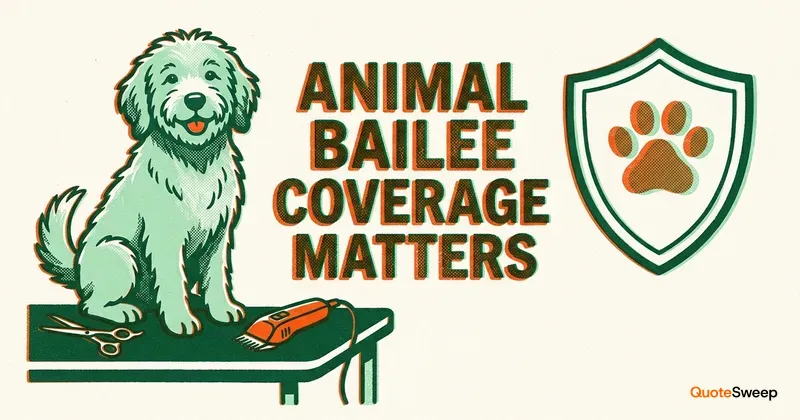
Here is the exposure that makes pet businesses genuinely different from almost any other trade: while a dog is on your table or in your kennel, that animal is legally in your care, custody, and control — and standard liability policies are designed around injury to third parties and their property, not the property you've been entrusted with. Owners treat pets as family, and a groomer who injures, loses, sickens, or is blamed for the death of an animal on their watch faces a claim that GL and E&O don't cleanly cover. Animal bailee coverage (sometimes written as a care, custody, and control endorsement) is the pet-industry answer: it responds to injury, illness, loss, escape, or death of an animal while it is in your custody. It matters even more for businesses that hold animals overnight — boarding kennels, daycare, and pet sitters — where the exposure runs around the clock. If your operation ever has a pet in its custody, ask specifically how this gap is handled; it is the coverage owners of grooming, boarding, walking, and daycare businesses most often discover they were missing only after a claim.
Workers' compensation — once you have employees
If your shop has W-2 employees — groomers, bathers, a receptionist, kennel staff — workers' compensation is legally required in nearly every state, and the penalties for going without it are severe. It pays medical bills and lost wages for employees injured on the job, and grooming is a physical, hazardous job: dog bites and scratches, cuts from shears, repetitive-strain injuries, back strain from lifting large dogs, and reactions to grooming chemicals are everyday exposures. In exchange for coverage, employees give up the right to sue you for those injuries. Premiums are driven by payroll: the formula is roughly payroll divided by 100, multiplied by the class-code rate, multiplied by your experience modification rate (EMR). Carriers audit actual payroll at year-end, so accurate payroll estimates up front prevent a surprise bill. Because animal-handling work carries a higher injury rate than clerical work, the class code assigned to your groomers drives most of the premium — accurate classification matters. When you do have employees, workers' comp is one of the highest-volume, non-negotiable lines you'll carry. See the workers' comp insurtech hub for the specialist players.
Cyber liability — your booking and payment data
Pet businesses run on software: online booking, appointment and vaccination reminders, a POS that stores card data, and a client list full of names, emails, phone numbers, and pet records. That's real cyber exposure, and standard GL and BOP policies contain absolute cyber exclusions — they do not cover a data breach or a ransomware attack that locks your booking system. Cyber liability insurance fills that gap, paying first-party costs like forensics, breach notification (required by law in all 50 states), and business interruption from downtime, plus third-party costs like lawsuits and regulatory fines when customer data is compromised. Some BOPs bundle a small cyber sub-limit (often $50,000–$100,000), but that's a fraction of what a real breach costs, so a standalone policy is the meaningful option for a shop that takes bookings and card payments online. Carriers increasingly want to see basics like multi-factor authentication and regular backups before they'll quote. See the cyber insurtech hub for the specialist players.
Commercial and hired/non-owned auto — mobile grooming and pickups
Auto is a bigger deal for pet businesses than for most storefront trades, because mobile grooming is a whole business model. If you run a wrapped grooming van or trailer, that vehicle needs commercial auto insurance — it's required by law for any vehicle registered to a business, and it covers liability, physical damage, and medical payments for accidents involving the rig. A mobile unit is also rolling equipment: the built-in tub, dryer, and generator are high-value property to insure. Even shops without a van often have a quieter exposure — an employee who runs to the pet-supply store or does client pickups and drop-offs in their own car. That's a hired and non-owned auto (HNOA) exposure, and it's easy to miss because personal auto policies exclude business use. HNOA can usually be endorsed onto a BOP or commercial auto policy; skipping it leaves a gap that only surfaces after an accident.
Industry-specific add-ons
Two more exposures worth flagging. First, product liability: if you sell retail shampoos, treats, supplements, or accessories, or apply manufacturer products in-service, product-related injury claims fall under the products/completed-operations side of general liability — confirm it's included rather than excluded, especially for anything applied directly to an animal's skin or coat. Second, businesses that expand beyond grooming into boarding, daycare, walking, training, or sitting take on broader exposures — overnight care, off-leash handling, and time on a client's property — that widen the animal bailee and general-liability picture and are worth quoting deliberately rather than assuming your grooming policy already covers them.
How much does it cost?
Pet-business insurance is quote-based — there's no flat rate, and premiums vary widely by operation. What you'll pay is driven by a handful of factors, and understanding them helps you set expectations before a quote comes back:
- Payroll and headcount. Workers' comp is rated directly on payroll by job class, and animal-handling classes carry higher rates than clerical work — so more groomers (and higher wages) mean higher premium. This is usually the biggest cost lever once you have employees.
- Revenue and square footage. General liability and the property side of a BOP scale with your sales volume and the size and contents of the space you're insuring.
- Services offered. A grooming-only shop carries a different risk than one that also boards, does daycare, or handles aggressive breeds. Overnight care and off-site handling raise the exposure and can move the price.
- Property and equipment values. The replacement cost of your tables, tubs, dryers, and — if you run mobile — the van and its built-in equipment sets the property portion of your program.
- Location and claims history. State, litigation climate, and your own loss history all matter; a clean history and a few years in business help.
A few of the online insurers advertise low entry prices for the simplest line — Next (ERGO NEXT), for example, lists general liability starting at about $19/month per its own site — but that's an entry point for a single coverage, not the cost of a full pet-business program with professional liability and animal bailee. The only real number is the one that comes back on a quote for your specific operation, its payroll, its services, and its property. Compare a few carriers rather than taking the first quote; pricing and coverage breadth vary more than most owners expect.
Best insurers for dog groomers and pet businesses
Below are four online insurers worth comparing for a dog groomer or pet business, each matched to the situation it fits best. All four sell direct online, which suits the straightforward risk profile of most shops. None pays for placement here.
Next (ERGO NEXT) — best for multi-line breadth from one fast provider
Next Insurance — now branded ERGO NEXT after Munich Re's ERGO Group acquired it for $2.6B in 2025 — is a digital-first small-business insurer that quotes and binds online in under 10 minutes. It writes one of the broadest multi-line stacks in the category: general liability, BOP, workers' compensation, commercial auto, professional liability (E&O), commercial property, tools & equipment, and EPLI. For a grooming business that wants its GL, property, workers' comp, and professional coverage from a single provider in one flow — rather than piecing together monoline policies — that breadth is the draw, and the commercial auto line is a real plus if you run a mobile rig. Per its site it has insured 750,000+ customers across 1,300+ business types, with general liability starting at about $19/month, and it's now backed by a global reinsurer. It's direct-first with licensed US-based advisors available, and it isn't available in every state.
Best for: dog groomers and pet businesses that want several coverages — including workers' comp and commercial auto for a mobile unit — from one fast, well-backed online provider.
biBERK — best for financial strength behind the policy
biBERK is the pick for owners who care most about who stands behind the policy. It sells directly to businesses online — no brokers — and writes general liability, BOP, workers' compensation, professional liability, commercial auto, and umbrella coverage. Its edge isn't a flashy interface; it's the balance sheet. biBERK is part of the Berkshire Hathaway Insurance Group and writes on carriers rated A++ (Superior) by AM Best, the top tier of financial strength. It positions on savings of up to 20% by cutting out the middleman and reports being trusted by 200,000+ small businesses. For a grooming shop's core GL-plus-property need, a direct BOP from a carrier with Berkshire's financial strength behind it is a straightforward, dependable foundation.
Best for: pet businesses that want to buy direct and want the strongest possible financial strength — Berkshire's A++ rating — behind the policy.
Thimble — best for mobile groomers and short-term or seasonal work
Thimble solves a problem annual policies ignore: sometimes you need coverage for a job or a season, not a whole year. It sells small-business insurance by the job, month, or year, and lets you modify, pause, or cancel instantly from an app. Its lineup is broad — general liability, professional liability, BOP, inland marine (equipment), commercial property, workers' comp, cyber, commercial auto, event insurance, and surety bonds — across 1,000+ activities. For an independent mobile groomer, a solo operator just getting started, or someone who works pet expos and adoption events, the on-demand model fits far better than a fixed annual policy, and the inland marine line covers the equipment you haul. It's a wholly owned subsidiary of Arch Insurance Group, with 170,000+ policies delivered since 2018.
Best for: independent and mobile groomers, solo operators, and pet businesses with short-duration, seasonal, or event-based coverage needs.
Coverdash — best for fast quote-to-bind and instant certificates
Coverdash is a digital business-insurance platform that gets a small business from quote to coverage "in clicks, not weeks." It places general liability, BOP, workers' comp, cyber, professional liability, and management liability through carrier partners, and — usefully for pet businesses — it generates certificates of insurance instantly. That matters because shopping-center landlords, booth or suite rental agreements inside pet-supply stores, and event venues frequently demand a COI before you can operate, and getting one on the spot removes a real headache. Coverdash also runs an embedded model, but for a shop buying directly it's a fast, self-serve online experience with a dashboard to manage everything. It's newer and places through carrier partners, so terms vary by carrier.
Best for: pet businesses that want fast online quote-to-bind and need certificates of insurance for a landlord, retail-store lease, or event on demand.
Frequently Asked Questions
What insurance does a dog groomer actually need?
Start with a business owner's policy (BOP), which bundles general liability with property coverage for your tables, tubs, dryers, and inventory. Add professional liability (E&O) for the grooming work itself — the clipper nick, the razor burn, the reaction to a product that general liability excludes — and an animal bailee endorsement for injury, illness, loss, or death of a pet while it's in your custody. Then layer workers' comp once you have employees, cyber if you take bookings and payments online, and commercial or hired/non-owned auto if you run a mobile rig or anyone drives for the shop.
Does general liability cover it if I injure a dog while grooming?
Not cleanly. General liability covers third-party bodily injury and property damage — a customer bitten in your lobby, or a client who slips near your wash station — but it excludes mistakes in the professional service you provide and damage to the animals in your care, custody, and control. A dog you nick with the clippers or injure on the table is a professional liability (E&O) and animal bailee matter, which is why pet businesses need those coverages, not just GL.
What is animal bailee coverage and do I need it?
Animal bailee — also called a care, custody, and control endorsement — covers injury, illness, loss, escape, or death of an animal while it is in your custody. Because pets are legally your responsibility while they're on your table or in your kennel, and standard liability policies are built around third parties and their property rather than property entrusted to you, this is the gap groomers, boarders, daycares, and sitters most often discover after a claim. If your business ever has a pet in its care, it's worth confirming exactly how this exposure is handled.
How much does dog groomer insurance cost?
It's quote-based and varies with your payroll, revenue, square footage, the services you offer, and your claims history — a mobile solo groomer pays differently than a shop that also boards and does daycare. Some insurers advertise low entry prices for a single line (Next lists general liability from about $19/month), but that's not the cost of a full program with professional liability and animal bailee. Compare a few carriers on your actual operation to get a real number.
The bottom line
A dog grooming or pet business is one of the clearer small-business insurance cases once you see the shape of it: you own a shop full of equipment, you perform a hands-on service, and you're responsible for a living animal that belongs to someone else. Build around a BOP for general liability plus your property, add professional liability for grooming injuries and an animal bailee endorsement for the pets in your custody, carry workers' comp once you employ groomers, pick up cyber for your booking and payment data, and add commercial auto if you run a mobile rig. For buying it online, compare Next (ERGO NEXT) for multi-line breadth, biBERK for financial strength, Thimble for mobile groomers and short-term needs, and Coverdash for fast binding and instant certificates. Quote more than one, and match the provider to how your business actually operates. Compare the full field on the small-business insurtech hub.