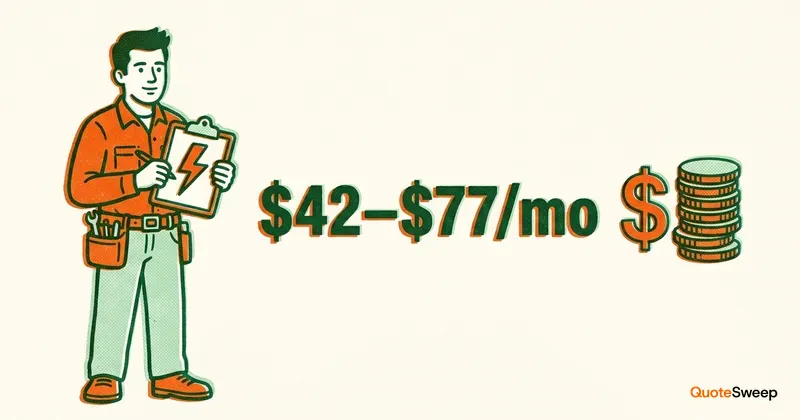
A typical small or solo US electrician pays roughly $50–$80 per month (about $500–$940 per year) for their core liability coverage. Three independent quote-based sources anchor that range: Insureon reports a median general liability premium of $57/month ($684/year) for electricians, Simply Business reports a median of $42/month (about $500/year) for a policy package, and NEXT Insurance reports that 48% of its electrician customers pay an average $77/month for general liability.
This is an independent guide from QuoteSweep, which maps the modern commercial insurance landscape. Every figure below is attributed to its source. This is the cost companion to our guide on what electricians need — head there for how each coverage actually works; this page focuses only on price.
TL;DR: For core liability, the quote-based medians converge tightly: $57/month ($684/year) per Insureon, $42/month (~$500/year) per Simply Business (a package of GL, tools/equipment, and/or workers' comp, from customers who bought July–Dec 2024), and ~$77/month for the 48% of electricians NEXT reports on general liability. A full stack that adds workers' comp and commercial auto runs several hundred dollars a month. There is no single industry-wide "total premium" median — the number depends entirely on which lines you carry and your limits, so treat the $500–$940/year figure as your core GL/package, not a fully-loaded program.
Compare business insurance options
How much does electrician insurance cost?
The most defensible single number is Insureon's median: $57/month, or about $684/year, for electrician general liability (Insureon). Simply Business lands close, at a $42/month (about $500/year) median — but note that its figure is for a policy package (general liability plus tools/equipment and/or workers' comp), based on customers who bought coverage July–December 2024. NEXT Insurance sits slightly higher, reporting that 48% of its electrician customers pay an average $77/month for general liability.
Those three sources measure real quotes from small operators, and they converge tightly — roughly $42–$77/month for your core liability coverage. One outlier is worth flagging: MoneyGeek models a standardized electrician profile and lands far higher, at $379/month ($4,553/year) for general liability. That is a modeled profile at higher limits, not a customer median, which is why it runs 5x+ above the quote-based sources. If you're a solo or small shop carrying $1M/$2M limits, the Insureon/Simply Business/NEXT range is closer to your reality.
One caveat before you anchor: there is no single published "total premium for all coverage" median for electricians industry-wide. Your fully-loaded cost depends on which lines you carry and your limits — so the $500–$940/year range describes your core GL or package, not a complete program with workers' comp and auto layered on.
Cost by coverage
Electrician-specific figures are published by coverage line — primarily by Insureon and its sister brand TechInsurance (same underlying quote data), cross-referenced with NEXT and MoneyGeek. Here's the breakdown:
| Coverage | Typical cost | Source |
|---|---|---|
| General liability | $57/mo ($684/yr) median | Insureon / TechInsurance |
| Business owner's policy (BOP) | $78/mo ($937/yr) | Insureon / TechInsurance |
| Workers' compensation | $217/mo ($2,602/yr) average | Insureon / TechInsurance |
| Professional liability (E&O) | $74/mo ($886/yr) | Insureon |
| Commercial auto | $140/mo ($1,682/yr) | Insureon / TechInsurance |
| Tools & equipment | $41/mo ($494/yr) | Insureon / TechInsurance |
| Commercial umbrella | $65/mo ($775/yr) | Insureon / TechInsurance |
| Surety bonds | ~$4/mo ($50/yr) | Insureon / TechInsurance |
General liability. The median is $57/month ($684/year), per Insureon and TechInsurance. NEXT reports 48% of its electrician customers pay an average $77/month. MoneyGeek's modeled standardized profile is a high outlier at $379/month ($4,553/year). GL is the line nearly every contract, license, and jobsite requires.
Business owner's policy (BOP). A BOP bundles general liability with commercial property. Insureon and TechInsurance put it at $78/month ($937/year) for electricians — often cheaper than buying the two lines separately.
Workers' compensation. Usually the single largest line, and it only applies once you have W-2 employees. Insureon and TechInsurance report an average of $217/month ($2,602/year); NEXT reports a $161/month median; MoneyGeek models $274 per employee per month ($3,293/year). It's priced on payroll and the electrician class code (5190).
Professional liability (E&O). Insureon puts this at $74/month ($886/year); TechInsurance lists $65/month ($785/year).
Other lines (Insureon / TechInsurance): commercial auto $140/month ($1,682/year); contractor's tools & equipment $41/month ($494/year) — NEXT quotes about $33/month; commercial umbrella $65/month ($775/year); and surety bonds at roughly $4/month ($50/year).
For broader context, NerdWallet does not publish an electrician-specific breakdown. Its contractor data (via Coverdash) states only that contractors under $10M revenue can typically get GL for under $2,500/year, and that small businesses under $1M revenue pay $700–$3,000/year for GL plus a BOP (NerdWallet). For a wider view across trades, see our small-business insurance cost guide.
What drives the cost for electricians
Several factors move your premium, in rough order of impact:
Payroll and number of employees. Workers' comp is the largest single line and scales directly with payroll (electrician class code 5190). Solo operators often skip it entirely, cutting total cost sharply (Insureon, MoneyGeek).
Residential vs. commercial/industrial work. Commercial and higher-voltage or industrial jobs carry more risk and higher required limits, raising premiums (Simply Business, NEXT).
Coverage limits required by contracts. Moving from $300K to $1M/$2M per-occurrence/aggregate limits increases GL cost — NEXT lists a $300K–$1M occurrence range.
State / location. MoneyGeek shows GL ranging from about $230/month (West Virginia) to $671/month (California), and workers' comp rates vary roughly 4x by state — Indiana around $150/month versus California or New York at $630+/month.
Claims history and experience modifier. Prior claims raise your rate, and your workers' comp experience modifier follows your loss history (NerdWallet, Insureon).
Revenue and business size. NerdWallet's Coverdash data ties GL bands to annual revenue and gross receipts.
Vehicles and tools. Business vehicles (commercial auto) and the value of tools and equipment you carry both add to the program.
Years in business, licensing, and safety record all factor in as well.
How to lower your premium
- Bundle GL and property into a BOP. Carriers discount the combined package versus buying the lines separately (Insureon, NerdWallet).
- Raise deductibles and pay annually. A higher deductible lowers the premium, and paying yearly rather than monthly avoids installment fees.
- Keep a clean claims history and lower your experience mod. OSHA-aligned safety programs and accurate employee classification improve your workers' comp experience modifier.
- Right-size your coverage limits. Match limits to what your contracts actually require instead of over-buying.
- Report payroll accurately. Reclassify clerical or estimating staff correctly so workers' comp isn't overcharged at the electrician class-code rate.
- Shop and compare multiple carriers. Quote-based medians vary widely — Insureon and MoneyGeek differ 5x+ for the same line.
- For true solo operators, minimize workers' comp where state law allows, since it's the largest cost line.
- Improve loss control. Proper lockout/tagout and licensed-work documentation help you qualify for preferred pricing.
Affordable options
If you want to shop electrician coverage directly, these are insurtechs QuoteSweep has profiled independently. Compare at least two — appetite and pricing vary by carrier and by business.
Next Insurance — now branded ERGO NEXT after Munich Re's ERGO Group acquired it in 2025 — is a digital-first small-business insurer that quotes and binds online in minutes. It's also one of the sources cited above: NEXT reports 48% of its electrician customers pay an average $77/month for general liability and a $161/month median for workers' comp. Good fit if you want several coverages from one fast, well-backed provider.
biBERK is a direct-to-business insurer that's part of the Berkshire Hathaway Insurance Group, writing on carriers rated A++ (Superior) by AM Best. It sells coverage online with no brokers and positions on savings from removing the middleman. The trust-and-stability pick for standard small-business risk.
Pie specializes in workers' compensation — the single largest line for a crewed electrical shop, where Insureon's average is $217/month. If you have W-2 employees and want a carrier focused on getting workers' comp priced right, Pie is worth a quote alongside the others.
Thimble sells on-demand coverage — by the job, month, or year — that you can modify, pause, or cancel instantly. It's a wholly owned subsidiary of Arch Insurance Group. Best when your coverage need is seasonal or job-based rather than a full annual policy.
Frequently Asked Questions
How much does electrician insurance cost per month?
For core general liability, expect roughly $42–$77/month. Insureon reports a $57/month ($684/year) median, Simply Business reports $42/month (~$500/year) for a policy package, and NEXT reports that 48% of its electrician customers pay an average $77/month. A fully-loaded program with workers' comp and commercial auto runs several hundred dollars a month more.
What does workers' comp cost for an electrician?
It's usually the single largest line, and it only applies once you have W-2 employees. Insureon and TechInsurance report an average of $217/month ($2,602/year); NEXT reports a $161/month median; and MoneyGeek models $274 per employee per month ($3,293/year). It's priced on your payroll and the electrician class code (5190), so a solo operator with no employees can often skip it entirely.
Why is my electrician quote higher than the $57/month median?
Because that median (Insureon) reflects core general liability for small operators at $1M/$2M limits. Your number climbs if you do commercial or industrial work, carry higher required limits, add lines like workers' comp or commercial auto, or operate in a high-cost state — MoneyGeek shows GL ranging from about $230/month in West Virginia to $671/month in California. MoneyGeek's modeled standardized profile lands at $379/month for GL alone, versus the $42–$77/month quote-based medians.
What's the cheapest way to insure an electrical business?
Bundle GL and property into a BOP (Insureon puts an electrician BOP at $78/month), right-size your limits to what contracts require, raise your deductible, and pay annually to avoid installment fees. Keep a clean claims history to lower your workers' comp experience modifier, report payroll accurately, and compare multiple carriers — quote-based medians differ 5x+ between insurers.
The bottom line
For core liability, the quote-based medians converge tightly: $57/month ($684/year) per Insureon, $42/month (~$500/year) per Simply Business, and ~$77/month for the 48% of electricians NEXT reports on general liability. That's your starting anchor — but it's not your whole program. Workers' comp (Insureon average $217/month), commercial auto ($140/month), and other lines stack on top once you have a crew and a truck, and no source publishes a single fully-loaded electrician median because the number is so business-specific. For which of those coverages you actually need, read what electricians need; for how price varies across trades, see small-business insurance cost. The only way to know your real number is to quote it — compare at least two carriers.