AI Insurance Quote: What's Real, What's Hype, and What Agents Actually Need
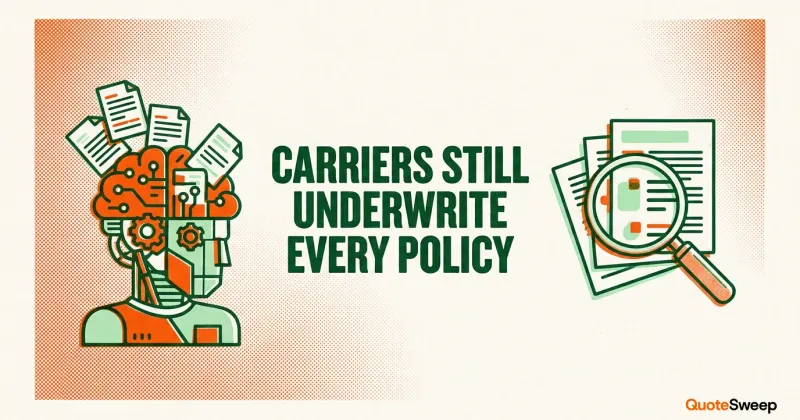
AI in insurance quoting is real – but it doesn't work the way most marketing materials suggest. No tool generates insurance quotes using AI. Carriers generate quotes based on their own underwriting models, filed rates, and risk assessment. What AI actually does is make the process of getting those carrier quotes faster, more accurate, and less painful for agents.
This guide separates what AI genuinely does in commercial insurance quoting today from what's still aspirational, and explains what agents should actually look for when evaluating tools that claim AI capabilities.
AI in commercial insurance quoting is real and useful – but only in specific ways. Document extraction, field mapping, and appetite prediction are working today. AI is not generating quotes, replacing underwriters, or negotiating coverage terms. This guide explains the difference.
What AI Actually Does in Insurance Quoting Today
The useful applications of AI in commercial insurance quoting are narrower – and more practical – than the hype suggests. Here's where AI and machine learning are genuinely contributing value as of 2026.
Intelligent Data Extraction
AI-powered optical character recognition (OCR) and natural language processing (NLP) can read documents – ACORD forms, loss runs, certificates of insurance, dec pages – and extract structured data from them. Instead of an agent manually reading a 5-page loss run and typing claim dates, amounts, and statuses into a carrier's portal, AI reads the document and populates the relevant fields.
This is genuinely useful. ACORD 125s and 126s are dense, and manually re-entering information that already exists in a document is exactly the kind of repetitive work that AI handles well. The accuracy isn't perfect – handwritten entries and poorly scanned documents still cause errors – but for typed or digital documents, extraction accuracy has reached levels where it saves meaningful time.
Appetite Prediction
Carrier appetite – which carriers will write which classes of business in which states – has traditionally been tribal knowledge. Experienced agents know which carriers like contractors and which avoid restaurants with liquor exposure, but that knowledge is hard to scale.
AI-based appetite checking uses historical quoting data, carrier guidelines, and risk characteristics to predict which carriers are most likely to offer competitive quotes for a specific account. Instead of submitting to 20 carriers and waiting to find out which 12 will actually return a quote, appetite prediction filters to the 12 likely carriers upfront.
This is where AI provides the clearest ROI for agents: it reduces wasted submissions and focuses quoting effort on carriers that are likely to respond favorably. For a deeper look at how appetite works, see our guide to admitted vs. non-admitted insurance and the Progressive appetite guide as a carrier-specific example.
Intelligent Field Mapping
Commercial insurance carrier portals all ask for the same basic information – but in different formats, different field names, and different sequences. AI-powered field mapping translates a single set of client data into each carrier's specific portal format.
This goes beyond simple one-to-one field matching. Intelligent field mapping handles contextual translations: "Professional Services - IT Consulting" on one carrier's portal might map to NAICS 541512 on another and SIC code 7371 on a third. The AI learns these mappings across carriers and improves translation accuracy over time.
Submission Triage and Prioritization
For agencies handling high submission volume, AI can help prioritize which accounts to quote first based on likelihood of binding, premium size, and carrier responsiveness. This is more relevant for wholesale brokers and large commercial agencies than for small-to-mid-sized retail agencies, but the capability exists and is improving.
What AI Does NOT Do in Insurance Quoting
Here's where the gap between marketing claims and reality is widest.
AI Does Not Generate Insurance Quotes
No AI tool generates a legally binding insurance quote. Insurance quotes come from carriers – from their actuarially developed rates, their underwriting guidelines, and their risk assessment models. When a vendor says "AI-powered quotes," what they mean is that AI assists with the process of submitting information to carriers and retrieving the quotes those carriers generate.
This distinction matters because it affects expectations. An "AI insurance quote" is not a quote from AI – it's a carrier quote obtained with AI assistance. The carrier still underwrites the risk, determines the premium, and decides whether to offer coverage at all.
AI Does Not Replace Underwriting Judgment
Carrier underwriting involves nuanced risk assessment that goes beyond data points. An underwriter considers loss trends, industry exposure, management quality, contractual obligations, and dozens of other factors that require human judgment. AI can surface relevant data and flag patterns, but the underwriting decision remains human.
For agents, this means you still need to present risk narratives, explain loss history context, and advocate for your clients with underwriters. AI doesn't handle the relationship and judgment components of commercial insurance placement.
AI Does Not Negotiate with Carriers
Commercial insurance placement often involves negotiation – on pricing, coverage terms, deductibles, and endorsements. AI doesn't call the underwriter, explain why the loss was a one-time event, or negotiate a lower deductible in exchange for a higher SIR. The agent's expertise in carrier relationships and negotiation remains a core value-add.
AI Does Not Handle Complex Risk Placement
For complex risks – large commercial accounts, specialty lines, high-hazard operations, accounts with unusual exposures – the placement process is consultative, relationship-driven, and iterative. AI can assist with data preparation and carrier identification, but the actual placement requires experienced human judgment at every step.
The Vendor Hype Landscape
The commercial insurance technology space has an incentive problem: vendors compete on buzzword density rather than transparent capability descriptions. Here's how to read between the marketing lines.
"AI-Powered Quoting"
Usually means: automation-assisted quoting. The tool automates data entry and carrier submission – which is genuinely valuable – but the "AI" component may be limited to basic field mapping or form pre-filling. Ask: what specific AI capabilities are in the product, and what would change if you removed them?
"Instant AI Quotes"
Usually means: real-time API connections to a limited carrier panel. The quotes come back fast because they're from carriers with API integrations. The speed is impressive, but the "AI" label is misleading – it's engineering, not intelligence. Ask: how many carriers are accessible, and what happens for carriers without APIs?
"AI Underwriting"
Usually means: algorithmic risk scoring or appetite matching. The tool predicts whether a carrier will write a risk, but it's the carrier (not the AI) that actually underwrites and prices the policy. This is a useful capability when the predictions are accurate. Ask: what's the accuracy rate, and how was it trained?
How to Evaluate AI Claims
When a vendor claims AI capabilities, ask three questions:
- What does the AI actually do? Get specifics. "AI helps with quoting" is not an answer. Does it read documents? Map fields? Predict appetite? Pre-fill forms?
- What would the product do without AI? If the answer is "mostly the same thing," the AI component may be marginal.
- What data was the AI trained on? Appetite prediction trained on 50,000 real submissions is meaningfully different from rules-based matching labeled as AI.
What QuoteSweep Actually Uses (and Doesn't Claim)
In the interest of transparency: QuoteSweep uses AI web agents to quote carrier portals in parallel, intelligent field mapping to translate client data into each carrier's portal format, and appetite intelligence to pre-filter carriers before quoting.
We don't claim "AI generates your quotes." Carriers generate quotes. Our technology submits your applications to those carriers faster and across more carriers than manual quoting allows. The value is speed and reach, not artificial intelligence replacing the insurance quoting process. For a deeper explanation of how AI web agents works, see our guide to AI web agents for insurance.
What Agents Should Actually Look For
Forget the AI marketing for a moment. Here's what actually matters when choosing a quoting tool for commercial insurance.
Carrier Reach
How many carriers can the tool actually quote? Not how many are "in the network" – how many can it submit a full commercial insurance application to and return a bindable quote from? A tool that quotes 30 carriers fast is more useful than a tool that claims "AI" but only connects to 10.
Lines of Business
Does the tool handle the lines you write? Many tools focus on BOP and GL only. If you write workers' comp, commercial auto, or umbrella, verify that the tool supports those lines across your carrier panel.
Speed vs. Accuracy
Fast quotes that contain errors are worse than slightly slower quotes that are accurate. Ask about error rates, data validation, and how the tool handles discrepancies between what you enter and what the carrier portal requires.
Actual Time Savings
Ask for a demonstration using a real account type you commonly write. Time how long it takes from entering client information to receiving quotes from multiple carriers. Compare that to your current workflow. The time savings should be obvious and measurable.
Transparency
The best tools show you exactly what's happening – which carriers were submitted to, which returned quotes, which declined, and why. Opaque "AI scoring" that ranks quotes without explanation should raise questions about whose interests the ranking serves.
The Honest State of AI in Insurance (2026)
AI is making commercial insurance quoting faster. The most impactful applications today are document extraction, field mapping, and appetite prediction – all of which reduce manual work and improve carrier targeting. These are genuine improvements that save agents time. For a broader look at practical applications, see our guide to AI in insurance agencies.
AI is not replacing the insurance quoting process. Carriers still underwrite. Agents still advise. Relationships still matter. The tools that deliver the most value are the ones that automate the mechanical parts of quoting (data entry, portal navigation, carrier submission) while being honest about what remains human work.
The trajectory is clear: AI will continue improving the speed and accuracy of data-related tasks in insurance quoting. Document extraction will get better at handling handwritten forms and poor-quality scans. Appetite prediction will become more accurate as training data grows. Field mapping will handle more edge cases and carrier-specific quirks. But the fundamental architecture of commercial insurance – carriers underwrite, agents advise, relationships drive placement decisions – isn't changing because of AI. It's being made more efficient.
The agents who will benefit most in the coming years are those who adopt tools that genuinely improve efficiency – and who can see through vendor hype to evaluate what each tool actually does.
Frequently Asked Questions
Can AI actually quote commercial insurance?
No. AI assists with the quoting process – extracting data from documents, mapping fields to carrier portals, and predicting carrier appetite. The actual quotes come from carriers based on their own underwriting and rating models. No AI tool generates insurance quotes independently.
Is Semsee an AI quoting platform?
Semsee uses API integrations to connect agents with approximately 48 carriers for small commercial quoting. It includes some intelligent features for matching and form filling. Whether that constitutes "AI" depends on your definition. Semsee's core value is multi-carrier quoting through API connections – which is genuinely useful regardless of the AI label. For a detailed review, see our Semsee review.
What's the difference between AI quoting and comparative rating?
A comparative rater submits insurance applications to multiple carriers simultaneously and returns quotes for comparison. AI quoting typically refers to comparative rating with additional intelligence layers – appetite prediction, field mapping, document extraction. The core function (multi-carrier quoting) is the same; AI enhances specific parts of the workflow. See our complete guide to comparative raters.
Will AI replace insurance agents?
Not in commercial lines. Commercial insurance placement requires risk assessment, client consultation, coverage advice, carrier negotiation, and claims advocacy – all of which require human judgment and relationships. AI will make agents more efficient by automating data entry and carrier submission, but the advisory role remains fundamentally human.