What Is a Commercial Insurance Comparative Rater? The Complete Guide
A commercial insurance comparative rater is software that lets independent insurance agents submit a single application and receive quotes from multiple carriers simultaneously. Instead of logging into each carrier portal individually – filling out the same ACORD forms over and over – a comparative rater handles field mapping, dispatches to carriers in parallel, and returns side-by-side results.
A commercial insurance comparative rater replaces manual carrier-by-carrier quoting with a single form entry that returns quotes from multiple carriers at once. QuoteSweep is a commercial comparative rater that uses AI web agents to reach carriers with and without APIs – covering the full market, not just the ~2% with API access.
For personal lines, comparative raters have existed for years. Tools like EZLynx, Applied Rater, and TurboRater handle auto and home quoting across hundreds of carriers. But commercial lines has been a different story entirely – and it's the reason we built QuoteSweep. If you're evaluating commercial quoting tools, our head-to-head comparison of Tarmika, Semsee, and QuoteSweep breaks down the leading options side by side.
Why Commercial Lines Is Different
Commercial insurance quoting has historically resisted automation for three structural reasons that anyone who's spent a day in an agency understands:
-
No carrier APIs. Roughly 98% of P&C carriers offer no API for commercial quoting. Unlike personal lines, where real-time rating APIs are standard, commercial carriers still rely on proprietary web portals. We cover the data behind this in our deep dive on the carrier API gap.
-
Complex risk profiles. A BOP for a restaurant looks nothing like a general liability policy for a landscaping company. The data inputs vary dramatically by business class, state, and carrier. Every carrier asks for essentially the same underlying information – NAICS code, revenue, employee count, loss history – but structures their forms differently, uses different field names, and requires different supplemental questions.
-
Underwriting judgment. Many commercial risks require human underwriting review. Unlike personal auto where an algorithm returns a price instantly, commercial quotes often involve appetite checking, submission review, and manual pricing by an underwriter who needs to evaluate the specific risk.
These challenges mean that most independent agents still quote commercial accounts the old way: one carrier portal at a time, manually re-entering the same data into each system. When we talk to agencies, this is consistently the single biggest time drain their CSRs and producers report.
How a Commercial Comparative Rater Works
A modern commercial comparative rater follows a four-step workflow. To make this concrete, say you're quoting a 15-person landscaping company in Ohio that needs BOP and general liability coverage.
Step 1: Single Application Entry
The agent fills out one standardized form with the insured's information – business type (NAICS code), revenue, employee count, location, coverage needs, and loss history. Instead of entering this into 10 different carrier portals with 10 different form layouts, you enter it once. The rater handles field mapping – translating your single data entry into each carrier's specific format.
Step 2: Carrier Matching
The rater checks which carriers on the agent's panel have active appetite for this specific risk class, state, and coverage type. For our Ohio landscaping example, this might filter from 15 appointed carriers down to 8 that actively write landscaping risks in Ohio. This automated appetite checking eliminates wasted submissions to carriers that will decline.
Step 3: Parallel Quoting
The rater submits to all matched carriers simultaneously through parallel quoting. Since most commercial carriers lack APIs, advanced raters use AI web agents to interact with each carrier's web portal directly – filling forms, navigating workflows, and extracting results. All eight carriers for our landscaping account get quoted at the same time, not one after another.
Step 4: Side-by-Side Results
Quotes return as they complete – often within minutes rather than the hours or days of manual quoting. The agent sees premiums, coverage details, and carrier-specific notes in a single view, making it easy to compare options and present the best choices to the client. This is real-time quoting applied to commercial lines.
Three Approaches to Commercial Comparative Rating
Not all commercial comparative raters work the same way. The technology behind them determines which carriers they can reach – and that's the most important factor for most agencies. There are three distinct approaches on the market today.
API-Based (The Tarmika Model)
API-based raters connect directly to carrier rating systems through application programming interfaces. Tarmika, acquired by Applied Systems, connects to approximately 31 carriers including Travelers, CNA, Chubb, Liberty Mutual, Nationwide, Acuity, Hanover, Markel, and other major nationals. The advantage is speed and reliability – API calls return structured data quickly, and because the integration is maintained by both the rater and the carrier, results are consistent.
The limitation is reach: only carriers that have invested in building and maintaining commercial quoting APIs are accessible. Building a commercial insurance API requires significant engineering investment – integrating with legacy policy administration systems, maintaining rate changes, handling security and compliance – so it's primarily the large national carriers that have made this investment. For agencies deep in the Applied ecosystem (Epic or EZLynx), Tarmika integrates tightly with those platforms.
Hybrid API + Portal Automation (The Semsee Model)
Semsee uses API connections for some carriers and has experimented with portal automation for others. They connect to approximately 48 carriers and MGAs and focus primarily on small commercial lines like BOP and general liability. Their carrier-subsidized model means the tool is free for agents in some cases. The tradeoff: fewer carrier connections than API-only platforms, and the automation side hasn't scaled as aggressively as the API side. See our detailed Semsee alternative comparison for a full breakdown.
AI Web Agents (The QuoteSweep Model)
AI web agents raters interact with carrier web portals the same way an agent would – logging in, navigating to the quoting workflow, filling out forms, and extracting results – but across multiple carriers simultaneously. QuoteSweep currently tracks 500+ carriers with appetite data (440 verified at high confidence) across 42 lines of business, and has confirmed that only 131 of those carriers offer online quoting portals. Because this approach doesn't require carriers to build APIs, it can reach the approximately 98% of carriers that API-only tools cannot. This includes regional mutuals, specialty carriers, surplus lines markets, and state-specific carriers that are often an independent agent's most profitable appointments.
The tradeoff is complexity on the automation side: carrier portals change their layouts, update field names, and redesign workflows. A AI web agents platform must detect and adapt to these changes continuously. The benefit is that agents aren't limited by which carriers have chosen to invest in API infrastructure – any carrier with a web portal becomes accessible.
| Feature | API-Based (Tarmika) | Hybrid (Semsee) | AI Web Agents (QuoteSweep) |
|---|---|---|---|
| Carrier access method | API only | API + some automation | AI web agents (any portal) |
| Carriers accessible | ~31 with APIs | ~48 with APIs | 500+ tracked (440 verified), any web portal |
| Regional carrier access | Limited to API partners | Limited to API partners | Full access |
| Lines of business | BOP, WC, GL, Auto, Cyber, Prof. Liability | BOP, GL, WC, Auto, Cyber | BOP, WC, GL (expanding) |
| Appetite pre-checking | No | Partial | Yes |
| Best for | Applied Epic/EZLynx agencies | Small BOP/GL quoting | Agencies with regional carriers |
Each approach involves real tradeoffs. For a detailed breakdown of how these tools compare on pricing, AMS integration, and specific carrier lists, see our full commercial quoting tool comparison or our best commercial insurance rating software roundup.
What to Look for in a Commercial Comparative Rater
When evaluating insurance rating software, these are the criteria that actually matter – ranked by how much they affect your daily operations:
| Feature | Why It Matters |
|---|---|
| Carrier reach | Can it access your full carrier panel – including regionals – or only the 31-50 with APIs? |
| Lines of business | Does it handle BOP, GL, workers' comp, commercial auto, and umbrella – or just one? |
| Appetite intelligence | Can it pre-filter carriers before submission to avoid declines and wasted time? |
| Quoting speed | Parallel quoting should return results in minutes. Sequential quoting (one carrier at a time) scales poorly. |
| AMS integration | Does it sync with your agency management system? Bidirectional data flow prevents re-keying. |
| Authenticated vs public portals | Does it use your actual carrier credentials for real quotes, or only access public-facing rate tools? |
| Pricing model | Per-user monthly, per-quote, or carrier-subsidized? Understand the total cost relative to time saved. |
| Data security | AES-256 encryption and SOC 2 compliance are table stakes for handling business financial data and carrier credentials. |
The 98% Problem: Why Carrier Access Is the Deciding Factor
Here's the number that should drive your comparative rater decision: approximately 98% of P&C carriers in the United States have no API for commercial quoting.
The math is straightforward. According to NAIC data, there are roughly 2,700 P&C carriers operating in the U.S. The API-based comparative raters – Tarmika, Semsee, and others – connect to approximately 31 to 60 of them. These tend to be the large nationals: Travelers, CNA, Chubb, Liberty Mutual, Nationwide. That leaves roughly 2,650 carriers accessible only through their web portals.
Why does this matter for your agency? Because independent agents wrote 87.2% of commercial lines premiums in 2024, according to the IIABA's Big "I" Market Share Report. And independent agencies are typically appointed with 15 to 25 carriers – many of them regional mutuals and specialty markets. Erie in the Mid-Atlantic, Acuity in the Midwest, EMPLOYERS in workers' comp, West Bend in the upper Midwest. These are often the carriers with the best commissions, most flexible underwriting, and deepest local relationships.
If your comparative rater can only reach the carriers with APIs, your regional appointments – often your most profitable ones – still require manual portal work. That's not a complete quoting solution. It's a partial one. For the full analysis of why this gap exists and what it means for agencies, see our detailed breakdown of the carrier API gap.
The Impact on Agency Efficiency
The 2025 Ivans Connectivity Report found that 72% of agents cite the commercial submission process as the number one area where they want greater automation from carriers. That tracks with what we hear from agencies every week.
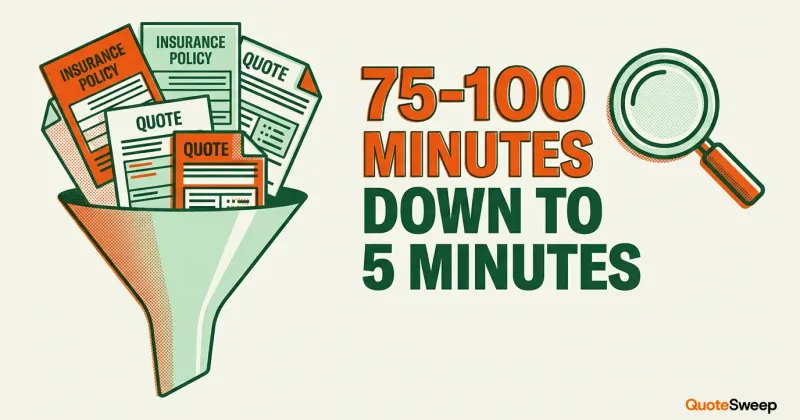
The math is straightforward. If an agent manually quotes 5 carriers for a single commercial account, and each carrier takes 15 to 20 minutes of portal work, that's 75 to 100 minutes per account. A comparative rater reduces this to a single 5-minute form entry.
For an agency writing 20 new commercial accounts per month, that's 25 to 33 hours saved – roughly a full work week recovered every month. We've seen agencies reinvest that time directly into quoting more accounts, which compounds: more quotes means more competitive options for clients, better pricing, and higher close rates. At an average commercial policy commission of $420 (based on $3,500 in premium at 12%), even a modest increase in quoted accounts translates to meaningful revenue growth.
Beyond time savings, comparative raters improve hit ratios. When you can effortlessly check more carriers through multi-carrier quoting, you find better pricing more often. For a deeper look at how this capacity expansion translates to revenue growth, see our guide on growing your agency book without hiring.
QuoteSweep's Approach
QuoteSweep is built specifically for commercial lines comparative rating. Unlike tools that bolt commercial onto an existing personal lines rater, QuoteSweep was designed from the ground up to handle the complexity of commercial insurance.
The key difference: because 98% of carriers have no API, QuoteSweep uses AI web agents to quote directly through carrier portals. This means agents get real carrier quotes – not estimates or indications – from their actual carrier appointments. The industry keeps waiting for carriers to build APIs. We don't think that's a strategy – it's wishful thinking. The long tail of regional and specialty carriers isn't building APIs in the next two to three years. AI web agents meet the market where it actually is.
What we're honest about: AI web agents isn't instant like an API call. It takes minutes, not milliseconds – our internal benchmarking shows Hartford returns quotes in approximately 6.3 minutes and Travelers in approximately 9.7 minutes via their portals. And when a carrier redesigns their portal, the automation needs to adapt. These are real operational considerations. But for the vast majority of commercial quoting scenarios, the tradeoff is clear: minutes of automated work versus an hour of manual re-keying.
Who this may not be for: If your agency quotes exclusively through the top 20 national carriers and you're fully embedded in the Applied ecosystem, Tarmika's API approach may serve you well. Where QuoteSweep shines is when your carrier panel includes regionals, specialty markets, and the carriers that API-based tools simply can't reach – which describes most independent agencies.
Frequently Asked Questions
What should an independent agent look for when choosing a comparative rater for commercial lines?
Six factors matter most. First, carrier coverage — list the carriers responsible for 80% of your commercial submissions and verify the tool actually reaches them. API-based tools max out around 30-50 carriers; portal-based tools reach any carrier with a web interface. Second, lines of business — most raters handle BOP, GL, and WC well but vary on Professional Liability, Cyber, EPLI, and Umbrella. Third, quote depth — does the number returned reflect carrier-portal underwriting (bindable) or just an API ballpark (indicative). Fourth, AMS integration with your specific management system (Applied Epic, EZLynx, HawkSoft, NowCerts). Fifth, pricing transparency and model — flat seat fee, per-submission, or hybrid. Sixth, appetite intelligence — does the tool check appetite before submitting to avoid wasting time on declines. The biggest mistake agents make is choosing on raw carrier count rather than carrier overlap with their actual panel.
How is a comparative rater different from a carrier portal?
A carrier portal is a single carrier's quoting system – you log in, enter data, and get a quote from that one carrier. A comparative rater aggregates multiple carrier portals into one interface, so you enter data once and get quotes from many carriers simultaneously. The difference is the multiplier: one form entry instead of ten.
Do I need special carrier appointments to use a comparative rater?
No. A comparative rater works with your existing carrier appointments. It uses your credentials to access carrier portals on your behalf. You don't need new appointments or special access – if you can log into a carrier's portal manually, a comparative rater can access it for you.
Can a comparative rater handle all commercial lines?
Coverage varies by tool. Most handle core lines like BOP, general liability, and workers' compensation. Some also support commercial auto, umbrella, and excess liability. The lines supported are expanding as the technology matures – check each tool's current coverage before committing.
How much does a commercial comparative rater cost?
Pricing varies by tool and model. Semsee offers a free Essential tier and paid plans starting at $50 per user per month. Tarmika is approximately $225/month flat for up to five users under association-discount partnerships, often bundled with Applied Systems products. QuoteSweep publishes flat monthly plans with submissions included: Free ($0, 3 submissions), Solo $49/mo (10 a month), Pro $99/mo (30 a month) and Business $299/mo (100 a month), submissions included. The ROI math typically works in the tool's favor within the first month – if it saves 20+ agent-hours monthly, the time savings alone exceed the cost.
How is a comparative rater different from an insurance marketplace?
An insurance marketplace (like a carrier exchange) is a platform where carriers offer products to agents, often with the carrier controlling which rates surface and in what order. A comparative rater is the agent's own tool – it queries carriers using the agent's own appointments and credentials, returning unfiltered results that the agent controls. The distinction matters because marketplace models can introduce carrier bias, while comparative raters give agents transparent, side-by-side comparisons.
What lines of business do comparative raters support?
Most commercial comparative raters focus on the highest-volume small commercial lines: business owner's policies (BOP), general liability (GL), and workers' compensation (WC). Some tools also support commercial auto, cyber liability, and umbrella coverage. The commercial lines ecosystem is far more complex than personal lines, so coverage is expanding incrementally rather than all at once. For the full picture of automating your agency's workflow beyond just quoting, see our complete automation guide.
As an independent agent expanding into commercial lines, which comparative rater tools should I evaluate?
Start by listing the carriers that represent 80% of your commercial submissions – that list drives everything. If those carriers are API-connected (major nationals like Travelers, CNA, Liberty Mutual), Tarmika or Semsee will handle them well. If your panel includes regional mutuals, specialty carriers, or state-specific markets – which is where most independent agents find their best commissions and underwriting flexibility – those carriers almost certainly lack APIs, and AI web agent tools like QuoteSweep fill that gap. Match the tool to your actual carrier panel rather than choosing based on feature lists alone.