Admitted vs Non-Admitted Insurance: What Every Independent Agent Needs to Know
Admitted insurance carriers are licensed and regulated by a state's Department of Insurance (DOI), and their policies are backed by the state's guaranty fund in case of insolvency. Non-admitted carriers – also called surplus lines or excess and surplus (E&S) carriers – are not licensed in the state where the policy is issued and their policies are not backed by state guaranty funds. Both types are legitimate insurance providers, but the regulatory framework, policyholder protections, and placement mechanics differ significantly.
For independent agents, the distinction between admitted and non-admitted insurance isn't academic – it determines which carriers you approach for a given risk, what compliance requirements you follow, and what you tell clients about the protections behind their policy.
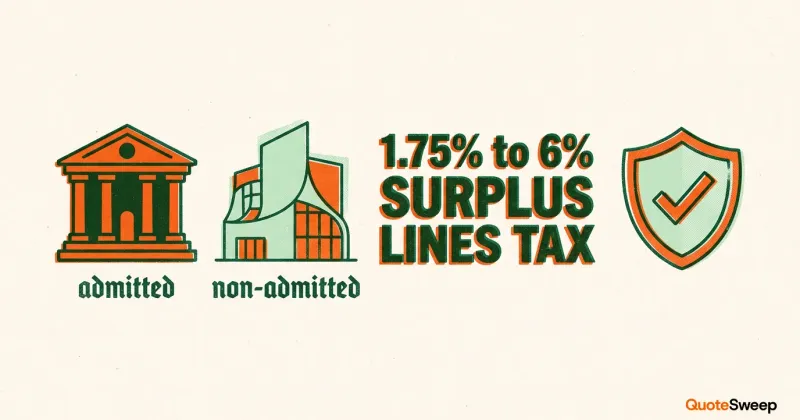
Admitted carriers are state-licensed, rate-filed, and backed by state guaranty funds. Non-admitted (surplus lines) carriers aren't licensed in the placement state, aren't rate-filed, and carry no guaranty fund protection – but they can write risks admitted carriers decline. Surplus lines taxes range from 1.75% to 6% by state.
What Makes a Carrier "Admitted"
An admitted carrier has been granted a license by a state's Department of Insurance to write specific lines of business in that state. To obtain and maintain this license, the carrier must:
Meet financial requirements. States require admitted carriers to maintain minimum capital and surplus levels, submit to regular financial examinations, and file annual financial statements with the NAIC (National Association of Insurance Commissioners).
File and get approval for rates. In most states, admitted carriers must file their rates and policy forms with the DOI for approval before using them. This means the state reviews what the carrier charges and what the policy covers. Depending on the state, this may be "prior approval" (rates approved before use), "file and use" (rates filed and used immediately, subject to review), or "use and file" (rates used immediately, filed afterward).
Participate in the guaranty fund. Admitted carriers contribute to the state's insurance guaranty fund. If an admitted carrier becomes insolvent, the guaranty fund pays claims – up to statutory limits. The NAIC model act sets the standard at $300,000 per claim, though some states set higher limits. State guarantee funds exist in all 50 states and DC to protect policyholders. This is the primary policyholder protection that distinguishes admitted from non-admitted coverage.
Accept regulatory oversight. The state DOI has direct authority over admitted carriers – including the ability to audit them, require corrective action, and handle consumer complaints.
The carriers most agents work with daily – Travelers, Hartford, CNA, Progressive, Nationwide, Liberty Mutual, Erie, Society Insurance, West Bend – are admitted in the states where they write business. When you quote through a carrier's portal and bind a policy, you're almost always working with an admitted carrier for standard commercial lines.
What Makes a Carrier "Non-Admitted"
A non-admitted carrier is not licensed in the state where the risk is located, but is typically licensed in its state of domicile and approved to write surplus lines business in other states. Most states maintain an "eligible surplus lines insurer" list – carriers that meet minimum financial standards and are authorized to write non-admitted business in the state, even though they're not fully licensed there.
Key differences from admitted carriers:
No rate filing requirement. Non-admitted carriers set their own rates without state DOI approval. This gives them pricing flexibility – they can rate unusual risks, emerging risk classes, and hard-to-place business that admitted carriers' filed rates can't accommodate.
No guaranty fund protection. If a non-admitted carrier becomes insolvent, the state guaranty fund does not pay claims. The policyholder's recourse is limited to whatever assets the carrier has available in insolvency proceedings. This is the most important client-facing distinction.
Surplus lines taxes and fees. Policies placed with non-admitted carriers are subject to state surplus lines taxes, which vary by state. These taxes are in addition to the premium and are typically passed through to the insured. Per STAMSITE, rates range from approximately 1.75% (Colorado) to 6% (Alabama) depending on the state.
Placement through surplus lines brokers. In most states, non-admitted business must be placed through a licensed surplus lines broker – either the agency itself (if licensed) or a wholesale surplus lines broker. The surplus lines broker handles the regulatory filing and tax remittance.
Well-known non-admitted carriers and E&S market players include Lloyd's of London (the largest surplus lines market), Markel, Scottsdale (a Nationwide subsidiary), Lexington (an AIG subsidiary), Nautilus (a Berkshire company), and numerous specialty MGAs and program administrators.
When to Use Admitted vs Non-Admitted Markets
The choice between admitted and non-admitted insurance isn't about quality or preference – it's about risk characteristics and market availability.
When Admitted Markets Work
Admitted carriers are the first choice for standard commercial risks. These are businesses with:
- Common industry classifications (IT consulting, retail, professional services, light manufacturing)
- Clean loss history (no claims or minimal claims in the past 3-5 years)
- Standard coverage needs (BOP, GL, WC with typical limits)
- Operations in states where the carrier has active appetite
Example: A 12-person IT consulting firm in Colorado with $2 million in revenue, no claims history, and standard BOP and workers' comp needs. This is a textbook admitted market risk. Multiple admitted carriers – Hartford, Travelers, Progressive, CNA, Hiscox – will compete for this account. Rates will be filed and competitive, and the policy will be backed by the state guaranty fund.
When Non-Admitted Markets Are Necessary
Non-admitted carriers exist to handle risks that admitted markets can't or won't write. Common scenarios:
Hard-to-place business classes. Some industries carry inherent risk that makes admitted carriers uncomfortable. Cannabis operations, firearms dealers, adult entertainment, haunted houses, skydiving operators – these business classes may have limited or no admitted market options.
Unusual or emerging risks. Cyber liability for cryptocurrency exchanges, event cancellation insurance for music festivals, pollution liability for environmental consulting firms. When the risk doesn't fit standard rating models, E&S carriers have the flexibility to write custom coverage.
Accounts with adverse loss history. A restaurant that's had three liability claims in two years may get declined by every admitted carrier. A surplus lines carrier can underwrite the risk at a premium that reflects the loss history.
High limits or unusual coverage structures. When a business needs $10 million in general liability or requires manuscript policy language for unique operations, the E&S market provides flexibility that admitted carriers' filed forms can't match.
State-specific gaps. Some risks are standard in most states but hard to place in specific states due to regulatory requirements, catastrophe exposure, or limited carrier appetite. Coastal property in hurricane-prone areas is a classic example.
Example: A restaurant in Louisiana with liquor liability exposure and two prior slip-and-fall claims in the past three years. Multiple admitted carriers will decline this risk based on the combination of class, exposure, and loss history. A surplus lines carrier can evaluate the risk individually and offer coverage – typically at a higher premium, reflecting the higher-risk profile.
Example: A licensed cannabis cultivation facility in any state. While President Trump signed an executive order in December 2025 directing the reclassification of marijuana from Schedule I to Schedule III, the formal rulemaking process is still underway as of early 2026, and cannabis remains a controlled substance under federal law. Most admitted carriers won't write cannabis-related coverage until reclassification is finalized. The cannabis insurance market remains overwhelmingly non-admitted, with specialized programs through surplus lines carriers and MGAs. This may gradually shift as rescheduling progresses, but admitted carrier entry is expected to be cautious and incremental.
How Surplus Lines Placement Works
Placing business with a non-admitted carrier involves additional steps compared to admitted market placement. Here's how the process works in practice.
The Diligent Search Requirement
Most states require a "diligent search" before placing business in the surplus lines market. This means the agent must demonstrate that they attempted to place the risk with admitted carriers and were unable to obtain coverage. The specifics vary by state – some states require written declinations from a minimum number of admitted carriers, others accept a certification that admitted markets were approached.
In practice, this requirement ranges from rigorous (states requiring documented declinations from three or more admitted carriers) to streamlined (states that maintain "export lists" of risk classes that can be placed directly in surplus lines without individual diligent search).
Surplus Lines Brokers
In most states, surplus lines business must be placed through a licensed surplus lines broker. If your agency holds a surplus lines license, you can place business directly with eligible non-admitted carriers. If not, you work through a wholesale surplus lines broker who handles the placement, filing, and compliance.
The surplus lines broker adds a layer to the submission process but also adds expertise. Experienced surplus lines brokers know which E&S carriers have appetite for specific risk classes, which underwriters are aggressive on pricing, and how to structure submissions for the best results.
Taxes and Filing
Surplus lines placements are subject to state-specific taxes that are separate from the premium itself. These taxes fund state regulatory oversight of surplus lines activity. The tax rates, filing deadlines, and reporting requirements vary by state.
Most surplus lines brokers handle the tax calculation, collection, and filing as part of their placement service. As the retail agent, you need to ensure the surplus lines tax is disclosed to the client and collected at binding.
The Practical Impact on Your Quoting Workflow
Understanding admitted vs non-admitted isn't just regulatory knowledge – it directly affects how you quote accounts efficiently.
Identifying the Right Market Early
The most common quoting mistake is spending 30 minutes submitting an E&S-caliber risk to admitted carriers that will all decline. If a risk has characteristics that suggest non-admitted placement – unusual class code, adverse loss history, high limits, or regulatory complexity – identifying that early saves time.
Automated appetite checking solves this problem at scale. Instead of manually evaluating each carrier's appetite for a specific risk, an appetite checking tool pre-filters your carrier panel to show which admitted carriers will write the risk and flags when the risk likely needs surplus lines placement. The agent sees the market disposition before submitting a single application.
Quoting Admitted and Non-Admitted Simultaneously
For borderline risks – accounts that might find coverage in either market – the most efficient approach is quoting both markets simultaneously. Submit to your admitted carriers through your standard quoting workflow while simultaneously reaching out to surplus lines markets. Compare the coverage and pricing side by side.
The challenge is that admitted and non-admitted quotes aren't directly comparable. Admitted quotes include guaranty fund protection and rate-filed pricing. Non-admitted quotes include surplus lines taxes but offer potentially broader coverage or availability. Presenting both options to the client with a clear explanation of the differences is part of your advisory role.
Client Communication
Clients need to understand what they're getting. When placing non-admitted coverage, the key points to communicate:
- The policy is with a carrier that is not backed by the state guaranty fund
- The carrier is authorized to write surplus lines business in the state (it's legal and legitimate)
- The premium includes surplus lines taxes in addition to the base rate
- The carrier was chosen because admitted markets could not provide coverage for their specific risk
Most clients accept non-admitted coverage readily once they understand that the alternative is no coverage at all. The guaranty fund distinction matters less to clients than the fact that they have the coverage they need to operate their business.
How Carrier Appetite Connects to Admitted vs Non-Admitted
Carrier appetite is the bridge between understanding the admitted/non-admitted distinction and applying it efficiently in your quoting workflow.
Every admitted carrier has appetite guidelines – the business classes, states, revenue ranges, and risk characteristics they're willing to write. When a risk falls outside every admitted carrier's appetite, it moves to the surplus lines market by necessity. But appetite isn't binary – it exists on a spectrum. A risk might be within appetite for one admitted carrier, borderline for another, and outside appetite for a third.
The practical implication: the more carriers you can check appetite against, the better your chance of finding admitted market coverage. An agent who checks 5 carriers may conclude a risk is E&S-only. An agent who checks 15 carriers may find an admitted option with a regional carrier that others missed.
This is where carrier panel breadth matters. Agencies appointed with more carriers – including regional and specialty markets – have more admitted market options before resorting to surplus lines. For context on why most carriers are only accessible through their web portals (not APIs), see our analysis of why 98% of carriers have no API. For a comparison of how different quoting tools handle carrier access – including which tools reach admitted regional carriers that others miss – see our Tarmika vs Semsee vs QuoteSweep comparison.
State-Specific Considerations
Surplus lines regulation varies significantly by state. A few important variations agents should be aware of:
Surplus lines taxes: Rates range from approximately 1.75% to 6% of premium depending on the state. Some states have additional fees or assessments.
Diligent search requirements: Some states require documented declinations from three or more admitted carriers. Others maintain export lists that allow direct surplus lines placement for specified risk classes. A few states have minimal diligent search requirements.
Filing and reporting: Deadlines and procedures for reporting surplus lines placements to the state vary. Some states require monthly filings, others quarterly or annually. Most surplus lines brokers handle this compliance.
Multi-state risks: When a risk has operations in multiple states, determining which state's surplus lines rules apply (and calculating multi-state taxes) adds complexity. Home state and multi-state allocation rules vary.
The critical takeaway: always verify surplus lines requirements for the specific state where the risk is located. Rules that apply in Texas may not apply in New York, and vice versa.
Frequently Asked Questions
Is non-admitted insurance less reliable than admitted?
Not necessarily. Many non-admitted carriers are large, financially strong companies – Lloyd's of London is the world's largest insurance marketplace and operates as a surplus lines market in the United States. The key difference is regulatory framework: admitted carriers are regulated by the state DOI and backed by guaranty funds, while non-admitted carriers have less state oversight and no guaranty fund protection. Financial strength ratings (AM Best, S&P) are the best indicator of carrier reliability regardless of admitted status.
Can an agent place surplus lines business directly?
In most states, yes – if the agent holds a surplus lines broker license in addition to their standard P&C license. If the agent doesn't hold a surplus lines license, they work through a wholesale surplus lines broker who handles the placement and compliance.
How do I know if a risk needs surplus lines?
Three indicators: (1) Admitted carriers are declining the risk based on class, loss history, or coverage needs. (2) The business operates in an industry with limited admitted market options (cannabis, firearms, certain entertainment). (3) The account needs unusual coverage terms, very high limits, or manuscript policy language that admitted carriers' filed forms can't accommodate. Appetite checking tools can also identify surplus lines-eligible risks before you start submitting to admitted carriers.
Do clients pay more for non-admitted coverage?
Usually, yes. Non-admitted premiums tend to be higher than admitted premiums for comparable risks – the carrier is pricing the additional risk that admitted markets declined. Clients also pay surplus lines taxes on top of the premium. However, for risks that have no admitted market option, the comparison isn't really "admitted vs non-admitted pricing" – it's "non-admitted coverage vs no coverage."
What happens if a non-admitted carrier goes insolvent?
Without guaranty fund protection, policyholders have claims against the carrier's remaining assets through the insolvency proceedings, but there's no state fund backstop to pay claims. This is why selecting financially strong non-admitted carriers (AM Best A- or better) is especially important for surplus lines placements. The risk of insolvency is real but rare for well-rated carriers.
Can the same carrier be admitted in some states and non-admitted in others?
Yes, this is common. A carrier might be admitted (fully licensed) in 30 states and write surplus lines business in 20 others. The carrier's admitted/non-admitted status depends on whether it holds a license in the specific state where the risk is located. For agents quoting multi-state accounts, it's worth checking each carrier's licensing status per state.