How Much Does Roofers Insurance Cost? 2026
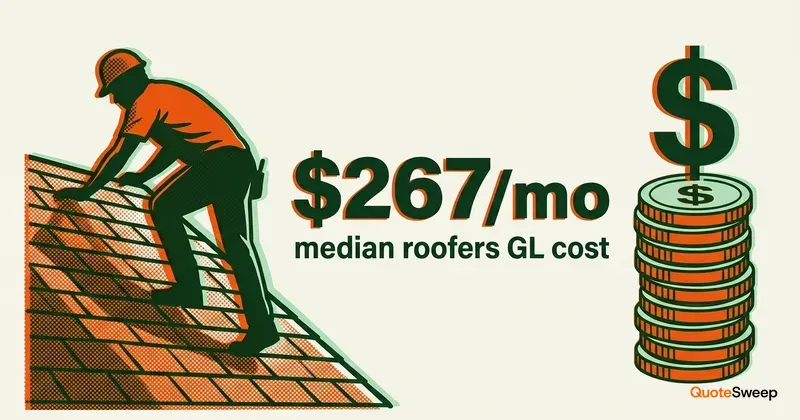
There is no single published "all-in" median premium for roofers, so the most defensible anchor is the baseline policy every roofer carries: general liability. Insureon reports a median GL premium of $267/month ($3,200/year) for a roofing contractor at $1M/$2M limits with a $1,000 deductible, and TechInsurance reports the same $267/mo ($3,200/yr). At the other end, NEXT Insurance says 97% of its roofing customers pay an average of just $133/month for GL (range $63–$661). For a broader "typical spend," MoneyGeek's 2026 report puts the average at $329/month ($3,944/year) per coverage line across five common lines for a 1–4-employee roofer.
This is an independent guide from QuoteSweep, which maps the modern commercial insurance landscape. Every dollar figure below is attributed to its source, and where sources conflict we show both rather than pick one. This is the cost companion to our coverage guide — for which policies a roofing contractor actually needs and why, see what roofers need.
TL;DR: Anchor on general liability: a median $267/mo ($3,200/yr) per Insureon and TechInsurance, while NEXT reports 97% of its roofing customers average just $133/mo. But GL is only the baseline. Roofers' costliest and most volatile line is workers' compensation — median $254/mo ($3,054/yr) per Insureon, though MoneyGeek's 2026 model runs $567/mo and swings from $306/mo to $1,905/mo per employee by state. There is no reliable single "total premium" for the average roofer, because sources describe different-sized businesses: Insureon/TechInsurance medians reflect small roofers, MoneyGeek's modeled figures run 2x+ higher, and NerdWallet (via Coverdash) reports ~$18,000/yr GL only for $10M+ revenue roofers. Read the numbers by line and by source, not as one blended average.
How much does roofers insurance cost?
Start with general liability, because it is the one policy every roofer carries and the only line with tightly clustered, roofer-specific data. Insureon's 2026 cost page reports a median GL premium of $267/mo ($3,200/yr) at $1M/$2M limits and a $1,000 deductible, and TechInsurance — its sister brand, drawing from the same kind of actual applicant quotes — reports the identical $267/mo ($3,200/yr). Those medians reflect what small roofing contractors actually bind.
NEXT Insurance tells a lower story from its own book: 97% of its roofing customers pay an average of just $133/mo for GL, in a range of $63–$661. And MoneyGeek's 2026 report — built on roughly 6M standardized pricing estimates across 10 providers, all 50 states plus DC, for roofers with 1–4 employees — frames "typical spend" differently, at an average $329/mo ($3,944/yr) per coverage line across five common lines, with any single policy ranging $87–$652/mo.
Here is the important part: there is no defensible single "all-in" number for the average roofer, and the sources diverge for a reason. Insureon and TechInsurance publish medians of policies small roofers actually buy, which run notably lower than MoneyGeek's standardized modeled estimates — MoneyGeek models GL at $652/mo ($7,829/yr) and workers' comp at $567/mo ($6,808/yr), roughly double the bound-policy medians. And NerdWallet (citing brokerage Coverdash) reports figures for a different business entirely: large commercial roofers with $10M+ annual revenue pay about $18,000/yr for GL alone. None of these is wrong; they describe small, modeled, and large roofers respectively. Cite the source and its method — not a blended average.
A note on confidence: this is medium-high. Five reputable sources publish roofer-specific figures, so the per-line numbers are well-sourced. But the methodology divergence above is real, and some construction-wide averages (BOP, commercial auto, umbrella, surety bond) are drawn from broader contractor data rather than roofers specifically. Treat every figure here as third-party marketing or editorial data — planning benchmarks, not a quote and not audited actuarial filings.
Cost by coverage
Here is how the individual lines a roofer carries price out, by source. No roofer buys all of these — the mix depends on payroll, vehicles, and what your general contractors demand — but seeing them separately shows where the money goes. All figures are the sources' own 2026 medians or averages.
| Coverage | Insureon (median) | TechInsurance | NEXT Insurance | MoneyGeek 2026 (avg) | NerdWallet / Coverdash ($10M+ rev) |
|---|---|---|---|---|---|
| General liability | $267/mo ($3,200/yr) | $267/mo ($3,200/yr) | 97% avg $133/mo (range $63–$661) | $652/mo ($7,829/yr) | ~$18,000/yr |
| Workers' compensation | $254/mo ($3,054/yr) | $226/mo ($2,715/yr) | — | $567/mo ($6,808/yr) | $12,000–$20,000/yr |
| Commercial auto | $173/mo ($2,075/yr) | $186/mo ($2,226/yr) | — | $221/mo ($2,652/yr) | — |
| Business owner's policy (BOP) | $98/mo ($1,173/yr) | $105/mo ($1,256/yr) | — | — | — |
| Professional liability (E&O) | $74/mo ($886/yr) | $65/mo ($785/yr) | — | — | — |
| Commercial umbrella | $81/mo ($977/yr) | $86/mo ($1,035/yr) | — | — | — |
| Tools & equipment | $14/mo ($169/yr) | — | 45% avg $30/mo | — | — |
| Commercial property | — | — | 40% avg $32/mo | $116/mo ($1,391/yr) | — |
| Surety bond | $8/mo ($100/yr) | $8/mo ($100/yr) | — | — | — |
| Builder's risk | — | — | — | — | ~$4,000/yr |
General liability. Your foundation policy and the one contracts, licenses, and general contractors require. Median $267/mo ($3,200/yr) per Insureon at $1M/$2M limits and a $1,000 deductible, and the same $267/mo ($3,200/yr) per TechInsurance. NEXT reports 97% of its roofing customers average just $133/mo (range $63–$661), while MoneyGeek's 2026 model runs far higher at $652/mo ($7,829/yr), with a state range from $396/mo in West Virginia to $1,158/mo in California. For large roofers, NerdWallet (via Coverdash) reports an average ~$18,000/yr at $10M+ revenue.
Workers' compensation. Usually the single biggest and most volatile line for a staffed roofer, because roofing sits in a high-hazard class driven by the trade's fall and injury rates, and it is priced off payroll. Median $254/mo ($3,054/yr) per Insureon and $226/mo ($2,715/yr) per TechInsurance (a construction average). MoneyGeek's 2026 model is $567/mo ($6,808/yr), with a per-employee state range from $306/mo in South Dakota to $1,905/mo in New York — a six-fold swing that makes geography and payroll the dominant variables. NerdWallet/Coverdash reports $12,000–$20,000/yr for $10M+ revenue roofers.
Commercial auto. For the trucks that haul crews and material. Median $173/mo ($2,075/yr) per Insureon and $186/mo ($2,226/yr) per TechInsurance. MoneyGeek's 2026 average is $221/mo ($2,652/yr), with a state range from $251/mo in Iowa to $738/mo in New York.
Business owner's policy (BOP). Where it's available, a BOP bundles property and GL. Median $98/mo ($1,173/yr) per Insureon, and $105/mo ($1,256/yr) per TechInsurance (a construction average). One caveat specific to this trade: many roofers can't get a BOP at all because of the elevated risk, and instead buy standalone GL plus commercial property. Don't assume a BOP is on the table until a carrier confirms eligibility.
Professional liability (E&O). Less commonly carried by roofers than GL or workers' comp. Median $74/mo ($886/yr) per Insureon at $1M/$1M limits, and $65/mo ($785/yr) per TechInsurance.
Commercial umbrella. Extra liability limits stacked over your GL and auto, often required by larger general contractors. Median $81/mo ($977/yr) per Insureon and $86/mo ($1,035/yr) per TechInsurance.
Tools & equipment. Covers the ladders, nail guns, and gear a crew loses to theft or damage. Median $14/mo ($169/yr) per Insureon; NEXT reports 45% of its roofing customers add it at an average $30/mo.
Commercial property. For a shop, yard, or storage. MoneyGeek's 2026 average is $116/mo ($1,391/yr), with a state range from $102/mo in North Dakota to $139/mo in New York; NEXT reports 40% of its roofing customers carry it at an average $32/mo.
Surety bond. Often required for licensing or a specific job. Median $8/mo ($100/yr) per Insureon, and the same $8/mo ($100/yr) per TechInsurance.
Builder's risk. Project-specific coverage for work in progress. NerdWallet (via Coverdash) reports an average ~$4,000/yr for $10M+ revenue roofers — a large-contractor figure, not a small-roofer benchmark.
What drives the cost for roofers
The factors that move a roofer's premium most, in rough order of impact:
- Elevation and fall exposure. Roofing has among the highest injury rates of any trade, and per NerdWallet and Insureon this is the single biggest reason roofers pay more than other subcontractors. It sits behind every high number on this page.
- Payroll size and number of employees. The primary rating base for workers' comp — the roofer's most volatile line — so headcount and payroll move the premium up faster than anything else.
- Roofing type. Commercial, steep-slope, and hot-tar or torch-down work rates higher than residential asphalt shingle.
- State and location. GL, workers' comp, and auto vary several-fold by state. Per MoneyGeek's 2026 data, GL runs $396/mo in West Virginia to $1,158/mo in California, and workers' comp swings from $306/mo per employee in South Dakota to $1,905/mo in New York.
- Annual revenue and job size. Large commercial roofers ($10M+ revenue) pay about $18,000/yr for GL and $12,000–$20,000/yr for workers' comp, per NerdWallet/Coverdash — orders of magnitude above the small-roofer medians.
- Claims and loss history. Prior claims raise premiums; a clean record lowers them, per Insureon.
- Coverage limits and deductibles. Higher limits and lower deductibles increase the premium, per Insureon.
- Use of commercial vehicles and work trucks. Each vehicle adds commercial auto exposure.
- Catastrophe and crime exposure of your service area. Disaster-prone or high-crime areas cost more, per Insureon.
How to lower your premium
- Run a documented safety and fall-protection program. OSHA-compliant harnessing and training reduce the workers' comp and GL losses that drive a roofer's rates.
- Choose higher deductibles in exchange for lower premiums — Insureon notes the deductible level directly affects price.
- Bundle GL and property into a BOP where eligible instead of buying standalone policies (Insureon puts the roofer BOP median at $98/mo) — but confirm you qualify first, since many roofers don't.
- Use pay-as-you-go workers' comp tied to actual payroll to avoid over-paying up front.
- Classify payroll correctly, separating lower-risk clerical and estimating staff from roofing-crew class codes.
- Maintain a claims-free record and a favorable experience mod over time.
- Collect certificates of insurance from every subcontractor so their exposure isn't rated onto your policy.
- Shop and compare multiple carriers and marketplaces — Insureon, NEXT, Simply Business, TechInsurance — rather than auto-renewing.
- Right-size your limits to contract and state-license requirements instead of over-buying.
- Review coverage annually as crew size, revenue, and job mix change.
Affordable options
If you're pricing a roofing business in 2026, these four modern insurers are worth a quote. Match them to your crew size and hazard, and always compare against at least one or two other carriers before you bind.
Foresight — built for higher-hazard trades like roofing, it bakes active safety and loss-control support into the policy, which can pull down the claims-driven workers' comp costs that dominate a roofer's bill over time.
Pie — a small-business workers' comp specialist that prices comp fast with its own data model, the right first call when your biggest and most volatile line is comp for a crew working at height.
NEXT Insurance — a digital carrier that writes GL, workers' comp, commercial auto, and tools coverage in one online flow, geared toward roofers who want fast quoting and everything bundled under one login.
biBERK — the direct-to-business arm of Berkshire Hathaway, competitive for straightforward roofing operations that want financial strength, umbrella capacity, and a buy-direct experience without a broker in the middle.
Frequently Asked Questions
How much does roofers insurance cost per month?
Anchor on general liability, the one policy every roofer carries: a median $267/mo ($3,200/yr) per both Insureon and TechInsurance at $1M/$2M limits, while NEXT reports 97% of its roofing customers average just $133/mo (range $63–$661). For a broader typical spend, MoneyGeek's 2026 model averages $329/mo per coverage line across five common lines for a 1–4-employee roofer. Your all-in cost climbs from there once you add workers' comp and commercial auto.
Why is there no single "average" roofer premium?
Because no source publishes a defensible all-in total, and the sources that exist describe different-sized businesses. Insureon and TechInsurance report medians of policies small roofers actually bind (GL ~$267/mo, workers' comp ~$254/mo). MoneyGeek's standardized modeled estimates run 2x+ higher (GL $652/mo, workers' comp $567/mo). And NerdWallet (via Coverdash) reports figures only for $10M+ revenue roofers. Read the numbers by line and by source, not as one blended average.
How much does workers' comp cost for a roofer?
It's usually the biggest and most volatile line, priced off payroll and heavily state-sensitive given roofing's fall and injury rates. Median $254/mo ($3,054/yr) per Insureon and $226/mo ($2,715/yr) per TechInsurance. MoneyGeek's 2026 model runs $567/mo ($6,808/yr), with per-employee rates from $306/mo in South Dakota to $1,905/mo in New York. Large roofers pay $12,000–$20,000/yr, per NerdWallet/Coverdash.
Why do large roofers pay so much more?
Premiums scale with revenue, payroll, and job size. Per NerdWallet (citing Coverdash), roofers with $10M+ annual revenue average about $18,000/yr for GL alone, $12,000–$20,000/yr for workers' comp, and ~$4,000/yr for builder's risk — figures that dwarf the small-roofer medians because they reflect far more payroll, more vehicles, larger commercial jobs, and higher required limits.
The bottom line
There is no single "all-in" number for the average roofer, so anchor on general liability — a median $267/mo ($3,200/yr) per Insureon and TechInsurance, with NEXT reporting 97% of its roofing customers at just $133/mo — and build from there. Workers' comp is the line that decides your total: median $254/mo per Insureon, but MoneyGeek's 2026 model runs $567/mo and swings from $306/mo to $1,905/mo per employee by state. Mind the methodology gap — Insureon/TechInsurance medians reflect small roofers, MoneyGeek's modeled figures run 2x+ higher, and NerdWallet's apply only to $10M+ revenue roofers — and cite the source, not a blended average. Run a documented safety program, classify payroll correctly, and compare multiple carriers — including Foresight, Pie, NEXT Insurance, and biBERK — before you bind. For which coverages you need and why, read what roofers need; for the wider benchmark, see the small-business insurance cost guide.
