Klaimee vs AIUC: Which AI Agent Insurer Fits?
Both Klaimee and AIUC show up when a company wants to insure autonomous AI agents, and both do something insurers rarely do: they assess the agent itself before they stand behind it. The difference is what that assessment is. Klaimee runs its own audit and scores an agent across eight risk dimensions; AIUC leads with AIUC-1, a published standard that accredited third parties audit against. Both sit inside the emerging AI agent insurance category on the ai-agents hub.
This is an independent comparison from QuoteSweep, which maps the modern commercial insurance landscape. QuoteSweep does not compete with any of these companies.
TL;DR: Klaimee is a Y Combinator-backed specialist that insures autonomous AI agents against both third-party harm (an agent harming your customers) and first-party harm (an agent damaging your own systems or data), pairing coverage with its own audit that scores risk across eight dimensions. AIUC, the Artificial Intelligence Underwriting Company, leads with AIUC-1, a public six-pillar certification standard verified by accredited third-party auditors, and layers insurance on top. Neither publishes pricing. Pick Klaimee if agents are your core exposure; pick AIUC if you want a formal, recognizable certification alongside coverage.
The one-line difference
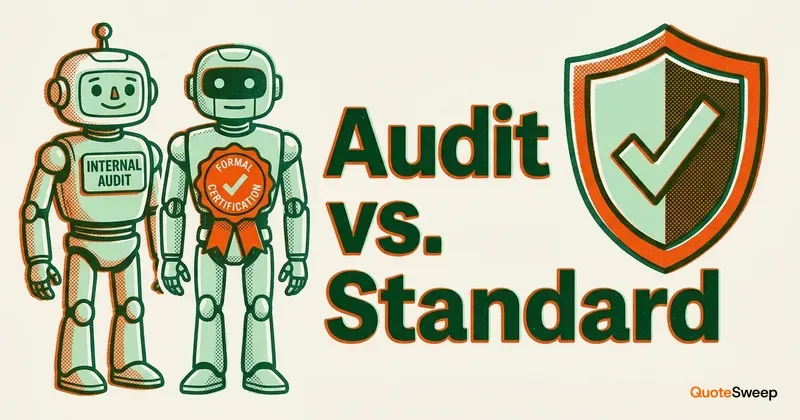
Klaimee sells insurance for autonomous agents and certifies them through an audit it runs itself. AIUC builds a standard first, has accredited third parties audit against it, and treats insurance as the layer on top. Both want to prove how an agent is governed before covering it; the split is a private audit versus a public standard.
Model and coverage
Klaimee insures autonomous AI agents specifically, covering losses that traditional errors and omissions (E&O) and cyber policies carve out when the harm comes from an AI agent. It covers two categories: third-party harm, where an agent harms customers or outside parties, and first-party harm, where an agent damages the company's own systems, data, or records. Named scenarios include hallucinated outputs, unauthorized actions, data exposure, prompt-injection attacks, and wrongful communications an agent makes on its own. Coverage is paired with an assessment: a roughly ten-minute declarative application, an audit of the agent's stack and policies, a risk score across eight dimensions (scope, data exfiltration, unauthorized action, output integrity, adversarial manipulation, behavioral stability, model drift, and operational control), a certification report with remediation recommendations delivered within days, and ongoing access to an adversarial testing environment. Klaimee is Y Combinator-backed and was founded by Ines Boutemadja (CEO) and Julien Catonnet (CTO). It focuses on B2B companies with bounded use cases and is explicitly not aimed at autonomous vehicles, robotics, or physical-world safety systems.
AIUC combines three things: the AIUC-1 certification standard, independent audits, and insurance. AIUC-1 is built around six pillars: data and privacy, security, safety, reliability, accountability, and societal risks, and it draws on established frameworks including MITRE ATLAS. Certification is verified through independent audits performed by accredited firms, with the audit and assurance firm Schellman noted as the first organization accredited to conduct AIUC-1 audits. On top of the standard and audits, AIUC provides insurance that protects enterprises against business losses from AI agent failures, with pricing that reflects how safe a given system is shown to be. Its advisors include Stanford professor Sanmi Koyejo, former Google CISO Phil Venables, and research scientist Keri Pearlson. Per reporting, AIUC emerged from stealth in 2025 with a $15M seed backed by Nat Friedman, and is based in San Francisco.
Neither company publishes coverage limits or pricing. AIUC's insurance details are limited publicly; Klaimee states no public metrics or pricing.
At a glance
| Klaimee | AIUC | |
|---|---|---|
| What it is | Insurance + certification for autonomous AI agents | AI agent standard (AIUC-1) + audits + insurance |
| Backing | Y Combinator-backed | $15M seed, backed by Nat Friedman (reported); San Francisco |
| The assessment | Own audit scoring risk across eight dimensions | AIUC-1 standard (six pillars), verified by accredited third-party audits |
| Coverage shape | Third-party and first-party agent harm | Insurance vs. business losses from agent failures (details limited publicly) |
| Distinctive feature | Eight-dimension audit + ongoing adversarial testing | Public certification standard meant as an enterprise-trust credential |
| Draws on | Its own eight risk dimensions | Established frameworks, including MITRE ATLAS |
| Pricing | Not published | Not published; tied to how safe the system is shown to be |
| Best for | Vendors and enterprises insuring autonomous agents | Enterprises and vendors wanting a certified-plus-insured approach |
Who each one fits
Klaimee fits you if agents are your core exposure. It is narrow and deep: built to insure and certify the autonomous agents you deploy or sell, covering first-party damage to your own systems as well as third-party harm. It is a strong fit for an AI vendor that needs both a policy and a certification it can hand to an enterprise buyer, or an enterprise running agents internally on bounded use cases.
AIUC fits you if you want a recognizable, third-party credential. Its emphasis is a formal standard, AIUC-1, audited by accredited outside firms and positioned to become an industry credential the way recognized security and privacy certifications did for software. That leans toward enterprises adopting agents with caution and AI companies that want to earn enterprise trust by getting certified against a published bar, then carry insurance behind it.
If your main question is which agent-insurance model to standardize on, the deciding factor is whether you value a specialist's own audit and first-party coverage (Klaimee) or a public, independently audited standard that buyers can recognize (AIUC).
Frequently Asked Questions
Is Klaimee or AIUC better for AI agent insurance?
Neither is universally better; they lead with different things. Klaimee is a specialist that insures autonomous agents and certifies them through its own eight-dimension audit, covering both third-party and first-party harm. AIUC leads with AIUC-1, a public certification standard audited by accredited third parties, with insurance layered on top.
What is the main difference between Klaimee and AIUC?
Both pair coverage with an assessment of the agent, but the assessment differs. Klaimee runs its own audit and risk scoring. AIUC's assessment is AIUC-1, a formal six-pillar standard verified by independent, accredited auditors such as Schellman, intended to work as an industry credential.
Does AIUC publish its certification standard?
Yes. AIUC-1 is a public certification standard built around six pillars (data and privacy, security, safety, reliability, accountability, and societal risks) and draws on established frameworks including MITRE ATLAS. It is verified through independent audits by accredited firms.
Which should an AI vendor choose?
An AI vendor whose product is agents can go either way. Klaimee covers first-party damage to your own systems and pairs coverage with certification and ongoing adversarial testing. AIUC gives you a recognizable third-party credential (AIUC-1) to show cautious enterprise buyers, with insurance behind it. Compare the actual terms for your specific deployment, since neither publishes pricing.
The bottom line
Klaimee and AIUC are aimed at the same problem, insuring autonomous AI agents, from two angles. Klaimee is the specialist: its own audit, an eight-dimension risk score, first-party plus third-party coverage, and ongoing adversarial testing, backed by Y Combinator. AIUC is the standards-first player: AIUC-1 as a public, accredited-audited certification meant to become a credential, with insurance on top, reportedly backed by a $15M seed from Nat Friedman. Choose Klaimee if the agents you deploy or sell are your core exposure and you want first-party coverage; choose AIUC if a recognizable, independently audited certification matters as much as the policy. Because neither publishes pricing, compare the actual quote and terms for your deployment before deciding.
Compare both, plus the rest of the field, on the ai-agents hub, or read the full Klaimee and AIUC profiles. For the full category, see AI agent insurance explained.