Professional Liability Insurance (E&O) Explained
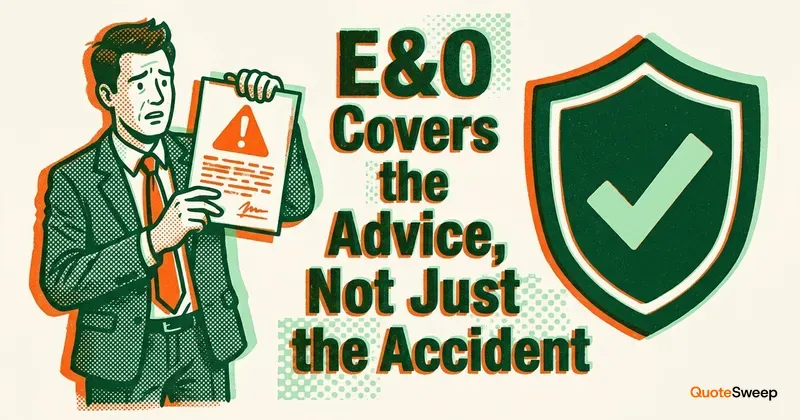
Professional liability insurance, usually called errors and omissions (E&O) coverage, protects a business or professional when a client claims that their advice, service, or work caused a financial loss. It pays for legal defense and any settlement or judgment, even when the claim turns out to have no merit. For anyone paid to provide expertise, advice, or a specialized service, it is the coverage that answers the core risk of the job: a client who believes your work cost them money.
What professional liability covers
E&O responds to claims arising from the professional services you provide. The typical triggers are:
- Negligence or mistakes in your work
- Errors and omissions that lead to a client loss
- Missed deadlines or failure to deliver a promised service
- Bad or disputed advice a client relied on
- Misrepresentation of what you could do
The policy pays your defense costs, which are frequently the largest expense even on a groundless claim, plus settlements or damages up to your limit. Coverage is usually written per claim and per aggregate (the most the policy pays in a policy period).
Errors and omissions vs professional liability
They are the same thing. "Errors and omissions," "E&O," and "professional liability" are interchangeable names for coverage against claims that your professional work caused a client financial harm. Some fields use their own label, for example "malpractice" for medical and legal professionals or "professional indemnity" in other markets, but the coverage does the same job.
How it differs from general liability
Professionals often assume general liability covers a mistake in their work. It does not. The two cover different risks and do not overlap. We break the distinction down in professional liability vs general liability, but the short version:
| Professional Liability (E&O) | General Liability (GL) | |
|---|---|---|
| Covers | Financial harm from your advice or work | Bodily injury and property damage |
| Typical claim | "Your work cost us money" | "A client tripped in your office" |
A professional who also has an office clients visit usually needs both. GL is often bundled with property in a business owner's policy (BOP), while E&O is typically a standalone policy.
Who needs professional liability insurance
Anyone paid for advice, expertise, or a specialized service. Requirements and risk vary by field, so coverage is usually shaped to the profession. Common examples with dedicated guides:
- Consultants
- IT consultants
- Accountants
- Lawyers
- Architects
- Engineers
- Real estate agents
- Estheticians
- Personal trainers
- Life coaches
- Nurse practitioners
- Therapists
- Counselors
- Social workers
- Veterinarians
Many client contracts also require you to carry it at a specified limit before work can start, which is often the reason a professional buys a policy in the first place.
Claims-made vs occurrence (why the retroactive date matters)
Most E&O is written on a claims-made basis. That means the policy covers a claim only if it is reported while the policy is active and the work happened after a set retroactive date. Two consequences:
- Keep continuous coverage. A gap can leave earlier work unprotected.
- Watch the retroactive date when you switch insurers, and consider "tail" coverage (an extended reporting period) if you stop a policy, so late-arriving claims on past work are still covered.
An occurrence policy, by contrast, covers claims from work done during the policy period no matter when the claim is filed. Occurrence forms are less common in professional lines.
What drives the premium
There is no single price for E&O. The main factors:
- Revenue and the size of the engagements you take on
- The services you provide and how high-stakes the advice is
- Coverage limits (clients often dictate a minimum)
- Claims history
- Retroactive date and years of continuous coverage
Because these vary so much between a solo practitioner and a large firm, the only reliable way to price it is to get quoted on your actual details.
How to get covered
- An independent agent can quote E&O across multiple carriers and match limits to what your contracts require.
- A direct online insurer works for simpler, lower-revenue professionals who need coverage quickly.
- A specialty brokerage helps when your field is regulated, technical, or hard to place. One AI-native option focused on professional and financial services is Harper.
Compare more than price: check the limit, the retroactive date, and whether defense costs sit inside or outside your limit, since that changes how much protection you actually have.
Frequently Asked Questions
Is professional liability the same as errors and omissions insurance?
Yes. Professional liability, E&O, and (in some fields) malpractice or professional indemnity are different names for the same coverage against claims that your professional work caused a client a financial loss.
Does general liability cover professional mistakes?
No. General liability covers bodily injury and property damage. Financial harm from your advice or services is covered by professional liability (E&O).
What is a retroactive date?
On a claims-made policy, the retroactive date is the point after which your work must have been done for a claim to be covered. Keeping continuous coverage protects your earlier work.
How much professional liability insurance do I need?
It depends on your field, revenue, and what your contracts require. Many clients specify a minimum per-claim limit; quote your actual details to size it properly.
Get a quote for professional liability
For related reading, see professional liability vs general liability and the E&O glossary entry.