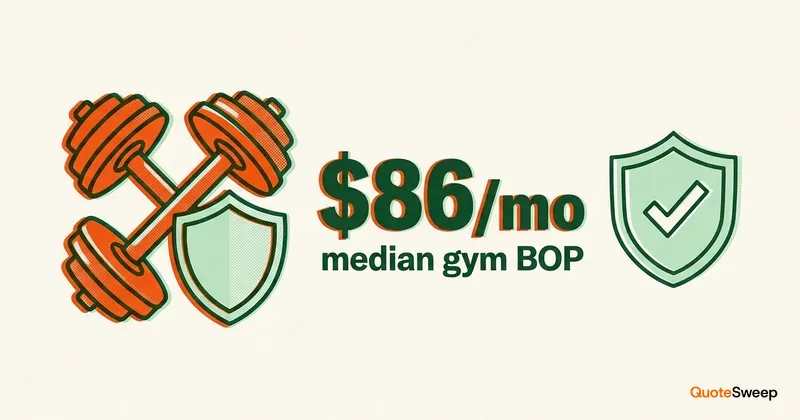
A typical small gym or fitness studio (1–4 employees, standard $1M/$2M limits) pays roughly $85–$90 per month — about $1,030–$1,085 per year — for its core coverage. Two independent sources converge here: Insureon reports a median Business Owner's Policy (BOP) — the core bundle of general liability plus commercial property — of $86/month ($1,031/year) for gyms and fitness centers, and MoneyGeek's 2026 modeled report puts the blended average across six common coverage lines at about $90/month ($1,085/year) for a gym with 1–4 employees.
This is an independent guide from QuoteSweep, which maps the modern commercial insurance landscape. Every figure below is attributed to its source so you can see exactly which population each number describes. This is the cost companion to our coverage guide on what gyms and fitness studios need — head there for what each policy actually covers; this page focuses on price.
TL;DR: Budget about $86/month ($1,031/year) for the core BOP at the median (Insureon), or ~$90/month ($1,085/year) as a blended 2026 average across six lines (MoneyGeek). Those numbers cover general liability plus property. Add workers' comp, professional liability, or commercial auto and total spend climbs fast — a fuller package commonly runs $1,500–$4,000/year for a small studio (FitSmallBusiness). The widest-spread line is general liability, where Insureon's gym median ($69/mo) and MoneyGeek's model ($131/mo) disagree — read it as a ~$69–$131/month range. Your own number depends most on your activities and risk mix, your payroll and headcount, and your state.
Compare business insurance options
How much does gym insurance cost?
The most defensible core figure is Insureon's median BOP for gyms and fitness centers: $86/month, about $1,031/year, at $1M/$2M limits with a $1,000 deductible (Insureon). A BOP bundles general liability with commercial property, so it's the single line that covers the most ground for the least money — which is why it's the right anchor for a small studio.
MoneyGeek's 2026 modeled report independently corroborates that anchor from a different direction. Rather than measuring actual purchases, it models roughly 6 million pricing estimates across 10 insurers and all states, and lands at about $90/month ($1,085/year) as a blended average across six common coverage lines for a gym with 1–4 employees. Two very different methods — median of real gym applications versus modeled all-state average — arriving at essentially the same ~$85–$90/month is about as much agreement as you'll get in small-business insurance.
One caveat before you anchor on that number: it's the core bundle, not your total bill. Once a studio adds workers' comp for staff, professional liability for training advice, or commercial auto, total spend rises quickly. A fuller package commonly runs $1,500–$4,000/year for a small studio, per FitSmallBusiness. The section below breaks down each line so you can build up your own estimate.
Cost by coverage
Gyms don't buy one policy — they assemble a stack. Here's what each line runs, attributed to its source. Where a gym-specific figure exists we use it; where two sources disagree we show both.
General liability (GL). This is the widest-spread line. Insureon's median for gyms and fitness centers is $69/month ($825/year) at $1M per-occurrence / $2M aggregate. MoneyGeek's 2026 model runs higher for gyms specifically at $131/month ($1,575/year), with a state range from about $100/month (North Dakota) to $191/month (California). The gap is a methodology difference — Insureon's median of actual gym purchases versus MoneyGeek's modeled all-state average — so GL is best expressed as a ~$69–$131/month range. For context, across the broader "sports & fitness" category (which folds in lower-risk trainers and instructors), Insureon's GL median drops to just $29/month ($350/year), with 56% paying under $30/month and 86% under $60/month (Insureon). Separately, NerdWallet — citing Coverdash — reports personal trainers (an adjacent, lower-risk segment, not gyms) pay a median of $600/year for GL (NerdWallet).
Business Owner's Policy (BOP — GL + commercial property bundle). Insureon's median for gyms and fitness centers is $86/month ($1,031/year) at $1M/$2M limits with a $1,000 deductible (Insureon). The broader sports/fitness BOP median is lower at $67/month ($800/year) (Insureon). Bundling into a BOP is why the core cost stays near $86/month rather than the sum of buying GL and property separately.
Workers' compensation. Insureon's median for gyms and fitness centers is $102/month ($1,221/year) (Insureon). MoneyGeek's 2026 model is close at about $98/month ($1,173/year) for gyms, with a wide per-employee state spread from about $55/month (Indiana) to $231/month (California) (MoneyGeek). Because workers' comp is rated per $100 of payroll, a common industry rule of thumb is $0.75–$2.50 per $100 of payroll (wod.guru). The broader sports/fitness workers' comp median is lower at $64/month ($768/year) (Insureon).
Professional liability (professional / E&O — covers training-advice claims). Insureon's median for gyms and fitness centers is $42/month ($503/year) at $1M/$1M with a $500 deductible (Insureon). MoneyGeek's 2026 figure for gyms is higher at $63/month ($758/year) (MoneyGeek). For the adjacent personal-trainer segment (not gyms), NerdWallet/Coverdash report a median of $900/year (NerdWallet).
Other lines. Insureon's gym-specific medians run $129/month ($1,552/year) for cyber and $245/month ($2,942/year) for commercial auto (Insureon). MoneyGeek's 2026 gym figures are lower on these: commercial property $53/month ($630/year), cyber $101/month ($1,209/year), and commercial auto $97/month ($1,170/year) (MoneyGeek). You only pay for auto if you own vehicles, so many studios skip it entirely.
What drives the cost for gyms and fitness studios
Seven factors move a gym's premium up or down, in rough order of impact:
Services offered and activity risk profile. This is the biggest category driver. Insurers rate a spin studio, a powerlifting gym, a youth sports program, and a CrossFit box very differently — heavy free weights, contact and combat classes, and youth programs all push GL up (Insureon, MoneyGeek).
Number of employees and total payroll. This is the primary driver of workers' comp, which is rated per $100 of payroll, and a factor in GL and BOP pricing too (MoneyGeek, Insureon).
Location / state. GL for gyms ranges from about $100/month (North Dakota) to $191/month (California), and workers' comp per employee ranges from about $55/month (Indiana) to $231/month (California), per MoneyGeek's 2026 report.
Property and equipment value. More machines, more buildout, and owned real estate raise commercial property and BOP premiums (Insureon, Wexford).
Coverage limits and deductible chosen. Higher limits and lower deductibles raise the premium (Insureon).
Annual revenue, gym size, and membership volume. Larger facilities and higher foot traffic increase exposure (MoneyGeek, FitSmallBusiness).
Years in operation and claims history. Prior injury or slip-and-fall claims raise your rate (Insureon).
How to lower your premium
Insureon, FitSmallBusiness, and the other sources point to a consistent set of levers:
- Buy a BOP instead of standalone GL + property. The bundle costs less than buying each separately (Insureon).
- Raise your deductible. A higher out-of-pocket deductible lowers the premium — just keep it to an amount you could actually pay on a claim (Insureon).
- Right-size your limits. Match your limits to your actual exposure rather than over-insuring (Insureon).
- Reduce claims risk operationally. Signed liability waivers, staff certifications and CPR, equipment maintenance logs, and slip-and-fall prevention improve your loss history and future pricing (Wexford, FitSmallBusiness).
- Shop and compare multiple carriers. Pricing for the same gym varies widely by insurer — compare through a brokerage or marketplace rather than taking a single quote (NerdWallet, Simply Business, MoneyGeek).
- Classify activities accurately and drop lines you don't need. Don't pay for irrelevant exposure — for example, skip commercial auto if you own no vehicles (Insureon).
- Pay annually and bundle policies with one insurer where the carrier offers a discount (FitSmallBusiness).
Affordable options
If you want to shop gym and fitness coverage directly, these are insurtechs QuoteSweep has profiled independently. Compare at least two — appetite and pricing vary by carrier and by business.
Next Insurance — now branded ERGO NEXT after Munich Re's ERGO Group acquired it in 2025 — is a digital-first small-business insurer that quotes and binds online in under 10 minutes. It writes a broad multi-line stack including general liability, property, workers' comp, and professional liability, and per its own site has insured 750,000+ customers across 1,300+ business types. The broadest all-in-one fit if you want the whole gym stack from one fast, well-backed provider.
biBERK is a direct-to-business insurer that's part of the Berkshire Hathaway Insurance Group, writing on carriers rated A++ (Superior) by AM Best. It sells GL, BOP, workers' comp, and more online with no brokers and positions on savings of up to 20% by removing the middleman. The trust-and-stability pick for a standard studio.
Thimble sells on-demand coverage — by the job, month, or year — that you can modify, pause, or cancel instantly. It's a wholly owned subsidiary of Arch Insurance Group and writes GL for 1,000+ activities. Best when your format is boutique, seasonal, or pop-up rather than a full-time facility.
Hiscox specializes in small-business coverage and is a strong pick for the professional liability exposure that matters most in fitness — the training-advice claims a BOP alone won't cover. Good fit if E&O for instruction is your priority line.
Frequently Asked Questions
How much does gym insurance cost per month?
Budget about $86/month ($1,031/year) for the core BOP bundle at the median, per Insureon — and MoneyGeek's 2026 modeled report independently lands at about $90/month ($1,085/year) as a blended average across six lines. That covers general liability plus commercial property. Add workers' comp, professional liability, or auto and your total climbs from there.
Why is my gym's general liability quote higher than $69/month?
Because $69/month is Insureon's median of actual gym purchases, and your quote reflects your specific risk mix. MoneyGeek's 2026 model puts gym GL higher at $131/month, with a state range from about $100/month (North Dakota) to $191/month (California). Read GL as a ~$69–$131/month range. Heavy free weights, contact classes, youth programs, or a high-cost state all push you toward the top end.
What does a full gym insurance package cost per year?
The core BOP runs about $1,031/year (Insureon). Layer on workers' comp (Insureon median $1,221/year), professional liability ($503/year), and any other lines, and a fuller package commonly runs $1,500–$4,000/year for a small studio, per FitSmallBusiness. Your total depends on how many lines you carry and your payroll, activities, and state.
What's the cheapest way to insure a gym?
Per Insureon and FitSmallBusiness: buy a BOP instead of standalone GL + property, raise your deductible to an amount you could actually pay, right-size your limits, drop lines you don't need (like auto if you own no vehicles), and compare at least two carriers since gym pricing varies widely by insurer. Reducing claims risk operationally — waivers, staff CPR certs, equipment maintenance logs — keeps future rates down too.
The bottom line
The most defensible core number for gym and fitness studio insurance is Insureon's median BOP of $86/month ($1,031/year), independently corroborated by MoneyGeek's 2026 blended average of about $90/month ($1,085/year) for a 1–4 employee gym. Treat that as the anchor for general liability plus property — not your total bill. Add workers' comp, professional liability, and any other lines and a fuller small-studio package commonly lands at $1,500–$4,000/year (FitSmallBusiness). Your own number rides mostly on your activities and risk mix, your payroll and headcount, and your state (GL alone spans ~$69–$131/month across sources). For what each policy actually covers, see our coverage guide on what gyms and fitness studios need; for how gyms compare to other trades, see the broader small-business insurance cost guide. The only way to know your real price is to quote it — compare at least two carriers.