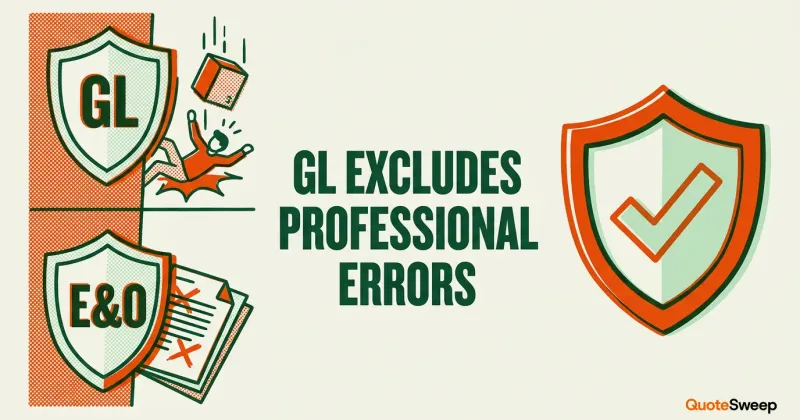
Professional vs General Liability Explained
Professional liability and general liability are two fundamentally different coverages that protect against fundamentally different risks – yet clients confuse them constantly. When a business owner says "I have liability insurance," they almost always mean general liability. But if they're a consultant, accountant, architect, IT provider, or any professional who gives advice or performs services, general liability alone leaves a massive gap. Professional liability (also called errors and omissions, or E&O) covers what general liability specifically excludes: claims arising from professional mistakes, bad advice, missed deadlines, and service failures.
Understanding the distinction isn't just academic – it's an E&O issue for agents. Failing to recommend professional liability to a client who needs it is one of the most common sources of agent errors and omissions claims. This guide breaks down what each policy covers, the critical differences between them, who needs which coverage, and how the two policies interact.
For agents placing both lines, understanding commercial insurance underwriting for each coverage type and knowing how claims-made and occurrence triggers differ is essential to properly protecting clients.
TLDR: General liability covers bodily injury and property damage to third parties – someone slips in your office, your employee damages a client's property. Professional liability covers financial losses caused by your professional mistakes – bad advice, errors in deliverables, missed deadlines. GL is occurrence-based; professional liability is claims-made. Most service-based businesses need both. Neither covers the other's exposures, and clients who only carry one are leaving a significant gap.
What General Liability Covers
General liability insurance – formally called commercial general liability (CGL) – is the foundation of most business insurance programs. The standard ISO CGL form (CG 00 01) covers three main categories of claims:
Coverage A: Bodily Injury and Property Damage
This is what most people think of when they hear "liability insurance." It covers claims where a third party (customer, visitor, vendor, member of the public) suffers:
- Bodily injury – physical harm, including medical expenses, lost wages, pain and suffering, and death
- Property damage – damage to or destruction of another party's tangible property
Common GL claim examples:
- A customer slips on a wet floor in your office and breaks their wrist
- Your employee accidentally damages a client's property while working on site
- A delivery person trips over exposed wiring at your warehouse and requires surgery
- A product you sold causes physical harm to a consumer (products-completed operations)
Coverage B: Personal and Advertising Injury
This covers non-physical harms, including:
- Libel and slander – defamatory statements about a person or business
- False arrest or detention – wrongfully detaining someone
- Malicious prosecution – baseless legal proceedings
- Invasion of privacy – unauthorized use of someone's likeness or information
- Copyright infringement in advertising – using copyrighted material in your ads
Coverage C: Medical Payments
Medical payments coverage (often called "med pay") pays for minor medical expenses incurred by third parties injured on the insured's premises, regardless of fault. Limits are typically $5,000 to $10,000 per person. Med pay is designed to handle small claims quickly, preventing them from becoming lawsuits.
Key GL Characteristics
- Coverage trigger: Occurrence – the policy in effect when the injury or damage happened responds, regardless of when the claim is filed
- Defense costs: Outside the policy limit – the carrier pays defense costs in addition to the stated limit
- Standard limits: $1M per occurrence / $2M general aggregate for most small commercial accounts
- Rating basis: Revenue, payroll, square footage, or unit count depending on the class of business
What Professional Liability Covers
Professional liability insurance – also called errors and omissions (E&O) – covers claims alleging that the insured's professional services or advice caused financial harm to a client. This is not about physical injuries or property damage. Professional liability covers the economic consequences of professional mistakes.
Core Covered Acts
- Errors – mistakes in professional work product (a bookkeeper transposes numbers, an engineer miscalculates load capacity, a software developer delivers code with critical bugs)
- Omissions – failure to do something that should have been done (a real estate agent fails to disclose a material defect, an insurance agent fails to recommend a necessary coverage)
- Negligent acts – professional work performed below the standard of care expected in the profession
- Misrepresentation – providing inaccurate information or advice that causes financial harm
- Breach of duty – violating the professional duty owed to a client
- Missed deadlines – failure to complete work on time, resulting in financial loss for the client (a tax preparer misses a filing deadline, an attorney misses a statute of limitations)
Common Professional Liability Claim Examples
- An accountant fails to identify a tax deduction, costing the client $50,000 in overpaid taxes
- An architect's design contains an error that requires $200,000 in remediation during construction
- A technology consultant installs a system that doesn't function as specified, causing the client to lose revenue during the transition
- A marketing agency's campaign contains a factual error about a competitor, resulting in a defamation lawsuit against the client
- A financial advisor recommends an investment strategy that produces significant losses
- An insurance agent fails to place coverage the client requested, and the client suffers an uninsured loss
Key Professional Liability Characteristics
- Coverage trigger: Claims-made – the policy in effect when the claim is reported responds, subject to the retroactive date
- Defense costs: Typically inside the policy limit (eroding/burning limits) – defense costs reduce the amount available for settlements or judgments
- Standard limits: $500K to $2M, depending on profession and risk level
- Rating basis: Revenue, number of professionals, fee income, or specialty area
- Retroactive date: Critical – only covers claims arising from acts committed after this date
Key Differences at a Glance
| Feature | General Liability (CGL) | Professional Liability (E&O) |
|---|---|---|
| What it covers | Bodily injury, property damage, personal/advertising injury | Financial loss from professional errors, omissions, negligence |
| Type of harm | Physical injury, tangible property damage | Economic/financial loss |
| Coverage trigger | Occurrence (date of event) | Claims-made (date claim is reported) |
| Defense costs | Outside the limit | Typically inside the limit |
| Policy form | ISO CG 00 01 (standardized) | Non-standardized (varies by carrier) |
| Tail coverage needed? | No (occurrence coverage is permanent) | Yes, if policy is canceled |
| Typical limits | $1M/$2M | $500K–$2M |
| Who needs it | Nearly every business | Service-based and advisory businesses |
| Exclusion overlap | Excludes professional services claims | Excludes bodily injury/property damage |
Who Needs Which Coverage
Businesses That Need GL Only
Very few businesses truly need only GL. However, businesses whose operations involve minimal professional service or advice may find GL is their primary liability coverage:
- Retail stores
- Restaurants (though restaurant-specific liability is complex)
- Landscaping and lawn care (basic operations)
- Janitorial and cleaning services
- Warehousing and storage
Even these businesses may benefit from professional liability if they provide any advisory component – a lawn care company that designs outdoor plans, for example, is performing a professional service.
Businesses That Need Professional Liability Only
Even fewer businesses need only professional liability. Most still face premises liability and general commercial risks that require GL. However, some very specialized consultancies operating entirely remotely with no physical client interactions may prioritize professional liability. In practice, we almost always recommend both.
Businesses That Need Both (Most Service Businesses)
The majority of service-based businesses need both coverages because they face both types of exposure:
| Industry | GL Exposure | Professional Liability Exposure |
|---|---|---|
| Accountants / CPAs | Client visits office, slips and falls | Tax error costs client money |
| Architects / Engineers | Job site injury to visitor | Design error requires costly remediation |
| IT Consultants | Technician damages client equipment on site | System implementation fails, causing downtime |
| Real Estate Agents | Open house visitor injury | Failure to disclose material defect |
| Insurance Agents | Client injured at agency office | Failure to place proper coverage |
| Attorneys | Client injured on premises | Missed statute of limitations |
| Marketing Agencies | Event setup causes property damage | Campaign error leads to client lawsuit |
| Management Consultants | Consultant's office has premises exposure | Advice leads to client financial loss |
| Healthcare Providers | Patient slip and fall | Misdiagnosis or treatment error (malpractice) |
| Financial Advisors | Client injured at office | Investment recommendation produces losses |
The Contract Requirement Factor
Many clients discover they need professional liability when a contract requires it. Large corporate clients, government agencies, and project owners frequently require vendors and consultants to carry professional liability with minimum limits (often $1M or $2M) before they'll award a contract. Agents who proactively recommend professional liability help clients stay contract-ready.
Claims-Made vs. Occurrence: Why It Matters Here
The different coverage triggers between GL (occurrence) and professional liability (claims-made) create practical issues agents need to manage.
How the Triggers Work in Practice
GL scenario (occurrence): A contractor's employee damages a client's floor in June 2025. The client doesn't discover the damage and file a claim until March 2026. The contractor's 2025 GL policy responds because the damage occurred during the 2025 policy period – even though the contractor may now have a different carrier for 2026.
Professional liability scenario (claims-made): A consultant delivers a flawed report in June 2025. The client discovers the error and files a claim in March 2026. The consultant's 2026 professional liability policy responds – because that's the policy in effect when the claim was made – as long as the retroactive date predates the June 2025 error.
Why This Difference Matters for Agents
- Switching GL carriers is straightforward – occurrence coverage from the old carrier remains in effect for past events permanently
- Switching professional liability carriers requires careful attention to retroactive dates. If the new carrier sets a new retroactive date (rather than matching the old one), there's a gap for prior acts. The client needs either tail from the old carrier or prior acts coverage from the new carrier.
- When a client closes their business, GL claims from past events are covered by the occurrence policies they held during those events. But professional liability claims need tail coverage – or the client has no ability to report claims for past professional work.
For a detailed breakdown of how these triggers work, see our complete guide on occurrence vs. claims-made.
Where the Coverages Overlap – and Don't
The Professional Services Exclusion in GL
Most CGL policies contain a "professional services" exclusion (either in the base form or by endorsement) that removes coverage for claims arising from the rendering of or failure to render professional services. This exclusion is what creates the gap that professional liability fills.
Without this exclusion, a client might try to make a professional negligence claim under their GL policy. With it, the carrier makes clear: GL covers physical injuries and property damage, not professional mistakes.
The Bodily Injury/Property Damage Exclusion in Professional Liability
Professional liability policies typically exclude bodily injury and property damage claims – those belong under the GL policy. A professional liability policy won't cover a situation where a consultant's employee trips and breaks a client's expensive equipment. That's a GL claim.
Scenario: Where Both Policies Might Apply
An architect designs a building with a structural flaw. During construction, the flaw causes a partial collapse that injures a worker and requires $300,000 in redesign work.
- The bodily injury claim (worker's medical expenses, lost wages, pain and suffering) goes to the architect's GL policy – it's physical injury caused by the architect's operations
- The financial loss claim ($300,000 in redesign costs) goes to the architect's professional liability policy – it's economic loss caused by a professional error
In reality, these claims often get litigated under both policies, with carriers arguing over which policy responds to which portion of the damages. This is another reason clients need both coverages – having only one creates gaps where the other policy's exclusions apply.
How Professional Liability Policies Differ from Carrier to Carrier
Unlike GL, which is largely standardized through ISO form CG 00 01, professional liability policies are non-standardized. Each carrier drafts its own form, which means significant variations in coverage terms. Key differences agents should compare:
Definition of Professional Services
Some policies define "professional services" narrowly (only the specific services listed on the declarations). Others use broader definitions that cover any service the insured is professionally qualified to perform. A narrow definition can leave gaps if the insured's practice evolves.
Definition of Claim
What constitutes a "claim" triggers the policy. Definitions vary:
- Narrow: A written demand for money or services, or a civil proceeding
- Broad: Includes oral demands, regulatory proceedings, arbitration, mediation, and even pre-claim "circumstances that may give rise to a claim"
A broader claim definition is generally better for the insured because it allows them to report potential claims earlier, securing coverage under the current policy.
Consent to Settle (Hammer Clause)
Many professional liability policies include a "consent to settle" or "hammer clause" – if the carrier wants to settle a claim and the insured refuses, the insured's recovery may be limited to the amount the carrier could have settled for. Hammer clauses vary in severity:
- Full hammer: Insured bears 100% of costs above the rejected settlement
- Modified hammer (50/50): Insured and carrier split costs above the rejected settlement
- No hammer: Insured has full control over settlement decisions
Extended Reporting Period (Tail)
Tail availability, duration, and cost vary by carrier. Some policies offer automatic short-term tail (30–60 days) at no charge, with optional purchased tail for 1–5 years or unlimited. Others require the insured to purchase tail immediately upon cancellation with no automatic extension.
Pricing Comparison
General Liability Premiums
GL premiums for service-based businesses are typically moderate because the exposure is primarily premises-based (client visits the office) rather than operations-based (working with heavy equipment). General benchmarks:
- Office-based professionals: $400–$1,500/year for $1M/$2M limits
- Field-based service businesses: $1,000–$5,000/year depending on operations
- Revenue-rated classes: typically $3–$15 per $1,000 of revenue
Professional Liability Premiums
Professional liability premiums vary significantly by profession, revenue, claims history, and limits:
- IT consultants: $1,000–$5,000/year
- Accountants/bookkeepers: $1,000–$4,000/year
- Architects/engineers: $3,000–$15,000/year (higher due to project severity)
- Attorneys: $3,000–$20,000+/year depending on practice area
- Insurance agents E&O: $2,000–$8,000/year
- Management consultants: $1,500–$5,000/year
- Real estate agents: $500–$2,000/year
According to Insureon, the median cost of professional liability for small businesses is approximately $1,735 per year, though this varies widely by profession and exposure.
How to Quote Both Coverages
When to Package vs. Write Separately
- BOP + standalone professional liability – the most common structure for small service businesses. The BOP bundles GL, property, and business income; professional liability is written as a separate policy.
- Professional liability package – some carriers offer professional liability with GL endorsement included, particularly for low-risk professional classes. This can be cost-effective but may limit GL coverage customization.
- Management liability package – for businesses that also need D&O and EPLI, a management liability package that includes professional liability alongside other management liability coverages can produce pricing efficiencies.
- Standalone for each – larger or more complex accounts may need standalone GL and standalone professional liability to get the best terms on each.
Quoting Checklist
For GL:
- ACORD 125/126 applications
- Revenue, payroll, and square footage
- Operations description and class codes
- Location details
- 5-year loss history
For professional liability:
- Professional liability application (carrier-specific)
- Revenue and fee income from professional services
- Number and types of professionals
- Services performed and client types
- Prior coverage details including retroactive date
- Claims history and known circumstances
- Sample contracts (some carriers review contract terms)
Quoting Tips
- Always compare defense cost treatment on professional liability. Inside-the-limit vs. outside-the-limit is a major coverage difference. A $1M professional liability policy with defense inside limits may only provide $600K–$700K in actual protection after defense costs.
- Match retroactive dates when remarketing. Moving the retroactive date forward on a professional liability policy creates a dangerous gap for prior professional acts.
- Check the professional services exclusion on the GL. Make sure you know exactly what the GL excludes – some professional services exclusions are very broad and may exclude claims that the professional liability policy also doesn't cover, creating an uninsured gap.
- Recommend both coverages proactively. Don't wait for a client to ask about professional liability. If they provide any form of professional service or advice, document your recommendation – whether they accept or decline.
Frequently Asked Questions
Can I just buy general liability and skip professional liability?
If your business provides any professional service, advice, or consultation, no. General liability specifically excludes professional errors and omissions. A client who suffers financial loss from your professional mistake will file a claim that your GL policy won't cover. Even if the claim is baseless, defense costs for an uninsured claim come out of your pocket.
Does a BOP include professional liability?
A standard BOP bundles general liability and commercial property – it does not include professional liability. Some carriers offer a professional liability endorsement that can be added to a BOP, but in most cases, professional liability is written as a separate policy.
What is the difference between professional liability and malpractice insurance?
They're essentially the same coverage under different names. "Malpractice" is typically used in healthcare (medical malpractice) and legal contexts (legal malpractice). "Professional liability" or "E&O" is the broader industry term used across all professions. The coverage concept is identical: protection against claims arising from professional errors, omissions, or negligence.
Why is professional liability claims-made instead of occurrence?
Professional errors often aren't discovered for months or years after the work is performed. An architect's design flaw might not surface until the building is renovated a decade later. A tax advisor's error might not be found until an IRS audit years later. The claims-made structure gives carriers the ability to price for known risk periods and manage their long-tail exposure through retroactive dates and step rating. For a full explanation, see our guide on occurrence vs. claims-made.
Do I need professional liability if I'm an independent contractor?
Yes – arguably even more so than if you were employed by a firm. When you're an independent contractor, you don't have an employer's insurance covering your work. If a client alleges your work product caused them financial harm, you're personally exposed. Many clients and staffing agencies require independent contractors to carry professional liability before engaging them.