Occurrence vs Claims-Made: Agent's Complete Guide
Every liability policy uses one of two coverage triggers – occurrence or claims-made – and the distinction affects everything from how claims are handled to what happens when a policy is canceled. As agents, we answer questions about this constantly, and getting it wrong creates real E&O exposure. A client who switches from claims-made to occurrence without tail coverage has a gap that could leave them uninsured for past acts. A client who doesn't understand retroactive dates may assume they're covered when they're not.
This guide covers how each trigger works, which commercial lines use which form, the mechanics of tail coverage and prior acts, and practical answers to the questions clients ask most.
TLDR: Occurrence policies cover incidents that happen during the policy period regardless of when the claim is filed. Claims-made policies cover claims that are both reported and arise from incidents occurring after the retroactive date, during the policy period. GL is almost always occurrence; professional liability, D&O, and EPLI are almost always claims-made. Switching between forms or canceling claims-made policies requires careful handling of tail coverage to avoid gaps.
How Occurrence Policies Work
An occurrence policy covers any incident (the "occurrence") that takes place during the policy period, regardless of when the claim is actually reported. The coverage trigger is the date of the event – not the date the claim is filed.
The Key Advantage: Permanent Protection
Once an occurrence policy is in effect for a given period, that coverage is locked in permanently for any events that occurred during that period. Even if the policy is canceled or non-renewed, the insured can report claims for covered events that happened while the policy was active – years or even decades later.
Example: A general contractor has a CGL policy from January 1 to December 31, 2025. In March 2025, a customer trips over debris at a job site. The customer doesn't file a lawsuit until September 2027 – well after the policy has expired. Under an occurrence trigger, the 2025 policy responds because the incident occurred during the 2025 policy period.
Where Occurrence Policies Are Used
- Commercial general liability (CGL) – nearly always written on an occurrence basis using ISO form CG 00 01
- Commercial property – inherently occurrence-based (damage happens at a specific time)
- Commercial auto – occurrence basis
- Workers' compensation – occurrence basis (date of injury or last exposure)
- Umbrella/excess liability – follows the form of underlying policies, which are typically occurrence
Occurrence Pricing Characteristics
Occurrence policies tend to have higher premiums than comparable claims-made policies because the carrier takes on "long-tail" risk – the possibility that a claim from the policy period could surface years or decades later. Occurrence premiums run roughly 30% higher than equivalent claims-made premiums at mature rates, according to industry data. The carrier must reserve for potential future claims from every occurrence policy they've ever written, which makes pricing inherently more expensive.
How Claims-Made Policies Work
A claims-made policy covers claims that satisfy two conditions:
- The claim must be made (reported) during the policy period – the insured must notify the carrier while the policy is active
- The wrongful act must have occurred after the retroactive date – an important date specified on the declarations page
Both conditions must be met. A claim filed during the policy period for an act that occurred before the retroactive date is not covered. A claim filed after the policy expires for an act that occurred during the policy period is also not covered – unless extended reporting (tail) coverage is purchased.
Critical Dates in Claims-Made Policies
Retroactive date: The earliest date from which covered acts are eligible for coverage. This is typically the date the insured first obtained claims-made coverage (the "inception date" of the first claims-made policy). When a policy is renewed with the same or a new carrier, the retroactive date should remain the same – it should never move forward if the insured has maintained continuous coverage.
Policy period: The time window during which claims must be reported.
Extended reporting period (ERP) / Tail: An optional extension that allows the insured to report claims after the policy expires for acts that occurred between the retroactive date and the policy expiration.
Step Rating: How Claims-Made Premiums Work
Claims-made policies use "step rating," where premiums start low and increase each year for the first five years until reaching a "mature" rate:
| Policy Year | Typical Premium as % of Mature Rate |
|---|---|
| Year 1 | 25%–40% |
| Year 2 | 40%–55% |
| Year 3 | 55%–70% |
| Year 4 | 70%–85% |
| Year 5 (Mature) | 100% |
The logic is straightforward: in Year 1, the retroactive date is the policy inception, so the carrier is only exposed to claims arising from acts committed during that single year. By Year 5, the carrier is exposed to claims from five years of prior acts – hence the higher premium.
Where Claims-Made Policies Are Used
- Professional liability / E&O – almost exclusively claims-made
- Directors & officers (D&O) – claims-made
- Employment practices liability (EPLI) – claims-made
- Cyber liability – predominantly claims-made
- Medical malpractice – both forms exist, but claims-made is more common
- Pollution liability – typically claims-made
Claims-made is used for these lines because the harm often isn't discovered until long after the wrongful act – a professional error may not surface for years, a D&O decision may trigger litigation much later, and data breaches may go undetected for months. The claims-made structure gives carriers more pricing control over this long-tail uncertainty.
Tail Coverage (Extended Reporting Period)
Tail coverage is the most critical – and most commonly misunderstood – aspect of claims-made policies. When a claims-made policy is canceled, non-renewed, or replaced with an occurrence policy, the insured loses the ability to report new claims for past acts. Tail coverage extends the reporting window.
When Tail Coverage Is Needed
- Policy cancellation or non-renewal – the insured is leaving the carrier and not purchasing replacement claims-made coverage with the same retroactive date
- Switching from claims-made to occurrence – the new occurrence policy covers future acts, but past acts under the old claims-made policy need tail coverage
- Retirement or business closure – the professional is no longer practicing but remains exposed to claims from past work
- Carrier change where the new carrier won't honor the retroactive date – if the new carrier sets a new retroactive date, the insured needs tail from the old carrier to cover the gap
Tail Coverage Costs
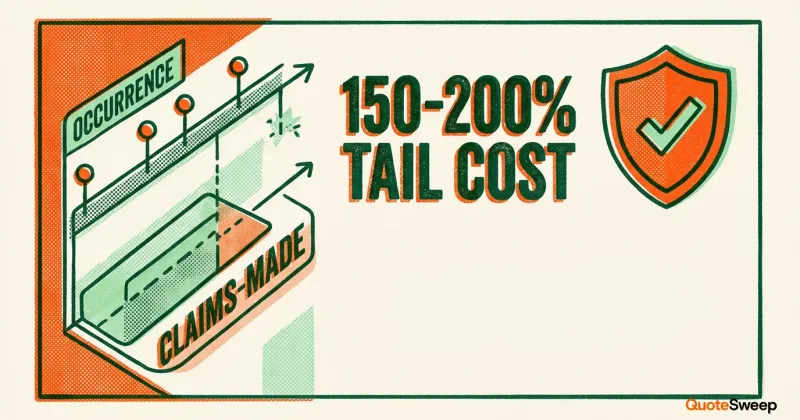
Tail coverage is expensive. Industry data shows tail coverage typically costs 150%–200% of the final annual premium – a one-time payment for an indefinite or multi-year reporting extension.
Example: An architect with a mature professional liability premium of $8,000/year retires. Tail coverage would cost approximately $12,000–$16,000 as a one-time payment to maintain the ability to report claims from their years of practice.
Nose Coverage (Prior Acts) as an Alternative
When an insured switches carriers, the new carrier may offer "prior acts" or "nose" coverage by setting the retroactive date on the new policy back to match the original retroactive date on the old policy. This eliminates the need for tail coverage from the old carrier because the new policy covers claims arising from acts all the way back to the original retroactive date.
Key negotiation point: When remarketing claims-made accounts, always ask the new carrier to match the existing retroactive date. If they will, the insured doesn't need to purchase tail from the old carrier – saving potentially thousands of dollars.
Switching Between Forms
From Claims-Made to Occurrence
This happens most commonly with general liability when an insured moves from a claims-made GL policy (less common, but they exist) to a standard occurrence GL policy. The new occurrence policy covers all future events, but the insured needs either:
- Tail from the old claims-made carrier – to report claims for past acts, or
- Prior acts coverage on the new occurrence policy – some carriers offer this, though it's unusual for GL
From Occurrence to Claims-Made
This transition is less common and less problematic. The old occurrence policies permanently cover events that happened during their respective periods. The new claims-made policy covers acts going forward from its retroactive date. There's no gap – the occurrence policies handle past acts, and the claims-made policy handles future acts.
The Dangerous Scenario: Claims-Made to Claims-Made with a New Retroactive Date
This is the E&O trap agents need to watch for. If a client switches from Carrier A (claims-made, retroactive date of 01/01/2020) to Carrier B (claims-made, retroactive date of 01/01/2026), there is a six-year gap where acts that occurred between 2020 and 2025 are not covered by either policy:
- Carrier A's policy expired, so claims can't be reported there (no tail)
- Carrier B's retroactive date is 2026, so acts before that date are excluded
The solution: ensure Carrier B matches the retroactive date, or purchase tail from Carrier A.
Pricing Differences at a Glance
| Factor | Occurrence | Claims-Made |
|---|---|---|
| Initial premium | Higher | Lower (Year 1 step rate) |
| Mature premium | Stable | Reaches mature rate by Year 5 |
| Long-term total cost | Predictable | Comparable once mature + tail costs |
| Tail coverage needed? | No (coverage is permanent) | Yes, if policy is canceled |
| Total lifetime cost | Premium only | Premium + potential tail |
For professional liability, where claims-made is the standard form, the total cost of ownership (premiums over the career + tail at retirement) is roughly comparable to what an occurrence policy would cost – the savings on annual premiums are offset by the tail premium at the end.
Common Client Questions Agents Face
"Why do I need tail coverage? I'm not practicing anymore."
This is the most common objection. The answer: claims-made coverage only applies if the claim is reported while the policy is active. After retirement, clients or patients can still discover harm from past work and file claims. Without tail coverage, the retired professional has no coverage for those claims – even though the acts occurred while they were insured. Tail coverage keeps the reporting window open.
"Can't I just keep renewing my claims-made policy instead of buying tail?"
Yes – and this is actually the most common approach. As long as the insured maintains a claims-made policy with the same retroactive date, they can report claims for past acts indefinitely. The tail question only arises when the policy is canceled or the insured retires. But the insured should understand that if they ever let the policy lapse without tail coverage, they lose protection for all prior acts.
"My new carrier says they'll give me full prior acts. Is that as good as tail?"
In most cases, yes. If the new carrier sets the retroactive date back to match the original inception date, the new policy covers claims from all prior acts. The insured doesn't need tail from the old carrier. However, we always recommend confirming the retroactive date on the new policy declarations page – and documenting this in the file.
"Why is my professional liability claims-made but my GL is occurrence?"
Different lines use different triggers based on the nature of the risk. GL claims (bodily injury, property damage) are typically discovered quickly – someone falls, something breaks, damage is visible. Professional liability claims (errors, omissions, negligence) can take years to surface. A design defect might not be discovered until a building is occupied. An accounting error might not surface until an audit years later. Claims-made gives carriers the ability to price for this uncertainty year by year.
E&O Traps for Agents
Not Documenting Retroactive Dates
Every time you place or renew a claims-made policy, document the retroactive date. If a future carrier change results in a gap because a retroactive date was moved forward without the insured's knowledge, you may face an E&O claim for failure to maintain continuous coverage.
Not Explaining Tail at Policy Inception
The time to discuss tail coverage is when the claims-made policy is first placed – not when the client is retiring and shocked by the cost. Set expectations upfront: "If you ever cancel this policy, you'll need to purchase tail coverage at approximately 1.5–2 times your annual premium."
Failing to Match Retroactive Dates When Remarketing
When you move a client from one claims-made carrier to another, always confirm that the new carrier matches the existing retroactive date. If they won't, you need tail from the old carrier. Missing this step is one of the most common agent E&O claims in professional liability placements.
Not Checking "Prior Acts" Exclusions in Claims-Made Policies
Some claims-made policies include exclusions for specific prior acts or known circumstances. If the insured disclosed a potential claim or circumstance on the application, the new carrier may exclude it. Make sure your client understands what's excluded – and whether the old carrier's tail would cover it.
Frequently Asked Questions
What is the difference between occurrence and claims-made?
An occurrence policy covers events that happen during the policy period, regardless of when the claim is filed. A claims-made policy covers claims that are reported during the policy period for acts occurring after the retroactive date. The trigger for occurrence is when the event happened; the trigger for claims-made is when the claim was reported.
How much does tail coverage cost?
Tail coverage typically costs 150%–200% of the final annual claims-made premium as a one-time payment. For example, if your mature professional liability premium is $5,000/year, tail coverage would cost approximately $7,500–$10,000. Some carriers offer payment plans, and some states mandate that carriers offer tail coverage at regulated rates.
Can I switch from claims-made to occurrence?
Yes, but you'll need tail coverage from the old claims-made carrier to cover prior acts. The new occurrence policy covers events going forward, but acts that occurred during the claims-made policy period need tail coverage so they can still be reported. Always factor tail costs into the total cost comparison when evaluating a switch.
Why are professional liability policies claims-made instead of occurrence?
Professional errors and omissions often aren't discovered for years after the work is performed. A structural engineer's design flaw might not be found until a building is renovated a decade later. Claims-made gives carriers the ability to price for known risk periods and control their long-tail exposure through retroactive dates and step rating. It also means premiums more closely reflect the current risk environment, rather than pricing for decades of future claims emergence.