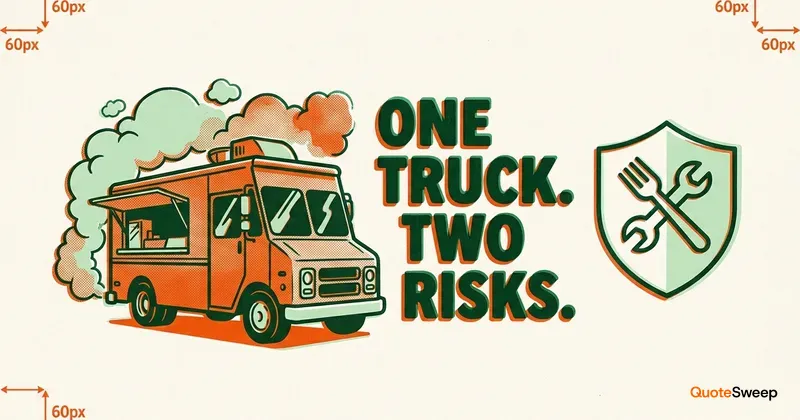
A food truck is two businesses stacked on one chassis. It's a commercial vehicle that drives on public roads and parks in crowded lots, and it's a cramped commercial kitchen serving the public — fryers, propane, sharp knives, and hot surfaces, all a few feet from a line of paying customers. That combination means no single policy covers a truck; you assemble a stack. This guide explains which coverages a food truck actually needs and why, then recommends four modern insurers worth comparing.
This is an independent guide from QuoteSweep, which maps the modern commercial insurance landscape. QuoteSweep does not compete with any of these companies, and none pays for placement here.
TL;DR: A food truck needs general liability with product coverage as its foundation (foodborne-illness claims plus slips and property damage), commercial auto for the truck itself and its built-in equipment, a business owner's policy for a fixed commissary and its contents, workers' compensation for the crew (mandatory in almost every state), and cyber liability for the payment data in your POS — plus liquor liability if you serve alcohol at events. Premiums are quote-based. For a fast all-in-one policy, compare Next (ERGO NEXT); for on-demand and event coverage, Thimble; for financial strength, biBERK; and for instant certificates of insurance, Coverdash.
Compare business insurance options
What insurance does a food truck need?
A food truck's exposures live in two worlds at once. On the road it's a vehicle — it can cause an accident, get stolen, or be damaged, and it carries expensive built-in equipment. Parked and serving, it's a food-service operation — customers can slip on a greasy curb, get burned reaching for an order, or fall ill from something you served. Because those two worlds are rated and covered differently, a truck's program is a stack of lines, not a single policy. Here are the ones that matter, and why.
General liability (and product liability)
General liability (GL) is the foundation. It covers third-party claims of bodily injury, property damage, and personal or advertising injury — a customer who trips over a cable running to your generator, someone burned by a hot plate handed across the counter, or damage your setup causes to the property you're parked on. It's written on an occurrence basis under the standard ISO CGL form, typically at $1 million per occurrence and $2 million aggregate, and it's the coverage that event organizers, commissary landlords, and city permit offices will require before you can operate — most will ask to be named as an additional insured and want a certificate of insurance on file.
For a food truck, the piece of GL that matters most is products/completed-operations coverage, which is where a foodborne-illness claim lands. If a customer gets sick from something you served, that's a product-liability claim — and it's the single exposure most specific to selling food to the public. Standard GL includes a products/completed-operations aggregate, so confirm the food you serve is covered rather than assuming any general policy handles it. What GL does not cover is just as important: it excludes your own truck and equipment, your employees' injuries, cyber incidents, and — critically for a mobile business — auto accidents. Each of those gaps is filled by a separate line below.
Commercial auto — the truck itself
This is the line that sets a food truck apart from a brick-and-mortar restaurant. Your truck is a vehicle registered to the business, so it needs commercial auto insurance — legally required in every state for any business-titled vehicle, and separate from personal auto, which excludes vehicles used for business. Commercial auto covers liability (bodily injury and property damage you cause with the truck), physical damage (comprehensive for theft, vandalism, and weather; collision for accidents), and medical payments, and most food-truck operators carry a $1 million combined single limit.
The physical-damage side deserves attention, because a food truck isn't a bare vehicle — it's a rolling kitchen with a hood system, griddles, fryers, refrigeration, and a generator built into it. Insuring the truck for its true replacement value, including that built-in equipment, is what protects you if it's stolen or totaled. Watch the ISO coverage symbols, too: selecting the wrong symbol leaves gaps, and if employees ever run errands or scout locations in their own cars, that's hired and non-owned auto exposure a standard policy only covers when the right symbols or an HNOA endorsement are in place. Carriers pull driver MVRs at quote and renewal, so a clean driving record keeps the truck placeable and the premium down.
Business owner's policy (BOP) and commercial property
Most food trucks operate out of a commissary — a licensed commercial kitchen where they prep, store inventory, and clean up. That fixed location, and the property inside it, is where a business owner's policy (BOP) fits. A BOP bundles general liability with commercial property coverage for a location's building (if you own it) and business personal property: prep equipment, walk-in storage, dry goods, and packaging. Bundling GL and property into a BOP is consistently cheaper than buying the two separately, and BOPs commonly build in business interruption coverage — replacing lost income if a covered event shuts you down — plus equipment breakdown at no extra charge.
There's a nuance food trucks have to get right: a BOP is built around a fixed premises, so the equipment bolted into the truck itself is generally handled by your commercial auto physical damage (or an inland-marine equipment endorsement for gear that moves with you), while the BOP covers the commissary and its contents. Spoilage is a related food-service concern — if refrigeration fails and inventory is lost — and is typically added by endorsement rather than assumed. Note that a standard BOP has eligibility limits and often excludes higher-hazard cooking operations, so confirm the carrier writes food trucks before you count on it.
Workers' compensation
The moment you hire even one employee, workers' compensation becomes the line you can't skip — it's mandatory for businesses with employees in nearly every state, with severe penalties for going without. A food truck's interior is exactly the environment workers' comp exists for: burns from fryers and griddles, cuts from prep knives, slips on a wet floor, and the propane and cramped quarters that make a small kitchen hazardous. Workers' comp pays medical costs, lost wages, and rehabilitation when a crew member is hurt, and in exchange employees give up the right to sue you for those injuries (the "grand bargain").
Workers' comp is priced differently from your other lines. The formula is payroll ÷ 100 × class code rate × experience modification rate (EMR). Food-service prep and cooking staff sit in a higher-hazard class code than a clerical or ownership role, so most of the premium comes from the on-truck payroll. Your EMR — a multiplier based on your claims history relative to similar operations — then scales the whole premium up or down, which is why a strong safety record directly lowers what you pay. Carriers also audit payroll at year-end, so an accurate payroll estimate up front avoids a surprise bill later, and carrier appetite for food-service classes varies widely, so it pays to compare (see the workers' comp hub).
Cyber liability
It's easy to assume a food truck has no cyber exposure, but nearly every truck runs a tablet-based POS and takes card and mobile payments — which means it stores and processes customer payment-card data. That's exactly the exposure cyber liability insurance is built for, and standard GL and BOP policies contain absolute cyber exclusions, so a breach of that data isn't covered by the foundation lines.
Cyber splits into first-party coverage (forensic investigation, breach notification to affected customers, business interruption while systems are down, ransomware response) and third-party coverage (lawsuits and regulatory fines stemming from the compromised data). Some BOPs offer a small cyber endorsement, but the sub-limits are usually a fraction of what a real breach costs, which is why a standalone policy is worth pricing for any truck that processes payments or stores customer data. Carriers increasingly require basic controls — multi-factor authentication, data backups — before they'll quote. See the cyber insurtech hub to compare options.
Liquor liability and other food-truck-specific add-ons
Some trucks pour beer, wine, or cocktails at festivals, private events, or breweries. The moment you serve alcohol, you take on liquor liability — the risk of being sued over harm caused by an intoxicated patron — which standard general liability does not cover. It's an industry-specific line you add by endorsement or separate policy, and venues that let you serve will usually require proof of it. Even if you don't serve, some events require it of vendors, so confirm what a given booking demands before you sign.
Two other food-truck-specific pieces to raise with an insurer: an inland-marine or tools-and-equipment endorsement for the mobile cooking gear that a fixed-location BOP doesn't naturally cover, and spoilage coverage for refrigerated inventory. These aren't part of the general-purpose coverage lines — they're the truck-specific details that make a program complete, so confirm they're included or endorsed rather than assuming your GL, BOP, or auto policy already handles them.
Professional liability (E&O) — a lighter need
Professional liability, or errors & omissions (E&O), covers financial losses a client suffers because of your professional advice or work product — the gap GL explicitly excludes. For a truck that just serves walk-up customers, this is a secondary concern; the food exposures are handled through GL's products coverage, not E&O. It becomes relevant if you take on catering contracts — where a client could claim a financial loss because you failed to deliver as agreed for a booked event — rather than only selling à la carte. It's written on a claims-made basis, so the retroactive date matters if you do add it.
How much does food truck insurance cost?
There is no published flat price for a food truck's insurance, and any number you see quoted as "the" cost is a guess. Premiums are quote-based and built from your specific operation. The main drivers:
- Payroll — the primary rating basis for workers' comp, and cooking-crew payroll sits in a higher-hazard class code than an owner-operator or clerical role, so headcount and wages move that line the most.
- Revenue and the truck's value — GL and the products/completed-operations exposure are rated partly on revenue, while commercial auto physical damage is rated on the replacement value of the truck and its built-in equipment.
- Where and how you operate — how far you drive, whether you work fixed spots or chase events across a wide radius, and the states and cities you serve all shape the commercial auto premium; carriers pull driver MVRs, and a poor record can push the truck out of standard markets.
- Location — operations in more litigious or higher-cost states generally pay more across every line.
- Claims history — your loss runs and, for workers' comp specifically, your EMR directly scale the premium; a clean record and a documented safety and food-handling program earn credits.
Entry pricing for some lines can start low — Next, for example, advertises general liability starting around $19/month per its own site — but your actual premium depends entirely on the truck, the crew, and how you run. The practical move is to compare several carriers on the same submission rather than anchoring to any single quote.
Best insurers for food trucks
These are four modern insurers worth comparing for a food truck, each with a different strength. Match the one whose angle fits how your truck operates, and get quotes from more than one.
Next (ERGO NEXT) — best for an all-in-one, fast
Next (ERGO NEXT) is the multi-line benchmark for a truck that wants most of its coverage in one place, bought online in under 10 minutes. It writes the exact stack a food truck assembles — general liability, BOP, workers' compensation, commercial auto, professional liability, commercial property, tools & equipment, and EPLI — so you can bundle the foundation lines and the truck's auto coverage in a single flow instead of piecing together monoline policies. Per its site it has insured 750,000+ customers across 1,300+ business types, with general liability starting around $19/month, and in 2025 it was acquired by Munich Re's ERGO Group for $2.6B, putting a global reinsurer behind it. It's direct-first (licensed advisors are available) and not available in every state.
Best for: an operator who wants general liability, commercial auto for the truck, tools & equipment, and workers' comp bundled and bought online in one fast pass.
Thimble — best for on-demand and event coverage
Thimble fits the food truck that lives on the festival, market, and private-event circuit. It sells small-business coverage by the job, month, or year, and lets you modify, pause, or cancel instantly from an app — so you can carry coverage that matches a seasonal or event-driven schedule instead of paying for a full year of exposure you don't have. Its lineup covers the truck essentials, including general liability, professional liability, BOP, inland marine (equipment), commercial property, workers' comp, cyber, commercial auto, and event insurance, and you can buy online, in the app, or by phone in minutes. It's a wholly owned subsidiary of Arch Insurance Group, backed by A-rated partners, with 170,000+ policies delivered since 2018. The on-demand model is strongest for short-duration or seasonal needs — a single festival weekend where the organizer wants a certificate on file — rather than complex, year-round accounts.
Best for: a truck that works events and seasonal stretches and wants coverage (and a certificate) for a job or a season rather than a full year.
biBERK — best for financial strength
biBERK is the pick for an operator who cares most about who's standing behind the policy. It sells directly to businesses online — no brokers — and writes on Berkshire Hathaway carriers rated A++ (Superior) by AM Best, the top financial-strength tier. Its lineup covers the truck essentials, including general liability, BOP, workers' comp, professional liability, commercial auto, and umbrella, and it positions on savings of up to 20% by cutting out the middleman. It reports being trusted by 200,000+ small businesses. It's best suited to standard food-truck risk bought direct, rather than complex accounts or an agent-led relationship.
Best for: a truck owner who wants to buy direct and wants the strongest possible balance sheet — including the commercial auto and umbrella lines — behind the coverage.
Coverdash — best for instant certificates of insurance
Food trucks live and die by the certificate of insurance — the proof of coverage a market manager, festival organizer, or commissary landlord wants before you can set up. Coverdash is built for exactly that fast, self-serve motion: it takes a small business from quote to bound coverage online "in clicks, not weeks," and generates certificates of insurance instantly, on your own or with help from a Coverdash agent. It places general liability, BOP, workers' compensation, cyber, professional liability, and management liability through carrier partners, and runs an embedded model that other platforms use to offer coverage with a single line of code. It's a newer platform that places through carrier partners (so terms vary by carrier) and is best for simpler small-business risk.
Best for: a truck that constantly needs to hand a certificate of insurance to a market, festival, or commissary and wants a fast, online buy with instant COIs.
Frequently Asked Questions
What insurance is required for a food truck?
The requirements come from three places. Commercial auto is legally required in every state for the truck itself, since it's a vehicle titled to the business. Workers' compensation is legally mandatory in nearly every state once you have employees. And general liability is required by virtually every event organizer, commissary landlord, and city permit office before you can operate — most will want to be named as an additional insured and will ask for a certificate of insurance. If you serve alcohol, venues will also require liquor liability.
Does my food truck's auto policy cover the cooking equipment inside it?
It can, if you insure the truck for its true replacement value. A food truck's built-in hood system, griddles, fryers, refrigeration, and generator are part of the vehicle, so commercial auto physical-damage coverage is what pays if the truck is stolen or totaled — but only up to the value you insure it for. Mobile gear that isn't bolted in is often better covered by an inland-marine or tools-and-equipment endorsement. Confirm how your equipment is scheduled rather than assuming the base auto limit covers a fully built-out kitchen.
Do I need cyber insurance for a food truck?
If your truck runs a POS or takes card and mobile payments, yes, it's worth pricing. Those systems store and process customer payment-card data, and cyber liability is the only line that covers a breach of it. Standard GL and BOP policies contain absolute cyber exclusions, and any small cyber endorsement on a BOP usually carries sub-limits far below what a real breach costs.
How much does food truck insurance cost?
There's no flat rate. Premiums are quote-based and driven by your payroll (the main factor for workers' comp), revenue (for general liability and product coverage), the replacement value of the truck and its equipment (for commercial auto), where and how far you operate, and your claims history. Some lines can start low, but the only reliable way to know your cost is to compare quotes from several carriers on the same submission.
The bottom line
A food truck's insurance is a stack, not a single policy: general liability with product coverage for the food you serve, commercial auto for the truck and its built-in kitchen, a BOP for a commissary and its contents, workers' comp for the crew, and cyber for the payment data in your POS — plus liquor liability if you pour. No single insurer is the right answer for all of it — Next (ERGO NEXT) bundles the most lines, including the truck's commercial auto, in one fast flow; Thimble fits the event-and-season circuit with on-demand coverage; biBERK brings Berkshire Hathaway's financial strength; and Coverdash gets you a certificate of insurance instantly for the next market or festival. Compare more than one on the same submission, and see the whole field on the small-business insurtech hub.