Accountants and bookkeepers carry a distinct risk profile: the biggest exposure is rarely a slip-and-fall, but a client claiming that a tax-preparation error, a missed filing deadline, a bookkeeping mistake, or your advice cost them money. That puts professional liability (errors & omissions) at the center of the program, with cyber liability a close second because a firm's servers hold Social Security numbers, bank details, and full financial records. This guide explains what an accounting or bookkeeping practice actually needs and why, then recommends four insurtechs worth comparing.
This is an independent guide from QuoteSweep, which maps the modern commercial insurance landscape. QuoteSweep does not compete with any of these companies, and none pays for placement here.
TL;DR: Accountants and bookkeepers build around professional liability (E&O) and cyber liability, then add general liability or a BOP, employee-dishonesty/crime cover if staff touch client funds, workers' comp once they hire, and hired-and-non-owned auto if they drive to client sites. For providers, Hiscox is the specialty benchmark for E&O bought direct, Embroker packages professional plus management liability by industry (and names accountants directly), Vouch fits venture-backed and growing firms, and Coalition is the category leader for cyber bundled with active security. Compare the field on the small-business hub and the cyber hub.
Compare business insurance options
What insurance does an accountant or bookkeeper need?
Professional liability (E&O) — the foundation
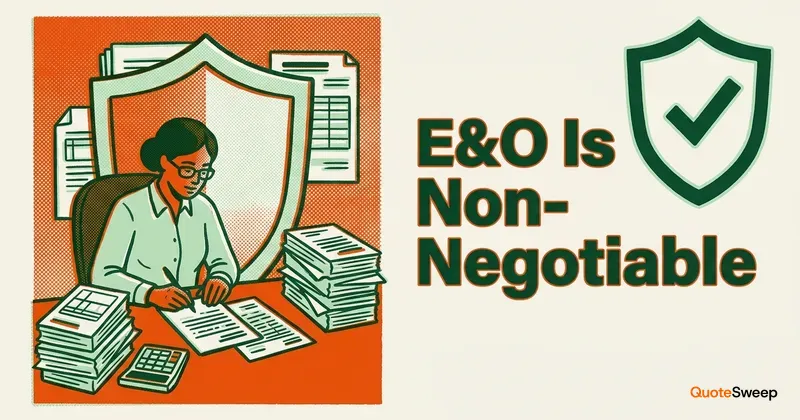
Professional liability insurance, commonly called errors and omissions (E&O), is the primary coverage for any firm that sells expertise rather than physical products — and accountants sit at the very top of that list. It responds when a client suffers a financial loss because of advice you gave, work you failed to complete, or a mistake in your deliverable. The glossary's own headline example is an accounting one: an accountant whose tax-preparation error costs a client $50,000 in IRS penalties has zero general liability coverage for that claim. A bookkeeper who misclassifies transactions, a tax preparer who misses a filing deadline, or an auditor who overlooks a material item is looking at an E&O claim — because general liability explicitly excludes professional services errors, and this is the gap E&O exists to fill.
Two mechanics matter for accountants at binding. E&O is almost always written on a claims-made basis, so the policy must be active when the claim is filed, not just when the error occurred — which matters a great deal in accounting, where a mistake on this year's return may not surface until an IRS notice arrives two or three years later. That makes the retroactive date critical: set it as early as possible, ideally the date you first obtained E&O coverage, so past engagements stay covered. And if you ever cancel or switch carriers, tail coverage (an extended reporting period) keeps future claims about past work covered; it typically costs 125–300% of the expiring annual premium. Standard limits for small-to-mid-sized professional firms are $1 million per claim and $2 million aggregate, with deductibles that scale to firm size. Carrier appetite varies here: Hiscox is strong in small professional-services firms under $5 million in revenue, while CNA dominates larger accounting-firm programs — so comparing markets is worth the effort.
Cyber liability — a close second, and often underestimated
Cyber liability insurance covers the financial fallout from data breaches, ransomware, and network failures — forensic investigation, breach notification, credit monitoring, regulatory defense, business interruption, and third-party lawsuits from compromised data. For an accounting or bookkeeping firm, this is not optional: you hold some of the most sensitive data any small business touches — Social Security numbers, bank account and routing numbers, payroll records, and complete financial histories — and the concentration of that data during tax season makes you a prime target. Standard GL policies contain absolute cyber exclusions, and while some BOPs bundle a limited cyber endorsement (often $50,000–$100,000), that is a fraction of what a real breach costs.
Cyber splits into first-party coverage (your own losses — forensics, notification, ransomware, business interruption, data restoration) and third-party coverage (network security liability, privacy liability, and regulatory defense when client PII is compromised). Because accountants operate in a regulated, data-sensitive field, the regulatory-defense and breach-notification pieces carry real weight — breach notification is required by law in all 50 states. One practical detail: most cyber carriers now require specific security controls before they will quote, particularly multi-factor authentication (MFA), endpoint detection and response (EDR), and regular backups. Getting these in place before you apply improves your terms and can be the difference between a quote and a decline.
General liability — still required by contracts and leases
General liability (GL) covers third-party bodily injury, property damage, and personal/advertising injury — a client tripping in your office, or you damaging property during a visit to their site. It is the most commonly required commercial coverage: nearly every commercial lease and vendor contract requires it, typically at $1 million per occurrence and $2 million aggregate. Accounting and auditing is a low-hazard class (the glossary lists ISO class code 61212 for accounting and auditing services), so GL for a firm is one of the lower-priced lines — but you almost certainly need it on paper to sign an office lease or satisfy a corporate client's insurance requirements, even if a physical-injury claim is unlikely. GL does not cover professional errors (that is E&O) or cyber incidents (that is a cyber policy), which is exactly why accounting firms need all three.
BOP — bundle GL and property if you have an office
If your practice has a physical location with computers, furniture, or tenant improvements to protect, a business owner's policy (BOP) bundles general liability with commercial property in one package, usually at a 15–25% discount versus buying each line separately. BOPs are the bread-and-butter policy for office-based professional-services firms — the glossary literally uses a three-person accounting firm as its example — and most include business interruption and equipment breakdown at no extra charge. Two endorsements are worth asking about: some carriers (Hiscox among them) allow professional liability / E&O to be endorsed onto the BOP for service firms, and cyber is increasingly available as a BOP endorsement — though for a data-heavy accounting firm, a standalone cyber policy usually provides materially more coverage than a BOP sub-limit.
Employee dishonesty and crime — for firms that touch client funds
This is the line most specific to bookkeepers. If your staff handle client checkbooks, process payroll, move money, or have access to client bank accounts, you have an embezzlement and theft exposure that neither GL nor E&O addresses. Employee dishonesty / crime coverage — available as a BOP endorsement per the glossary, and offered as a standalone Crime line by some carriers — protects against theft by employees. For a bookkeeping practice built on financial trust, a single dishonest hire can create both a direct loss and a client claim, which is why crime cover belongs on the checklist alongside E&O.
Workers' compensation — required once you hire
If your practice has employees, workers' compensation is mandatory in nearly every state, with steep penalties for going without it. The good news for accounting firms: most staff are clerical or professional office workers (NCCI class code 8810), which carries one of the lowest rates in the system — a small fraction of what field trades pay. Premium is calculated as payroll ÷ 100 × the class code rate × your experience modification rate (EMR), and carriers audit actual payroll at year-end, so accurate payroll estimates upfront — including any tax-season temporary staff — prevent surprise audit bills.
Commercial auto and hired-and-non-owned auto — for firms with travel
Most accounting and bookkeeping practices do not own a fleet, so full commercial auto is often unnecessary. But if you or your staff drive personal vehicles to client sites, drop off documents, or run business errands, you have hired and non-owned auto (HNOA) exposure — a gap a personal auto policy will not cover and that standard commercial auto only fills if the right ISO symbols (such as Symbol 9 for non-owned autos) are selected. HNOA can often be added as an endorsement to a BOP or GL policy, which is the practical fit for most firms.
How much does it cost?
There is no flat price for accountant or bookkeeper insurance — every line is quote-based and varies with your specific practice. The main drivers:
- Revenue or billings rate professional liability (E&O) and general liability. A larger firm with more billings represents more exposure and pays more.
- Payroll and class codes drive workers' comp. Accounting staff usually classify as clerical (NCCI 8810), one of the lowest-rated codes, so comp is comparatively inexpensive per dollar of payroll.
- Data volume and security posture move cyber pricing. Firms handling more client records pay more; strong controls like MFA, EDR, and backups can improve terms — and their absence can get you declined.
- Services offered shift E&O pricing. Tax preparation, audit, and attest work generally carry more risk than bookkeeping or write-up services, and carriers price accordingly.
- Location and state matter — litigious states and higher-cost regions push premiums up across lines.
- Claims history and, for workers' comp, your experience modification rate (EMR) scale premiums up or down based on past losses.
General liability tends to start low for a low-hazard class like accounting and auditing, and clerical workers' comp is among the cheapest coverage per dollar of payroll — but E&O and cyber are where an accounting firm's real premium sits, and both vary widely by carrier. Because the same risk can price very differently across insurers, comparing multiple carriers is the single best way to control cost. Quote your actual practice; the premium comes from your services, revenue, payroll, and risk profile, not a published rate card.
Best insurers for accountants and bookkeepers
Four providers serve accountants and bookkeepers well, each with a different strength. None publishes flat pricing, so treat these as starting points to quote against your specific firm.
Hiscox — best for professional liability (E&O) depth, bought direct
Hiscox is a specialty small-business insurer, part of the publicly listed Hiscox Group, and its calling card is professional liability / errors & omissions — the coverage that protects a firm when a client claims its work caused a loss, which is precisely the exposure that sits at the center of an accounting practice. It is strong in small professional-services firms under $5 million in revenue, and it can endorse E&O onto a BOP for service firms, giving a small accounting office a single-policy path to liability, property, and professional cover. Hiscox also writes general liability and cyber, and it was the first US insurer to sell business owner's coverage direct and online in real time; its BOP is available in 43 states plus DC. One gap worth noting: Hiscox does not write commercial auto, so if you need vehicle coverage you will source it elsewhere.
Best for: solo and small accounting or bookkeeping firms whose main exposure is professional liability and who want to buy direct online from an established specialty insurer.
Embroker — best for professional plus management liability, packaged by industry
Embroker is a digital commercial insurance brokerage and platform that organizes around specific industries — and accountants, tax preparers, and bookkeepers are named directly as one of its target verticals. It pairs a broker's guidance with online quoting and packages coverages by industry: BOP, general liability, professional liability (E&O), D&O, EPLI, cyber, and crime. That crime line matters for bookkeepers who handle client funds, and its D&O and management-liability depth suit a firm that adds partners, a board, or staff. Per its own site it has served customers for 10 years and secured 16,000+ policies across 9,500+ businesses; third-party sources report a $100M Series C led by FTV Capital in 2021. It is a brokerage and platform, not a carrier, so it places coverage with insurers.
Best for: accounting and bookkeeping firms that want professional and management liability (E&O plus D&O, EPLI, and crime) packaged around their industry with a broker's guidance.
Vouch — best for venture-backed and growing firms
Vouch is a technology-powered insurance brokerage built for startups and growing companies, and professional services — explicitly including accountants — is one of its four core industries, alongside technology, healthcare and life sciences, and financial services. It pairs advisors with digital tools to place general liability, cyber, professional liability (E&O), and D&O — coverage designed to clear the requirements investors, regulators, and enterprise clients put on a growing company, which fits a fast-scaling or outsourced-accounting/fractional-CFO practice serving funded startups. Per its own site it has insured 6,000+ companies, with a 74+ NPS and 81% same-day quoting; third-party sources report about $185M in total funding. In 2025 Vouch sold its MGA and carrier operations to Hiscox and now operates as a broker under a multi-year Hiscox distribution deal.
Best for: venture-backed or fast-growing accounting and bookkeeping firms — including outsourced-finance and fractional-CFO practices — that need E&O, cyber, and D&O to satisfy investors and enterprise customers.
Coalition — best for cyber coverage bundled with active security
Coalition is the category leader for cyber, built around what it calls Active Insurance — coverage paired with security technology that monitors, alerts, and responds, rather than a bare policy you only file against. For an accounting firm sitting on Social Security numbers, bank details, and tax records, that prevention-first model directly reduces the risk you most fear: policyholders get the Coalition Control risk platform, continuous vulnerability and dark-web monitoring, and Wirespeed managed detection and response, with Coalition Incident Response on call when something goes wrong. It also writes miscellaneous professional liability (E&O for professional service providers) and technology E&O, so it can address both the breach and the professional-error side. It is distributed through appointed brokers and backed by A-rated capacity (Allianz, Swiss Re, Lloyd's, Zurich, and others); per reporting it raised a $250M Series F at a $5B valuation in 2022.
Best for: accounting and bookkeeping firms that want cyber coverage with active security monitoring and response built in — the data-protection line most critical to a firm holding client financial records. Compare it on the cyber hub.
Frequently Asked Questions
What insurance do accountants and bookkeepers actually need?
Professional liability (E&O) comes first, because the core risk is a client claiming a tax error, missed deadline, bookkeeping mistake, or bad advice cost them money — something general liability explicitly excludes. Cyber liability is a close second, since you hold Social Security numbers, bank details, and financial records that standard GL and BOP policies exclude. From there, most firms add general liability (or a BOP if they have an office), employee-dishonesty/crime cover if staff handle client funds, workers' comp once they hire, and hired-and-non-owned auto if they drive to client sites.
Doesn't my general liability policy cover a tax error or a data breach?
No. General liability covers third-party bodily injury and property damage — a client tripping in your office — but it explicitly excludes professional services errors and contains absolute cyber exclusions. A tax-preparation mistake that triggers IRS penalties is a professional liability (E&O) claim; a breach of client records is a cyber claim. That is why accountants typically carry GL, E&O, and cyber together rather than relying on GL alone.
Why does the claims-made basis matter for an accounting firm?
Because accounting errors often surface long after the work is done — an IRS notice or an audit finding can arrive two or three years after a return is filed. E&O is written on a claims-made basis, so the policy must be active when the claim is filed, not just when the error occurred. Set the retroactive date as early as possible (ideally when you first bought E&O) so prior engagements stay covered, and buy tail coverage if you ever cancel or switch carriers so future claims about past work are still covered.
How much does insurance for an accountant or bookkeeper cost?
It depends on your revenue, payroll, the services you offer (tax and audit work price higher than bookkeeping), your state, claims history, and — for cyber — your data volume and security controls. None of the providers here publish flat pricing. General liability tends to start low for a low-hazard accounting class and clerical workers' comp is inexpensive, but E&O and cyber are where most of the premium sits. The only reliable number is a quote on your specific practice, and because the same risk prices very differently across carriers, comparing several is the best way to control cost.
The bottom line
For accountants and bookkeepers, the program starts with professional liability (E&O) and cyber liability — the two lines that answer for your actual work and the sensitive client data you hold — then adds general liability or a BOP, employee-dishonesty/crime cover if staff touch client funds, workers' comp once you hire, and hired-and-non-owned auto if you drive for work. Match the provider to your situation: Hiscox for specialty E&O bought direct, Embroker for professional plus management liability packaged by industry, Vouch for venture-backed and growing firms, and Coalition for cyber bundled with active security. Compare the full field on the small-business hub and the cyber hub, and quote your actual practice — premium comes from your services, revenue, and risk, not a rate card.