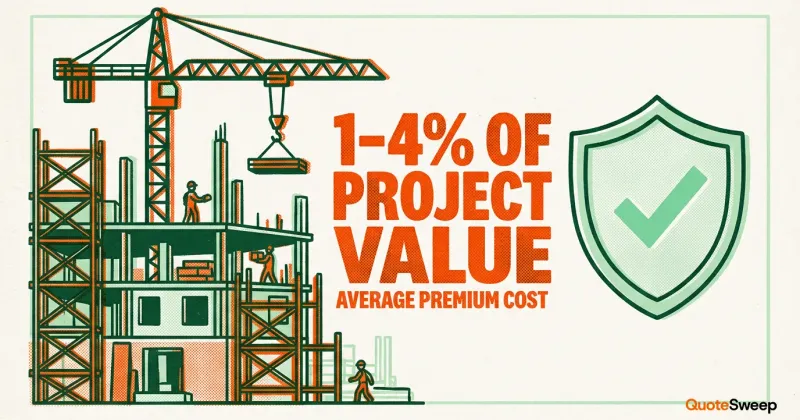
Builder's risk insurance pays to repair or replace a building while it is under construction or being renovated, along with the lumber, wiring and fixtures waiting to go into it. It responds to losses like fire, theft of materials, vandalism and wind damage. You need it if you have money in a project that isn't finished yet: as the property owner, the general contractor, or a homeowner building with a construction loan. Your contract or your lender will often require it. Insureon's small-business customers pay a median of $105 a month for it, and Insureon says policies typically run 1% to 4% of the finished project's value.
The decision most people get wrong isn't the price. It's who buys the policy and when it stops: a family that moves into a new house before the punch list is done can end the builder's risk cover without anyone noticing. Both are covered below. When you're ready, you can compare business insurance quotes for the policies a contracting business carries year-round, and this guide sits in QuoteSweep's business insurance section.
What does builder's risk insurance cover?
It covers the project itself: the structure as it goes up and the materials that will become part of it. Carriers describe the core cover in similar terms. The Hartford's builder's risk page lists:
| What's covered | Example |
|---|---|
| The building or structure under construction, renovation or repair | A fire guts a framed second floor |
| Materials and supplies at the job site | Copper wire stolen from the site overnight |
| Materials in transit or temporarily stored off-site | Windows damaged in a supplier's warehouse before delivery |
| Temporary structures | Scaffolding, fencing, cribbing and falsework blown down in a storm |
| Debris removal after a covered loss | Hauling away the burned framing so work can restart |
| Property of others at the site | Materials a supplier owns but has left on your site |
| Testing of newly installed equipment | Damage when a new system is first run, depending on the policy |
Insureon adds the perils a small project usually worries about: fire, theft, vandalism and non-severe weather such as wind, rain and hail.
The limit should match the finished project. The Hartford's rule of thumb is a limit equal to the anticipated cost of construction, and Insureon notes the value excludes land.
What about soft costs?
Soft costs are the bills that keep coming when a covered loss delays the job. The Hartford names lost sales, rental income, extra interest on loans and real estate taxes. This is often called "delay in opening" cover, and it isn't always in the base policy. Nationwide lists business income, rental value and extra expense among its builder's risk endorsements, and Chubb asks for a breakdown of soft costs and a pro forma before it quotes delay cover. If the project is financed, or will earn rent when it opens, ask for it by name.
What builder's risk doesn't cover
Builder's risk is property insurance for the project. It doesn't pay for bad work, slow deterioration, or people getting hurt. The Hartford lists these common exclusions:
- Faulty design, planning, workmanship and materials
- Wear and tear, rust and corrosion
- Employee theft
- Mechanical breakdown
- War and terrorism
A builders risk form analyzed by FC&S, an insurance-industry reference, carries the same three core exclusions: faulty or defective design and workmanship, wear and tear, and dishonest or criminal acts (including theft) by your own employees.
The faulty-work exclusion stops short of resulting damage. The Hartford explains that policies generally won't pay to fix a subcontractor's faulty work, but a policy with an "ensuing loss" provision may pay for damage that the faulty work causes to other property. Bad wiring isn't covered; the fire it starts may be. Liberty Mutual offers faulty workmanship and hot testing cover by endorsement on its form, so on that form it is an add-on, not part of the base cover.
Other gaps to plan for:
- Flood and earthquake: The Hartford says earthquake, flood, and wind or beach zones are usually excluded, with extensions available. Nationwide sells earthquake and flood as endorsements.
- Your tools and equipment: builder's risk covers what goes into the building, not the saws and lifts used to build it. That's tools and equipment (inland marine) insurance.
- Injuries: worker injuries fall under workers' compensation, and injuries to visitors or damage to a neighbor's property fall under general liability.
Who buys builder's risk: the owner or the contractor?
Either can, and the construction contract usually decides. State Farm puts it simply: the owner or the contractor can buy the policy, and the contract between them typically says who is responsible. The Hartford lists general contractors, subcontractors, property owners, developers and construction managers as typical buyers.
| Your situation | Who usually buys | What to check |
|---|---|---|
| You own the property and hired a general contractor | Whoever the contract names; read the insurance section before signing | If you buy it, add the contractor to the policy. If the contractor buys it, ask for proof and your name on it |
| You're the general contractor | You, if the contract assigns it to you | Price it into the bid. If the owner buys it, Insureon suggests making sure you're listed on the owner's policy |
| You're a homeowner building with a construction loan | You or your builder, per the contract | Insureon notes lenders may require builder's risk and ask to be listed as a loss payee |
| You're a subcontractor | Usually not you | Ask the GC whether its policy covers your installed work and your materials on site |
Insureon's advice is to talk it through with every party up front, because the question of who's on the policy matters as much as who pays for it. Clients and lenders may ask for proof before work starts; that's a certificate of insurance.
When does builder's risk coverage start and end?
It starts when the project starts and ends when the building is finished or in use. The Hartford says cover generally ends at the first of three events: the project is completed, the building is occupied or opened for its intended use, or the policy term expires.
The occupancy trigger is the one that catches owners. The ISO Builders Risk Coverage Form (CP 00 20), as summarized by FC&S, ends cover 90 days after construction is complete or 60 days after any building is occupied in whole or in part, or put to its intended use, unless the insurer agrees otherwise in writing. FC&S also points out the form doesn't define "complete." A tenant who starts storing stock early, or a family that moves in before the last trim is fitted, can start that clock.
What to do about it:
- If the project runs long, ask for an extension before the expiry date, not after.
- If you plan to occupy part of the building early, tell the insurer and get the arrangement in writing.
- Line up the permanent commercial property insurance (or a homeowners policy) to start the day builder's risk ends.
How much does builder's risk insurance cost?
For small businesses buying through Insureon, the median is $105 a month, or about $1,259 a year. Insureon's figures come from policies its customers bought; it calls them averages, and its method note says they are medians.
| Measure | Figure | Source |
|---|---|---|
| Median premium | $105 a month (about $1,259 a year) | Insureon's figures for its own customers, updated July 2026 |
| Share paying under $100 a month | 49% | Same |
| Share paying $100 to $200 a month | 26% | Same |
| Typical annual range | About $350 to over $7,000 | Same |
| Rule of thumb Insureon gives | 1% to 4% of the total completed project value | Same |
Those two ways of stating the cost describe different buyers. Most of Insureon's customers have fewer than five employees, so its median reflects small jobs. The 1% to 4% range is how Insureon says a policy relates to the size of the project; on a large build it implies a premium far above the median, so get a quote rather than relying on either figure.
What moves the price, per Insureon:
- Completed value, including materials and labor (not land)
- Construction type and materials: frame, masonry and fire-resistive structures are rated differently
- Location: coastal projects in Florida or Texas face hurricane and flood risk; California adds earthquake and wildfire
- Open perils vs named perils: open-perils cover costs more
- Limits, deductible and project length
If you build continuously, Insureon notes some contractors buy a master policy that covers a stream of projects without a fixed expiry, instead of one policy per job. For what contractors pay for their other policies, see insurance costs by business type.
Builder's risk vs inland marine, property and liability
Builder's risk is a type of inland marine insurance. The Hartford says most insurers write it on an inland marine form rather than a standard property form, which lets them tailor it to the project.
| Policy | What it protects | When it applies |
|---|---|---|
| Builder's risk | The building and materials during construction | From project start until completion or occupancy |
| Commercial property | A finished building and its contents | Year-round, at the address on the policy |
| Tools and equipment (inland marine) | Your tools and machinery, on site or in transit | Year-round, wherever the tools go |
| General liability | Injuries to others and damage to their property | Year-round, for your operations |
One exception: some carriers package liability into their builder's risk product. State Farm's version, for example, includes liability for non-employees hurt on the site. Ask what yours includes rather than assuming.
Which insurers write builder's risk?
In QuoteSweep's carrier appetite data for general contractors, 8 of the 26 carriers list builder's risk among the lines they write: Travelers, The Hartford, Nationwide, Liberty Mutual, Chubb, Cincinnati Financial, Hanover and Auto-Owners (as of March 2026, each row checked against the carrier's own construction page). By comparison, 15 of the 26 list inland marine.
Size matters. Liberty Mutual's single-project form is for projects over $50 million, with a master program for projects of all sizes, while Insureon's builder's risk customers are mostly small contractors. A homeowner or a small builder can start with a local agent, a broker, or an online marketplace such as Insureon, which sells builder's risk to small businesses.
What you'll need for a builder's risk quote
Chubb's application asks for a project description, a statement of values, locations, limits and coverage requirements, and soft-cost detail if you want delay cover. For a smaller project, have this ready:
- What you're building or renovating, and the address
- The total completed value (materials and labor, not land)
- Construction type (wood frame, masonry, steel or concrete)
- Start date and expected completion date
- Who the named insured is, plus any lender (loss payee) and other parties to add
- For a renovation: the existing building's value and who insures it now
- Extras you need: soft costs, flood, earthquake, testing, early occupancy
The general version of this checklist is in what you need for a business insurance quote. A contractor's year-round insurance (liability, workers' comp, auto, tools and license bonds) is covered on the general contractor insurance page, and surety bonds have their own guide.
If you want prices for the policies you carry all year, compare business insurance quotes from one form.
Frequently Asked Questions
Do I really need builder's risk insurance?
If a fire, storm or theft would leave you paying to rebuild unfinished work, yes. Many people don't get a choice: Insureon notes clients may require it before work starts and lenders financing the project may require it too. Builder's risk is the policy written for unfinished work, so check with your insurer before assuming a homeowners or property policy covers a project under construction.
Who usually carries builder's risk insurance?
The property owner or the general contractor, and the construction contract usually says which. State Farm and Insureon both describe it this way. Whoever doesn't buy it should make sure they're named on the policy.
What is not covered under a builder's risk policy?
Faulty design and workmanship, wear and tear, employee theft and mechanical breakdown are common exclusions, according to The Hartford. Flood and earthquake usually need an extension. Your tools, worker injuries and liability claims need other policies.
How do I calculate the cost of builder's risk insurance?
Start with the total completed value of the project, materials plus labor and excluding land. Insureon says policies typically cost 1% to 4% of that value, with construction type, location, perils covered, deductible and project length moving the rate. Small projects bought through Insureon have a median premium of $105 a month.
Is builder's risk insurance worth it for a homeowner building a house?
Usually, and your lender may not give you the option. The policy covers the house and materials until you move in. Make sure your homeowners policy starts when you occupy the house, because builder's risk cover ends at occupancy.
What happens if construction takes longer than planned?
Ask your insurer for an extension before the policy expires. A lapse during active construction leaves the project uninsured until new cover starts.