What Is Embedded Insurance? A Plain-English Guide
Embedded insurance is coverage sold inside the checkout flow of a product you were already buying, rather than through a separate visit to an agent or carrier. A business owner might add general liability while registering an LLC on a filing platform, or switch on professional liability when signing up for a freelancing marketplace. The insurance is stitched into an existing workflow instead of being sold through a traditional distribution channel.
This is an independent guide from QuoteSweep, which maps the modern commercial insurance landscape.
TL;DR: Embedded insurance integrates coverage directly into the purchase flow of a non-insurance product or platform, so a customer can buy at the point of need without contacting an agent. Carrier and MGA APIs return a quote and bind a policy in milliseconds during checkout. It works well for standardized small-commercial risks like general liability, professional liability, cyber, and simple BOPs, but it cannot handle complex, multi-line, or customized accounts. Coverdash and Coterie are among the providers building the API layer that makes it possible.
What is embedded insurance
Embedded insurance is the practice of integrating insurance coverage directly into the purchasing experience of a non-insurance product or platform, so the buyer can obtain coverage at the point of need without leaving the transaction or contacting an agent separately. In commercial insurance, that means the coverage is offered at a contextually relevant moment in a workflow the customer is already completing, rather than through a separate quoting process.
The classic examples are small-commercial: adding a million dollars of general liability while forming a business on a state-filing or business-formation service, or attaching professional liability during signup for a gig or freelancing marketplace. The coverage is "embedded" because it lives inside the host platform's flow. For the deeper reference definition, see our glossary entry on embedded insurance.
The model is growing fastest in the small-business segment, where risks are standardized and buyers are price-sensitive and convenience-driven. Businesses with fewer than ten employees, many with straightforward coverage needs, are the segment most susceptible to an embedded offer, which is why so much of the activity clusters there.
How it works
Embedded insurance relies on three components working together:
The distribution platform. This is the non-insurance business where the customer is already transacting: an e-commerce platform, a payment processor, a gig marketplace, a business-formation service, or a payroll provider. The platform exposes an insurance offer at the right moment in the customer journey, typically at or near checkout.
The carrier or MGA. A licensed carrier or managing general agent provides the actual coverage, the pricing engine, and the policy-issuance infrastructure. Participants in embedded distribution have built API-first products that return quotes and bind coverage programmatically, without human underwriting in the loop.
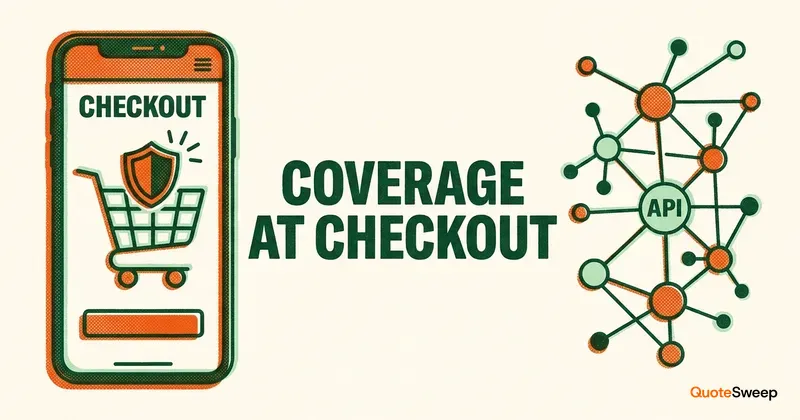
The API integration layer. Insurance APIs connect the platform to the carrier's systems. The platform passes basic business information through the API, receives a quote in milliseconds, and presents it in the flow. If the customer accepts, the API triggers policy issuance and payment automatically. This is what makes an instant, in-checkout offer feasible.
The lines most commonly sold this way are the ones that can be standardized, priced algorithmically, and issued without a human underwriter: general liability, professional liability / E&O, cyber liability, and Business Owner's Policies (BOPs) for small retail and service businesses.
Regulation still applies the same as for any insurance product: the carrier must be licensed in the state, the product must be filed and approved, and the distribution platform must hold an appropriate license (typically a limited-lines or digital-distribution license). Most embedded programs operate under the carrier's direct authority, so no commission flows to an independent agent, though some carriers offer "agent-of-record" arrangements that attach an agent's code, and commission, to policies sold through a partner platform.
Key considerations
Embedded insurance is a real convenience for the right risk and a poor fit for the wrong one. The trade-offs:
Where it works well
- Speed and context. The offer appears exactly when coverage is top of mind, and the buyer never leaves the transaction.
- Standardized simple risks. A solo consultant who needs basic GL to satisfy a client contract is well served by an in-flow, algorithmically priced policy.
- Instant proof of coverage. Many embedded flows can generate a certificate of insurance immediately, which small businesses frequently need to show a client or landlord.
- New revenue for platforms. The host platform earns an ancillary revenue stream without building an insurance product itself.
Where it falls short
- No customization. Embedded offerings are almost always standardized, limited-coverage products. They will not account for a restaurant's specific endorsements, a growing contractor's umbrella coordination, or a multi-state employer's workers' comp complexities.
- Limited scope and limits. They tend to break down when a business needs higher limits, unusual operations covered, or multiple coordinated lines.
- No advisor in the loop. There is no agent to catch a coverage gap or explain a tricky exclusion, which matters as a business grows.
- Terms vary by carrier. When a platform places coverage through carrier partners, the actual terms, and any fees, depend on the underlying carrier.
The practical rule: embedded is a good fit for simple, standardized needs and a bad fit for complex, multi-line, or fast-changing accounts, which still call for agent expertise.
Who offers it
Embedded insurance is delivered by carriers, MGAs, and platform providers that build the API layer other businesses plug into. Two providers we profile independently sit squarely in this space:
-
Coverdash is a digital business-insurance platform for small businesses, startups, e-commerce merchants, and freelancers. Its distinctive feature is an embedded model that lets a partner platform add its full quote-rate-bind-checkout experience, and instant certificates of insurance, by installing a single component. It places coverage across lines like general liability, BOP, workers' comp, cyber, professional liability, and management liability through carrier partners.
-
Coterie Insurance is an API-first, tech-enabled managing general agent for small-business coverage, built around a simple, highly customizable API and digital real-time underwriting. It offers instant bindable quotes and is aimed at agents, brokers, and digital partners that want to embed small-business coverage, with lines including BOP, general liability, professional liability, cyber, EPL, and workplace violence.
Beyond these, the broader market includes carriers such as NEXT Insurance, Hiscox, and biBERK, which have built API-driven products designed for embedded distribution. Neither Coverdash nor Coterie publishes flat pricing; embedded quotes are generated in-flow based on the business's details, so the price a buyer sees depends on their risk and the underlying carrier.
To compare the field, see the small-business insurtech hub.
Frequently Asked Questions
What is embedded insurance?
It is the integration of insurance coverage directly into the purchase flow of a non-insurance product or service, letting customers buy coverage at the point of sale without contacting an agent. A business owner might add general liability while registering an LLC on a business-formation platform, or add professional liability during signup for a freelancing marketplace. The coverage is powered by carrier APIs and offered without traditional agent involvement.
What types of insurance are sold through embedded channels?
The commercial lines most commonly sold this way are general liability, professional liability (E&O), cyber liability, and simple BOPs for small retail and service businesses. These can be standardized, priced algorithmically, and issued without human underwriting, which is what makes embedded distribution feasible. Complex specialty lines, workers' comp for multi-class employers, and large accounts are not suited to the model.
How does embedded insurance actually get quoted so fast?
An API connects the host platform to the carrier or MGA's systems. The platform passes basic business information through the API, receives a quote in milliseconds, and shows it during checkout. If the customer accepts, the API triggers policy issuance and payment automatically, so the whole quote-to-bind flow happens without a human underwriter.
Does embedded insurance replace independent agents?
Not broadly. It bypasses the agent for simple, standardized small-commercial risks, where no agent interaction occurs and often no commission flows to the agency channel. But complex accounts, those with multiple locations, unusual operations, higher limits, or multi-line needs, cannot be handled through embedded channels and still require agent expertise. Some carriers also offer agent-of-record programs that attach an agent's commission to embedded sales.
The bottom line
Embedded insurance moves coverage to the point of need: it is offered inside a workflow the customer is already completing, quoted and bound in milliseconds through carrier APIs, and it shines for simple, standardized small-business risks. It is not a fit for complex or customized accounts, which still need an advisor. For businesses buying and platforms building, providers like Coverdash and Coterie illustrate what the model looks like in practice; for the underlying concept, see the embedded insurance glossary entry, and to compare providers, the small-business insurtech hub.