If you run a small business, offering real health benefits and staying compliant across payroll and HR taxes can feel like a big-company problem you don't have a big-company team to solve. A professional employer organization (PEO) exists to close that gap: it takes over the employment back office and pools you with other small employers so you can offer benefits that would otherwise be out of reach.
This is an independent guide from QuoteSweep, which maps the modern commercial insurance landscape.
TL;DR: A PEO enters co-employment with your business and becomes the employer of record for HR purposes. That lets it run payroll, HR, and compliance and — the part most owners care about — pool many small employers under a master policy to deliver large-group health coverage. It's sold as an all-in-one, per-employee-per-month bundle. The trade-off is that health is a group plan you outsource rather than employee choice; the leading alternative is an ICHRA.
What is a PEO
A professional employer organization (PEO) is a firm that bundles payroll, HR, compliance, and benefits for small and midsize businesses through an arrangement called co-employment. Under co-employment, the PEO becomes the employer of record for HR and tax purposes, while you keep control of hiring, firing, and the actual work your team does day to day. In practice, you hand off the administrative side of being an employer and keep running your business.
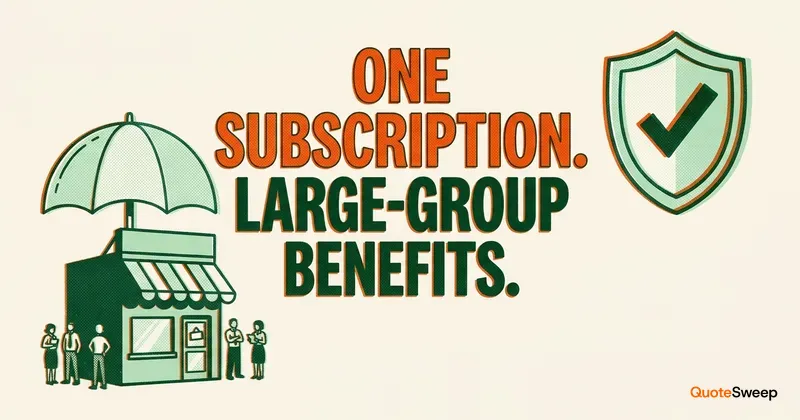
The centerpiece for most small employers is health coverage. On its own, a 12-person company is too small to command a competitive group medical plan. A PEO solves this by pooling many small employers together under a single master policy with a major carrier, so each participating business can access large-group coverage it couldn't get alone. That's the core insight behind the model — it turns a crowd of small employers into one big group in the eyes of a health carrier. Justworks, for example, delivers large-group health through a master policy with carriers like Aetna, UnitedHealthcare, and Kaiser Permanente.
Around that health benefit, a PEO typically layers 50-state payroll processing and tax filing, HR and compliance support, workers' compensation and employment practices liability (EPLI), and ancillary benefits like dental, vision, HSA/FSA, life and disability, and a 401(k) — all in one per-employee-per-month subscription.
How it works
The mechanics are straightforward once you understand co-employment:
- You sign a co-employment agreement. The PEO becomes the employer of record for payroll, tax, and benefits administration. You remain the "worksite employer" — you still direct the work, manage performance, and decide who to hire and let go.
- Payroll and taxes run through the PEO. It processes pay, withholds and files payroll taxes across states, and handles the associated filings so you don't administer them in-house.
- Your employees join the PEO's group plans. Because your team is now part of the PEO's pooled workforce, employees can enroll in the large-group health plan and ancillary benefits the master policy makes available.
- HR and compliance are shared. The PEO provides HR support, compliance guidance, and coverage like workers' comp and EPLI as part of the bundle.
- You pay per employee, per month. PEOs generally price as a per-employee-per-month (PEPM) subscription, often with a base HR/payroll tier and a higher tier that adds health insurance. Justworks publishes PEO Basic at roughly $59/employee/month and PEO Plus at roughly $109/employee/month with health — one concrete example of how the tiers are typically structured.
Many PEOs also offer adjacent products such as an international Employer of Record (EOR) for hiring abroad and standalone payroll for businesses that want the software without the full co-employment arrangement.
Key considerations
A PEO is a bundle, and bundles cut both ways. Weigh these trade-offs against your situation.
Where a PEO shines:
- Access to large-group health. The single biggest draw — a pooled master policy gives a small employer group coverage it usually can't buy on its own.
- One vendor for the employment back office. Payroll, HR, compliance, benefits, workers' comp, and EPLI live under one roof, which reduces the number of systems and vendors an owner juggles.
- Predictable per-employee pricing. PEPM subscriptions make the cost easy to model as you grow, and the better-known PEOs publish their tiers.
- Compliance support. Multi-state payroll tax and HR compliance are exactly the areas where small teams get exposed; a PEO carries much of that load.
Where the trade-offs sit:
- Co-employment isn't for everyone. Sharing employer-of-record status is a structural commitment; some owners prefer to keep every employment function fully in-house.
- Health is a group plan, not employee choice. Employees join the PEO's plan rather than picking their own — which is precisely the thing an ICHRA is designed to change.
- Group renewals can swing. Because coverage rides a group master policy, renewal pricing can move year to year, versus the fixed budget an ICHRA lets you set.
- Usually sold direct. PEOs are often sold direct or through their own sales teams rather than primarily through independent insurance brokers, which matters if you'd rather work through a broker.
The clearest alternative is the ICHRA (individual coverage health reimbursement arrangement), which flips the model: instead of a pooled group plan, you give employees a tax-free budget to buy their own individual coverage. We compare the two head-to-head in PEO vs ICHRA.
Who offers it
PEOs range from large national names — the likes of ADP TotalSource, Insperity, and TriNet — to modern, software-first providers aimed squarely at small businesses. QuoteSweep maps the newer, tech-forward end of this market on the health & benefits insurtech hub.
- Justworks — one of the largest independent SMB-focused PEOs in the US. Through co-employment it bundles payroll, HR, compliance, and large-group health via a master policy (with carriers including Aetna, UnitedHealthcare, and Kaiser Permanente), plus workers' comp, EPLI, ancillary benefits, an international EOR, and standalone payroll. It sells direct on transparent per-employee-per-month pricing.
If you're weighing the co-employment bundle against the newer defined-contribution approach, the same hub also profiles the ICHRA platforms that serve as the alternative — Thatch, Take Command, and StretchDollar among them. Pricing and specific plan details vary by provider and, in some cases, aren't published; confirm current terms directly with each company.
Frequently Asked Questions
What does a PEO actually do?
A PEO enters co-employment with your business and becomes the employer of record for HR and tax purposes. That lets it run payroll and tax filing, handle HR and compliance, provide workers' comp and EPLI, and — most importantly for many owners — offer large-group health and other benefits through a pooled master policy, all for a per-employee-per-month fee. You keep control of hiring, management, and the day-to-day work.
How does a PEO provide health insurance a small business can't get alone?
By pooling. A single small employer is too small to command a competitive group medical plan, so a PEO groups many small employers together under one master policy with a major carrier. To that carrier, the pool looks like one large group, which unlocks large-group coverage for every participating business.
Do I lose control of my employees with a PEO?
No. Co-employment splits responsibilities: the PEO is the employer of record for payroll, tax, and benefits administration, while you remain the worksite employer who directs the work, manages performance, and decides who to hire and let go. Day-to-day control stays with you.
PEO vs ICHRA — which should a small business choose?
They solve health benefits in opposite ways. A PEO gives you an all-in-one bundle (payroll, HR, compliance) plus a pooled group plan under co-employment. An ICHRA keeps you as the sole employer and hands employees a tax-free budget to buy their own individual coverage, trading the group plan for employee choice and a fixed, predictable cost. Choose a PEO for the all-in-one back office and a group plan; choose an ICHRA for choice and cost control without co-employment. See the full breakdown in PEO vs ICHRA.
The bottom line
A PEO is the "outsource the whole employment back office" answer to small-business benefits: co-employment lets it run payroll, HR, and compliance while pooling you with other employers to deliver large-group health you couldn't get on your own. That bundling is both the appeal and the trade-off — it's simple and comprehensive, but health becomes a group plan you outsource rather than a choice you hand to each employee.
If that all-in-one model fits, Justworks is a benchmark to compare. If you'd rather keep sole-employer status and give your team choice and a fixed budget, weigh a PEO against an ICHRA — and see the full field on the health & benefits insurtech hub.