Tarmika is the most widely known commercial insurance comparative rater, connecting to 31 carriers via API partnerships. Since its acquisition by Applied Systems in 2022, it's become tightly integrated with the Applied ecosystem (Epic, EZLynx). But a growing number of independent agents are evaluating alternatives – particularly agencies with carrier panels that extend beyond Tarmika's 31-carrier network.
This isn't a hit piece on Tarmika. Tarmika works well for agencies whose carrier panel aligns with its API partnerships and who are committed to the Applied ecosystem. But for agencies with regional carriers, specialty markets, or a need for broader carrier coverage, Tarmika's limitations are real. Here are the five reasons agents tell us they're looking for alternatives.
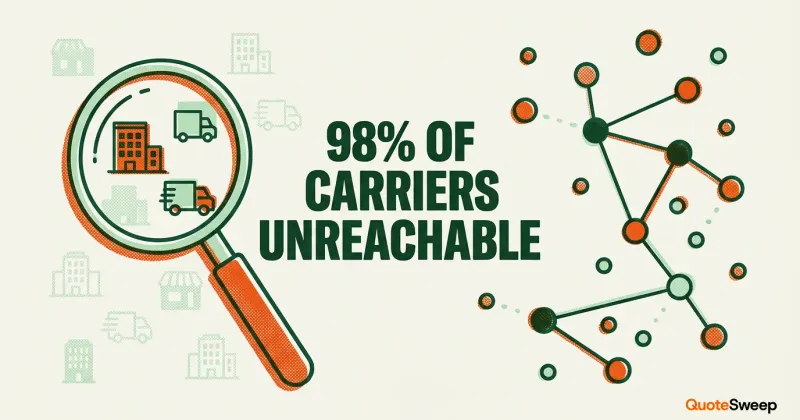
Tarmika covers 31 carriers via API. QuoteSweep's carrier audit found that 172 of the top 250 US commercial carriers have no quoting API – no BOP, no GL, no WC. These carriers write $175B in annual premium. For agencies appointed with any of them, that gap matters. Here's why agents are evaluating alternatives – and what to consider.
1. 31 Carriers Isn't Enough
Tarmika connects to 31 carriers via API – and that count includes carriers still in progress that aren't fully live yet. For an agency whose entire panel falls within those 31, that's sufficient. But most independent agencies are appointed with carriers that aren't on Tarmika's list.
There are approximately 2,700 property and casualty carriers in the United States (NAIC 2025 Market Share Report). Tarmika covers 31 of them. But the more telling number: of the top 250 commercial carriers – which write ~80% of all US commercial premium – only 11 have full small commercial APIs (BOP+GL+WC) on third-party platforms. The other 172 (69%) have no quoting API at all, representing $175B in premium that is portal-only.
There's another nuance worth understanding: not all of Tarmika's 31 carrier connections return the same thing. Many Tarmika carriers return indications – ballpark premium estimates – rather than bindable quotes. For those carriers, the agent still needs to visit the carrier's own portal to get the actual quote with real terms and conditions. This means Tarmika saves a step on data entry but doesn't eliminate the portal visit for a significant portion of its carrier panel. QuoteSweep, by contrast, fills out the actual carrier portal and returns the carrier's own quote – no estimates, no second trip.
If your panel includes carriers like Hartford (small commercial BOP), Auto-Owners, Erie, Sentry, EMC, Encova, or any state-specific regional carrier – Tarmika can't quote them. You're still logging into those portals manually, which means Tarmika saves you time on some carriers but not others. (Note: Hanover and Selective do have proprietary small commercial APIs available on Tarmika – they are among the exceptions, not the rule.)
For agencies where regional and specialty carriers represent a significant portion of business, the time savings from Tarmika only apply to a fraction of their quoting workflow. A typical independent agent logs into 3-5 different carrier portals to quote a single commercial risk, spending approximately 45-60 minutes per submission re-entering the same ACORD form data into each portal. Tarmika reduces that time for its 31 connected carriers – but the remaining portals still require manual entry.
According to the Ivans 2025 Connectivity Trends Report, 72% of independent agents say commercial submissions is the area most in need of automation. But existing API-based tools only automate a small slice of the carrier landscape.
2. The Applied Ecosystem Lock-In
When Applied Systems acquired Tarmika in 2022, it became part of a vertically integrated ecosystem: Applied Epic (AMS) + EZLynx (AMS/PL rating) + Tarmika (CL quoting) + Ivans (carrier connectivity). For agencies already in this ecosystem, the integration is a feature. For agencies on other platforms – HawkSoft, NowCerts, QQCatalyst, or others – it's a concern.
Agents have noted that Applied products work best together and less well as standalone tools. If you're not on Epic or EZLynx, Tarmika's AMS integration advantage doesn't apply to you, and you're paying for a tool optimized for an ecosystem you're not in.
Agent feedback on review sites reflects this friction: complaints about rigid workflow structures, complex pricing with unexpected fees, and products that are "priced out of the small business market." These are Applied ecosystem concerns, not Tarmika-specific issues, but they affect the Tarmika experience for agencies outside the ecosystem.
3. Adding New Carriers Takes Months
Because Tarmika uses bilateral API partnerships, adding a new carrier requires the carrier's engineering team to build and test an API integration. This process typically takes months – sometimes longer for smaller carriers with limited technical resources.
Tarmika has been live since 2017 and has reached 31 carriers in approximately 9 years. At that pace, covering even half of the P&C carrier market would take decades.
For agents waiting for a specific carrier to be added, the timeline is unpredictable. Carriers may not prioritize API development for a tool that represents a small fraction of their submission volume. This creates a chicken-and-egg problem: Tarmika needs carrier participation to grow, but carriers need agent volume to justify the investment.
AI web agents tools like QuoteSweep bypass this problem entirely – new carriers can be added in days because no carrier cooperation is needed.
4. Quoting Is Faster – But Not Visible
Tarmika's API approach returns quotes quickly – approximately 15 seconds per carrier according to available documentation. That's genuinely fast. But the process is opaque: you submit the form, wait, and get results. If something fails, you see an error but don't know what went wrong on the carrier's side.
AI web agents offers a different experience: you can watch AI agents navigate carrier portals in real time. You see which step each carrier is on, which forms are being filled, and where any issues occur. When a carrier requires an additional underwriting question or has a portal quirk, you see it happen rather than getting a generic error.
This transparency matters more than speed for many agents. Knowing exactly what happened during a failed quote – and being able to retry with adjusted information – is worth the difference between 15 seconds and 2 minutes.
5. The Industry Is Moving Beyond APIs
The insurance industry's approach to data connectivity has been slow. While other industries standardized on open APIs years ago, most P&C carriers still rely on web portals as their primary agent interaction point. This isn't changing quickly – carrier technology investment tends to prioritize policyholder-facing systems over agent tools.
API-based quoting tools are betting that carriers will eventually build APIs. AI web agents tools are betting that carriers already have web portals – and that's enough.
Semsee recognized this early, adding RPA alongside their API connections. But they've been running this hybrid approach since 2017 without scaling the RPA side aggressively. QuoteSweep was built from the ground up with AI web agents as the core architecture, not a bolt-on.
The question for agents isn't "which technology is better" – it's "which technology gives me access to more carriers today?" The largest API-based commercial rater connects to approximately 48 carriers. QuoteSweep tracks 500+ carriers with appetite data – 440 verified at high confidence – across 42 lines of business, with 131 confirmed online quoting portals. Today, AI web agents cover more ground.
Is Tarmika Still the Right Choice for You?
If all three of these are true, Tarmika is probably still a good fit:
- Your carrier panel mostly falls within Tarmika's 31 API-connected carriers
- You're on Applied Epic or EZLynx and value tight AMS integration
- Carrier breadth beyond the national carriers isn't a priority
If any of these sound like you, it might be time to evaluate alternatives:
- Your panel includes regional or specialty carriers that Tarmika can't quote
- You're not in the Applied ecosystem and don't plan to be
- You want to quote across 15-25 carriers simultaneously, not just 5-10
- You need Umbrella, EPLI, or Professional Liability alongside standard BOP/GL/WC
What Agents Actually Tell Us
In discovery calls and agent feedback, five reasons come up repeatedly for why agencies either leave Tarmika or never adopt it:
-
"It doesn't cover enough of my carriers." An agent with 20 appointments discovers Tarmika covers 6–8 of them. Paying $225+/month to automate 30–40% of their panel – while still manually quoting the other 60–70% – doesn't pencil out. This is the most common churn reason per agent reviews.
-
"I'm not on Applied Epic." Tarmika is tightly coupled to Applied Systems. Agencies on HawkSoft, NowCerts, QQ Catalyst, or AMS360 get weaker or no integration. The value proposition drops significantly outside the Applied ecosystem.
-
"The pricing is wrong for my volume." Tarmika runs $225/month for 5 users as a pure flat fee regardless of usage. An agency quoting 10 submissions per month is paying over $20 per submission for a tool that only covers a third of their panel – and pays the same rate whether they quote 5 times or 50. Flat monthly plans with submissions included cost that agency $49 on Solo, and reach the whole panel rather than a third of it.
-
"I tried it and it didn't have my carriers." Agent signs up, discovers Hartford, Erie, Auto-Owners, or their key regional carriers aren't available, and cancels. The gap between expectations and reality is the single biggest source of early churn.
-
"It's good enough manually." Solo agents doing 5–10 quotes per month can handle manual quoting in 45–60 minutes per risk. Painful but survivable – especially when the alternative only automates a fraction of their workflow.
These aren't edge cases. According to the Rough Notes 2024 Technology Survey, 76% of independent agents use no commercial lines comparative rating tool at all. The primary reason isn't that they don't want automation – it's that existing tools don't cover enough of their carrier panel to justify the cost.
See the full comparison: Tarmika vs Semsee vs QuoteSweep: Commercial Quoting Tools Compared | Best Commercial Insurance Rating Software 2026
Frequently Asked Questions
How many carriers does Tarmika support?
Tarmika connects to 31 carriers through API partnerships. These are primarily major national carriers. Note that some of these connections return indications (estimates) rather than bindable quotes – meaning agents may still need to visit the carrier portal for the actual quote.
Is QuoteSweep a Tarmika replacement?
It depends on your needs. QuoteSweep covers significantly more carriers through AI web agents, but Tarmika offers tighter AMS integration with Applied products. Some agencies use both – Tarmika for Applied-integrated carriers, QuoteSweep for everything else.
How much does Tarmika cost vs. QuoteSweep?
Tarmika is approximately $225 per month flat covering 5 users – you pay the same whether you quote 5 risks or 500. QuoteSweep uses flat monthly plans with submissions included. Solo is $49/mo with 10 submissions included (15 carrier appointments, BOP, 1 seat), Pro is $99/mo with 30 (25 appointments, BOP + GL + WC, 3 seats), and Business is $299/mo with 100 (unlimited appointments, all lines, 10 seats). The free tier covers 3 submissions with no card.
Can I try QuoteSweep before switching?
Yes – QuoteSweep offers 3 free quotes with no credit card required. You can start with public carriers (Progressive, Hiscox, NEXT Insurance, biBERK, and others) that don't require any carrier credentials.