How to Quote a Restaurant: Liquor, Spoilage, and Equipment Coverage
The United States has over 1 million restaurant locations, making food service one of the most common commercial account types an independent agent will encounter. But restaurants carry a combination of exposures – liquor liability, equipment breakdown, food spoilage, employee injuries, and premises liability – that require more than a generic business owners policy (BOP). Getting the coverage stack right means understanding how a fast-casual sandwich shop differs from a fine dining restaurant with a full bar, and how both differ from a late-night nightclub.
This guide walks through the full restaurant quoting process: what to collect from the client, how to build the coverage stack, when liquor liability applies, and the endorsements most agents overlook.
Quoting restaurant insurance starts with the food-to-liquor revenue split, an equipment list, employee count by role, and a completed ACORD 125. The coverage stack builds from a BOP base and adds liquor liability, equipment breakdown, food spoilage, and workers comp – each rated on factors specific to food service operations.
The Coverage Stack for Restaurants
A restaurant's insurance program isn't a single policy. It's a stack of coverages, some bundled into a BOP, others written as standalone policies or endorsements. The specific combination depends on the restaurant's size, service model, and whether alcohol is served.
| Coverage | What It Covers | How It's Typically Written |
|---|---|---|
| General liability (GL) | Bodily injury, property damage, slip-and-fall claims | Included in BOP; standard limits $1M/$2M |
| Commercial property | Building, equipment, inventory, tenant improvements | Included in BOP |
| Liquor liability | Claims arising from serving alcohol to intoxicated patrons | Separate policy or BOP endorsement |
| Workers compensation | Employee injuries on the job – burns, cuts, slips | Standalone policy; required in nearly all states |
| Equipment breakdown | Mechanical/electrical failure of ovens, refrigeration, HVAC | BOP endorsement or standalone |
| Food spoilage | Loss of perishable inventory due to power outage or equipment failure | BOP endorsement |
| Commercial auto | Delivery vehicles, catering vans | Standalone policy |
| Umbrella/excess liability | Additional limits above GL, liquor liability, and auto | Standalone policy |
Small businesses pay a median of ~$83/month for a BOP, but restaurant BOPs often run higher because of the food service classification, higher property values (commercial kitchen equipment is expensive), and the need for additional endorsements. A fast-casual restaurant with no alcohol might land at $120-180/month for the BOP alone. A full-service restaurant with a bar could be $250-400/month before adding liquor liability and workers comp.
What You Need From the Client
Before submitting to a single carrier, collect these items. Missing any of them delays the quote or produces pricing that won't hold up at binding.
| Item | Why It Matters | Where to Get It |
|---|---|---|
| ACORD 125 (Commercial Insurance Application) | Standard application for all commercial lines | Client completes; agent verifies |
| Revenue breakdown: food vs. alcohol | Determines liquor liability need and how the account is classified | Client's P&L or accountant |
| Liquor license type | Determines whether liquor liability is required and at what limits | Client; verify with state ABC board |
| Total annual revenue | Primary exposure base for GL premium calculation | Client's tax returns or financial statements |
| Number of employees by role | Affects workers comp class codes and premium | Client's payroll records |
| Equipment list with replacement values | Sets property coverage limits and equipment breakdown schedule | Client; equipment invoices or lease agreements |
| Square footage and building details | Property coverage, fire suppression, and occupancy classification | Lease or building records |
| Three years of loss runs | Carriers evaluate claims history for pricing and eligibility | Current carrier (allow 7-10 business days) |
| Delivery operations (yes/no) | Triggers commercial auto or hired/non-owned auto needs | Client interview |
| Hours of operation | Late-night operations (past midnight) affect carrier appetite | Client |
The food-to-alcohol split is the single most important data point. A restaurant where 80% of revenue comes from food and 20% from alcohol is a fundamentally different risk than a bar where those numbers are reversed. We've seen agents submit restaurant applications without this breakdown and receive either declinations or quotes with liquor liability excluded – forcing a re-submission that adds a week to the process.
The Liquor Liability Question
Every restaurant account requires you to ask one question early: does this business serve, sell, or distribute alcohol? If the answer is yes, liquor liability insurance moves from optional to essential – and in most states, it's required by the liquor licensing authority.
When Liquor Liability Is Required
Liquor liability applies to any business that serves, sells, or distributes alcoholic beverages. This includes restaurants with beer and wine licenses, full-bar establishments, breweries with taprooms, and catering operations that serve alcohol at events. The coverage responds to claims under dram shop laws – state statutes that hold alcohol-serving establishments liable when an intoxicated patron causes injury or property damage to a third party.
How Liquor Liability Is Rated
Carriers rate liquor liability based on:
- Total alcohol revenue – The primary exposure base. Higher alcohol sales mean higher premiums.
- Percentage of alcohol revenue to total revenue – A restaurant with 15% liquor sales is rated differently than one with 60%.
- Type of liquor license – Beer and wine only vs. full liquor license.
- Hours of operation – Establishments open past midnight or 2 AM face higher rates.
- Entertainment – Live music, DJs, and dance floors increase the risk profile substantially.
- Claims history – Prior liquor-related claims are a major red flag for carriers.
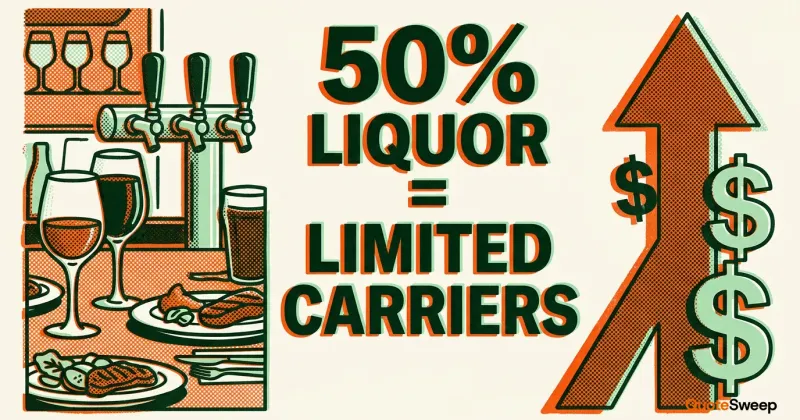
Here's an honest limitation we share with agents: restaurants where liquor revenue exceeds 50% of total revenue, or that operate past 2 AM with live entertainment, face severely limited carrier options in the standard market. At that point, you're often looking at surplus lines carriers or specialty programs – and premiums can be two to three times what a standard restaurant pays. A neighborhood Italian restaurant with a wine list is a completely different underwriting conversation than a nightclub with bottle service.
Step-by-Step Quoting Process
Step 1: Classify the Restaurant
Restaurant classification determines everything downstream – carrier appetite, available programs, and pricing. The industry isn't monolithic, and carriers know that.
- Fast casual / limited service (sandwich shops, pizza by the slice, counter-service) – Lowest risk profile. Often eligible for standard BOP programs. No or minimal alcohol exposure.
- Full-service / casual dining (sit-down restaurants with wait staff, moderate bar) – Mid-range risk. BOP plus liquor liability. Workers comp class codes for wait staff, kitchen, and bar staff.
- Fine dining (high-ticket, extensive wine/spirits program) – Higher property values (expensive kitchen equipment, wine inventory). Liquor liability is standard.
- Bar / nightclub (alcohol-primary, entertainment) – Highest risk category. Many standard carriers decline. Specialty markets or surplus lines often required.
When we work with agents quoting restaurant accounts, the first thing we ask is: "What percentage of revenue is food vs. alcohol, and what are their hours?" Those two data points immediately narrow the carrier list.
Step 2: Build the Coverage Stack
Start with the BOP as the foundation. A business owners policy bundles general liability and commercial property at a 15-25% discount compared to purchasing them separately. Then layer on:
- Liquor liability – If alcohol is served. Can sometimes be endorsed onto the BOP; larger accounts may need a standalone policy.
- Equipment breakdown – Commercial kitchens rely on refrigeration, ovens, fryers, HVAC, and dishwashers. When a walk-in cooler compressor fails on a Friday night, the repair bill is the small part – the spoiled food is the real loss.
- Food spoilage – Covers perishable inventory lost due to equipment failure or power outage. A well-stocked restaurant can have $5,000-15,000 in perishable inventory at any given time.
- Workers compensation – Restaurants have among the highest workers comp claim frequencies of any industry. Burns, knife cuts, slips on wet kitchen floors. See our workers comp quoting guide for the full process on that policy.
- Commercial auto – If the restaurant operates delivery vehicles. If they use third-party delivery services (DoorDash, Uber Eats), hired and non-owned auto coverage is still needed.
- Umbrella – Especially important for restaurants with liquor liability. A single serious dram shop claim can exceed the underlying $1M liquor liability limit.
Step 3: Select Carriers and Submit
Carrier appetite for restaurants varies widely. Some carriers actively target food service with dedicated programs and competitive pricing. Others avoid it entirely or restrict it to food-only operations with no alcohol.
Factors that shape carrier appetite for restaurants:
- Alcohol percentage – Most standard carriers cap alcohol at 30-40% of total revenue. Above that, expect declinations from mainstream markets.
- Hours of operation – Carriers distinguish between closing at 10 PM, midnight, and 2 AM. Each threshold narrows the field.
- Entertainment – Live music, DJs, and dancing are separate risk factors that many carriers won't accept.
- Claims history – Assault/battery claims or liquor-related incidents dramatically reduce available markets.
- Years in business – New restaurants (under 3 years) face tighter underwriting. The restaurant failure rate is well known to carriers.
- Fire suppression – Carriers require commercial kitchen fire suppression (Ansul systems) and may require verification.
We've seen the best results when agents submit restaurant accounts to 8-12 carriers rather than the typical 2-3. The spread between the highest and lowest quote on a restaurant account can be 40-60% – far wider than most commercial lines. That's because carriers weight restaurant-specific factors (liquor ratio, hours, cuisine type) very differently.
Step 4: Review Quotes for Coverage Gaps
When quotes arrive, don't just compare the bottom-line premium. Check for these restaurant-specific items:
- Liquor liability limits and trigger – Is liquor liability included or excluded? What limits? Does it match the state's dram shop requirements?
- Equipment breakdown – Is it included in the BOP or excluded? What's the sublimit?
- Food spoilage sublimit – Standard BOP spoilage sublimits can be as low as $1,000-2,500. A restaurant may need $10,000-25,000.
- Business income / extra expense – If a kitchen fire shuts down the restaurant for 3 months, does the policy cover lost revenue and ongoing expenses? What's the waiting period?
- Hired and non-owned auto – If the restaurant uses any third-party delivery drivers or employees ever use personal vehicles for restaurant errands.
- Assault and battery – Some GL policies exclude assault and battery claims. For restaurants and bars, this exclusion creates a serious gap.
Equipment Breakdown and Food Spoilage: The Endorsements Most Agents Forget
These two endorsements are where we see the most frequent gaps in restaurant coverage, and they're the ones that generate the most client complaints when a claim happens.
Equipment Breakdown
A standard commercial property policy covers fire, theft, wind, and other named perils. It does not cover mechanical or electrical breakdown – and that's exactly how most commercial kitchen equipment fails. A compressor burns out, a circuit board in a convection oven shorts, or the HVAC system's condenser fails during a July heat wave.
Equipment breakdown coverage (sometimes called boiler and machinery) responds to these losses. For a restaurant with $75,000-200,000 in kitchen equipment, the endorsement typically adds $150-400 per year to the BOP premium. When we've helped agents review restaurant accounts after a denial, the missing equipment breakdown endorsement is the single most common gap.
Food Spoilage
Food spoilage coverage pays for perishable inventory lost when refrigeration or freezer equipment fails, or when a power outage causes food to reach unsafe temperatures. The standard BOP either excludes food spoilage entirely or includes a sublimit that's far too low for a restaurant with a walk-in cooler full of protein.
A fine dining restaurant might carry $15,000-20,000 in perishable inventory on any given day. A sublimit of $2,500 – which is common in base BOP forms – covers a fraction of the actual loss. Agents should ask carriers to raise the spoilage sublimit to at least $10,000, and ideally to match the client's estimated peak perishable inventory value.
Common Pitfalls When Quoting Restaurants
Pitfall 1: Missing the liquor liability question entirely. If the application doesn't specifically ask about alcohol service, some agents skip it. Then the claim comes in – a patron leaves intoxicated, causes an accident – and there's no liquor liability coverage on the policy. This is an E&O claim waiting to happen.
Pitfall 2: Not asking about delivery operations. A restaurant that started delivering during the pandemic may still be using employee vehicles without commercial auto coverage. Hired and non-owned auto is inexpensive to add and fills a gap that creates significant liability exposure.
Pitfall 3: Accepting default equipment breakdown and spoilage sublimits. As described above, default sublimits are almost always inadequate for food service operations. When we work with agents on restaurant accounts, we specifically flag these sublimits in every quote comparison.
Pitfall 4: Treating all restaurants the same. A fast-casual location with no alcohol, 20 seats, and a $400,000 annual revenue requires a fundamentally different coverage approach than a 200-seat fine dining establishment with a sommelier, $1.5 million in revenue, and a 35% liquor ratio. Using the same submission template for both wastes underwriter time and produces quotes that don't fit.
Pitfall 5: Quoting workers comp without understanding restaurant class codes. Restaurant employees span multiple workers comp class codes – wait staff, kitchen staff, bartenders, and delivery drivers each have different rates. Lumping all payroll under a single class code inflates the premium or underestimates the exposure. Our workers comp quoting guide covers class code assignment in detail.
Carrier Selection for Restaurants
Not every carrier that writes commercial lines writes restaurants well. Food service requires specialized underwriting, and carriers with dedicated restaurant programs tend to offer better coverage forms, more competitive pricing, and faster turnaround.
When evaluating carrier options for a restaurant insurance account, look for:
- Dedicated food service programs – Carriers that have built restaurant-specific BOP forms with built-in equipment breakdown and spoilage coverage.
- Liquor liability availability – Some carriers write the BOP but won't write liquor liability, forcing you to split the account across two carriers.
- Appetite for the specific restaurant type – A carrier that writes fast-casual all day may decline fine dining or bar accounts.
- Package pricing – Carriers that can bundle the BOP, liquor liability, umbrella, and sometimes even workers comp into a single program typically offer the best total cost of risk.
- Claims handling for food service – Restaurant claims (slip-and-fall, foodborne illness, dram shop) require specialized adjusting. Carriers with restaurant experience handle these more effectively.
Independent agents place roughly 87% of commercial lines premium, and the agents who build strong restaurant books do so by developing relationships with 3-4 carriers that specialize in food service rather than submitting every restaurant account to generalist carriers.
Frequently Asked Questions
Does every restaurant need liquor liability insurance?
Only if the restaurant serves, sells, or distributes alcoholic beverages. A fast-casual restaurant that serves only food and non-alcoholic drinks does not need liquor liability. However, any establishment with a liquor license – even if alcohol is a small percentage of revenue – should carry liquor liability coverage. Most state liquor licensing boards require proof of liquor liability insurance as a condition of maintaining the license.
How much does restaurant insurance cost?
Total insurance cost varies dramatically by restaurant type, location, revenue, and coverage stack. A small fast-casual restaurant with no alcohol might pay $2,000-4,000 annually for a BOP and workers comp combined. A full-service restaurant with a bar, 30 employees, and $1.5 million in annual revenue could pay $12,000-25,000 annually across BOP, liquor liability, workers comp, and umbrella. The liquor-to-food ratio, claims history, and state jurisdiction are the three biggest pricing variables.
What's the difference between equipment breakdown and property coverage?
Standard commercial property insurance covers damage from named perils – fire, theft, windstorm, vandalism. It does not cover mechanical or electrical failure, which is how most kitchen equipment breaks down. Equipment breakdown coverage (also called boiler and machinery) fills this gap, covering the cost to repair or replace equipment that fails due to internal mechanical or electrical causes. For a restaurant that depends on refrigeration, ovens, and HVAC, this endorsement is not optional in practice.
Do restaurants need commercial auto insurance if they use DoorDash or Uber Eats?
If the restaurant doesn't own any vehicles and relies entirely on third-party delivery platforms, they typically don't need a commercial auto policy. However, they should carry hired and non-owned auto (HNOA) coverage, which can usually be endorsed onto the general liability or BOP policy. HNOA covers the restaurant's liability when employees use personal vehicles for any business purpose – picking up supplies, making bank deposits, or running errands. If even one employee occasionally drives for business, the gap exists.
Can a restaurant get a BOP, or does it need separate policies?
Most restaurants qualify for a business owners policy, which bundles general liability and commercial property. The BOP is typically the most cost-effective way to cover the foundational exposures. However, the BOP alone is rarely sufficient – restaurants almost always need additional coverage for liquor liability (if applicable), workers compensation, and usually higher equipment breakdown and spoilage sublimits than the base BOP provides. Think of the BOP as the foundation, not the complete program.