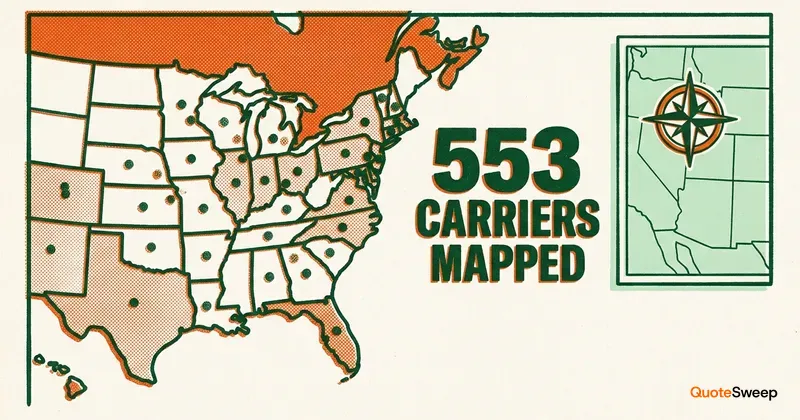
Beyond the 228 carriers that write nationwide, availability splits sharply by state: 134 carriers file in Pennsylvania versus 41 in Alaska — a roughly threefold gap. QuoteSweep mapped commercial insurance carrier availability across all 50 states, the District of Columbia, and the US territories. Where you operate quietly decides how many quotes you can get.
This is a first-party dataset. The figures below come from QuoteSweep's own carrier-appetite registry — 553 US commercial property & casualty carriers, normalized from their public appetite guides, coverage pages, and state filings into one machine-readable corpus. This isn't a premium or market-share ranking; it's a map of where carriers say they'll write.
How we built this
For each of the 553 carriers, we recorded the states it lists as available. Carriers fall into two groups: 228 write nationwide (available in every state), while the rest file state by state and appear only where they've chosen to compete. The counts below are the number of state-by-state carriers that list each state — the layer of the market that actually varies by geography. Every figure traces to a carrier's own published availability. Appetite reflects what carriers publish, not a guarantee any one of them will bind a given risk.
The full ranking: carriers by state
228 carriers reach every state. On top of that national core, the state-by-state layer ranges from 134 carriers in Pennsylvania down to a single carrier in the US Virgin Islands. Here is every state and territory, ranked by the number of carriers that specifically file there:
| State | Carriers filing here |
|---|---|
| Pennsylvania | 134 |
| Illinois | 122 |
| Georgia | 119 |
| Tennessee | 118 |
| Virginia | 117 |
| Indiana | 115 |
| Iowa | 110 |
| Wisconsin | 108 |
| Kentucky | 108 |
| Arizona | 107 |
| Texas | 106 |
| South Carolina | 106 |
| Michigan | 105 |
| North Carolina | 105 |
| Missouri | 103 |
| Minnesota | 102 |
| Colorado | 99 |
| Florida | 99 |
| Alabama | 99 |
| Ohio | 98 |
| New Jersey | 97 |
| Utah | 96 |
| Maryland | 96 |
| Nebraska | 96 |
| New Hampshire | 95 |
| New York | 95 |
| Kansas | 94 |
| Connecticut | 90 |
| Massachusetts | 89 |
| Mississippi | 88 |
| Arkansas | 86 |
| California | 85 |
| Oklahoma | 85 |
| Oregon | 85 |
| Delaware | 85 |
| Maine | 84 |
| Nevada | 84 |
| Idaho | 84 |
| Vermont | 83 |
| South Dakota | 83 |
| New Mexico | 82 |
| Rhode Island | 82 |
| West Virginia | 79 |
| Louisiana | 75 |
| North Dakota | 73 |
| Montana | 69 |
| Washington | 68 |
| Wyoming | 59 |
| District of Columbia | 54 |
| Hawaii | 42 |
| Alaska | 41 |
| Puerto Rico | 4 |
| U.S. Virgin Islands | 1 |
Add the 228 nationwide carriers to any state for its full available market.
Deep markets vs. thin markets
Pennsylvania (134), Illinois (122), Georgia (119), Tennessee (118), and Virginia (117) are the deepest state markets. A business in one of these — in a mainstream class — can genuinely shop: dozens of state-specific carriers compete alongside the 228 nationwide writers.
At the other end, Alaska (41), Hawaii (42), the District of Columbia (54), and Wyoming (59) are the thinnest, and the US territories are barer still — Puerto Rico has 4 carriers filing and the US Virgin Islands just 1. In a thin-market state, expect fewer quotes and a greater chance of landing in the excess & surplus (E&S) market — not because your business is riskier, but because fewer admitted carriers file there.
Size of economy doesn't guarantee a deep market, either. California sits at 85 carriers and Washington at 68 — below smaller states like Iowa (110) and Wisconsin (108) — a reminder that carrier availability tracks state filing decisions, not GDP.
More carriers still isn't an instant quote
Depth helps, but it doesn't make commercial insurance behave like personal auto. Only 131 of the 553 carriers analyzed — 24% — let a business start a quote online. That's a registry-wide rate: even in Pennsylvania's deep market, roughly three in four carriers still require a human-handled submission. More carriers means more markets to approach, not more instant quotes.
What this means for buyers and agents
For business owners: how many carriers will compete for your policy depends heavily on where you operate. In a deep-market state and a mainstream class, shop widely — the options are there. In a thin-market state, or a niche or higher-hazard class, you likely need an independent agent with E&S access rather than a direct online quote.
For agents: availability is fragmented and poorly disclosed, which is exactly why matching a risk to the right in-state markets is still skilled work. The thin online-quoting rate (24%) is the structural reason quoting commercial business stays slow — deep market or not.
Frequently asked questions
Which state has the most commercial insurance carriers?
Pennsylvania. In QuoteSweep's registry, 134 carriers specifically file there — the deepest state market. Illinois (122), Georgia (119), Tennessee (118), and Virginia (117) round out the top five. On top of these, 228 carriers write nationwide and are available in every state.
Why do fewer carriers write in my state?
State filings, population, and risk profile all play a role. Admitted carriers have to file forms and rates in each state they want to write, so many skip smaller or higher-catastrophe markets. That's why thinly covered states — Alaska (41), Hawaii (42), the District of Columbia (54), and Wyoming (59) — have a fraction of Pennsylvania's state-specific options, even though the 228 nationwide carriers still reach them.
What if no carriers write my business in my state?
That's what the excess & surplus (E&S) market is for. When admitted carriers won't write a risk — because of the state, the industry, or the size — a surplus-lines carrier often can. Reaching E&S markets almost always requires an independent agent or broker with surplus-lines access, not a direct online quote. A thin admitted market is one of the most common reasons a business ends up in E&S.
Which states have the fewest carriers?
Outside the US territories — Puerto Rico (4) and the U.S. Virgin Islands (1) — Alaska (41) and Hawaii (42) have the thinnest state markets, followed by the District of Columbia (54) and Wyoming (59).
About this data
These figures come from QuoteSweep's proprietary carrier-appetite registry, normalized from carriers' own published appetite guides, coverage pages, and state availability. It powers the free appetite checker, which shows which carriers write your industry in your state. Availability reflects what carriers publish, not a guarantee any carrier will bind a given risk. We'll refresh this report as the registry is re-enriched. Questions or corrections: agent@quotesweep.com.