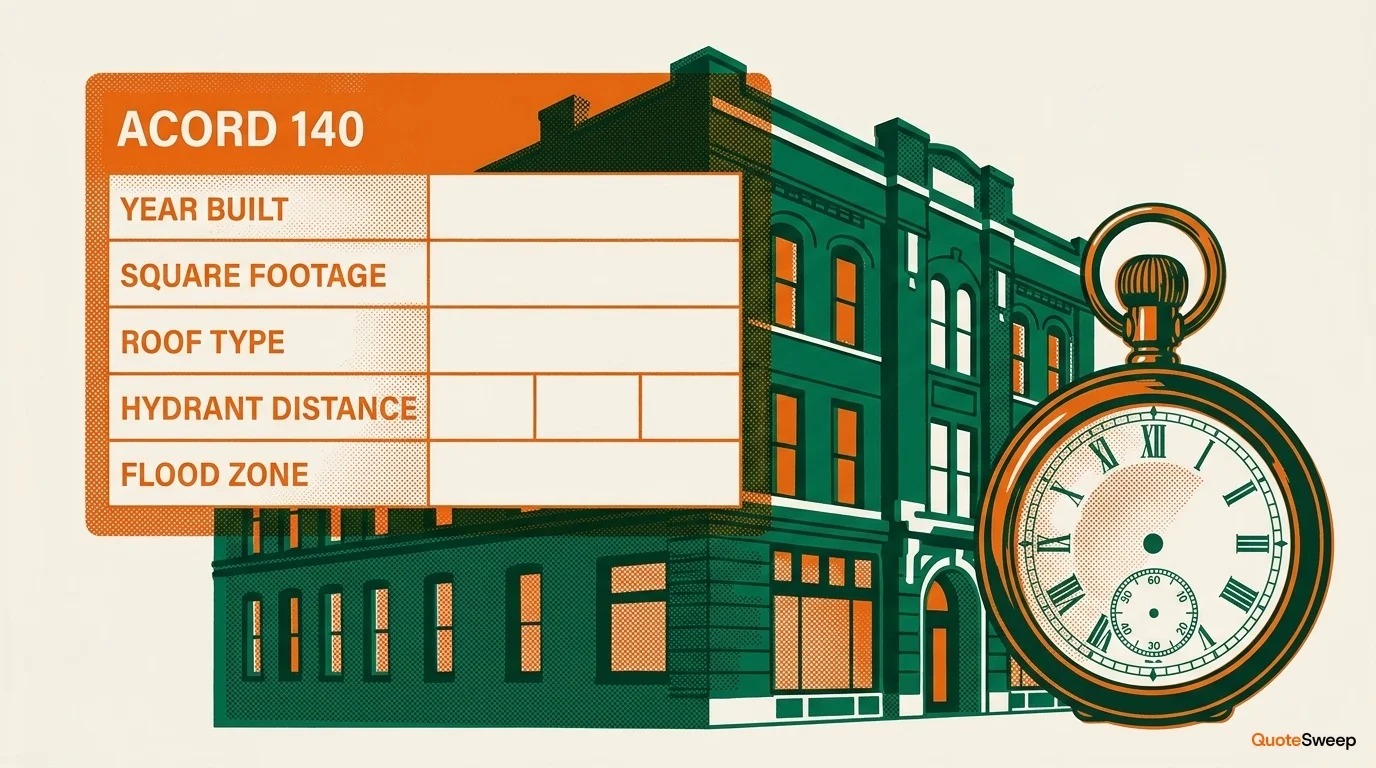
ACORD 140: Why Commercial Real Estate Quotes Take Two Days
A VP at a 13-person independent agency described his commercial real estate workflow to us. He gets a call on a commercial building. He builds a property research packet before he touches a single carrier portal. That packet takes him between an hour and an hour and a half on a good day. On a bad day, it drags out over two.
Then he submits to three carriers out of the 15-25 appointments on his panel.
In his own words: "If I have nothing else going, and it's just a building like that, and I get all the information up front, I can do it in a day. But realistically, I'm tied down with other stuff, too, so it'll drag on for a couple days."
He's not outside the norm. The 2025 Corporate Insight survey of 214 independent agents found that 55% of agencies report commercial quote cycles of 4 to 7 days, and only 7% can turn quotes around in 1 to 3 days. Commercial real estate sits at the hard end of that distribution. It's the ACORD 140, not the 125 or 126, that makes it that way.
The bottleneck isn't the carrier portal. It's what has to happen before the carrier portal screen even loads.
What the ACORD 140 Actually Is
The ACORD 140 is the Commercial Property Section supplemental application, maintained by ACORD. It accompanies the ACORD 125 for any submission requesting commercial property coverage. Where the 125 describes the applicant and their operations, the 140 describes the buildings and the physical exposure. That's a different kind of question. The 125 asks what the business does. The 140 asks what the building is, where it sits, and what's nearby.
The ACORD 125 data lives in the agency management system. Once the agency has the client's entity name, FEIN, address, revenue, employee count, and operations description in the AMS, the 125 is largely filled. Pre-populating it across carriers is a solved problem – comparative raters have been doing it for years.
The 140 is different. The building-level data it asks for isn't in the AMS. It's in public records, satellite imagery, and government maps. That's the difference that makes commercial real estate the hardest commercial line to quote.
What ACORD 140 Asks For
Here are the data points the 140 demands that require external research, and where agents pull them from today:
| ACORD 140 field | What it asks | Where agents find it |
|---|---|---|
| Year built | Age of the structure | County appraisal district website |
| Square footage | Gross building area | County appraisal district website |
| Construction type | Frame, joisted masonry, non-combustible, etc. | CAD listing + visual confirmation |
| Roof type and age | Material (shingle, TPO, metal) + approximate age | Google Maps satellite + client |
| Protection class | Distance to nearest fire hydrant and fire station | Google Maps measure tool |
| Flood zone | FEMA flood zone designation for the address | FEMA National Flood Hazard Layer |
| Tenants | List of occupants for multi-tenant buildings | Google Maps business listings, on-site |
| Valuation / replacement cost | Rebuild cost estimate | ITV software or carrier tool |
| Equipment breakdown, ordinance/law | Special property exposures | Client interview + risk assessment |
The first seven items on that list, everything above valuation, live outside the agency's stack. That's the entire point. The carriers aren't hiding that data. Nobody is. It's scattered across dozens of county websites, Google, FEMA, and the building itself.
Where the Data Actually Lives
County appraisal district websites. Every U.S. county maintains a public record of every parcel, searchable by address. In Texas, that's the Bexar County Appraisal District for San Antonio, Harris CAD for Houston, Travis CAD for Austin, Dallas CAD for Dallas. Each one has its own website, its own search interface, and its own data format. Most of them look like they were last redesigned in 2008. Some require CAPTCHAs. Some rate-limit. None of them offer a clean API.
Google Maps street view and satellite. The VP we spoke with uses Google Maps to pull a roof photo from aerial view, a building photo from street view, and then measures the distance to the nearest fire hydrant by hand using the street-view measure tool. His exact description: "Usually I spend a lot of time on Google Maps, printing the roof picture, printing the building picture, searching for hydrants on Google Maps, just trying to find how far it is from that address."
FEMA National Flood Hazard Layer. Flood zone lookups go through the federal flood map portal. The designation (X, AE, VE, etc.) is authoritative for underwriting but has to be pulled per address.
Commercial aggregators (optional). Agencies that pay for Reonomy, CoStar, or similar services can short-circuit some of this. The VP we spoke with doesn't use one. Most small and mid-size indies don't, because the per-user licensing fees only pencil out above a certain property volume.
Why the Bottleneck Compounds
The VP has built his own custom AI prompt to speed this up. He pastes in an address, and thirty minutes later he gets a research packet back. That's already faster than doing it by hand. It's also why he can only quote three carriers per account: the research part was the slow piece, and even at 30 minutes per property, quoting the full panel of 15-25 appointments would cost him the better part of a week.
So the carrier count collapses. The 2025 IVANS Connectivity Survey found that agents typically consult 6-8 carriers per marketed submission. On commercial real estate with a tight ACORD 140 deadline, that number drops. Not because the panel shrunk. Because the research cost ate the time.
And when the carrier count drops, the business loss rate climbs. 76% of agents in the same IVANS survey said they've lost an opportunity because they couldn't find or access a market. A full panel of 15 carriers doesn't matter if the agent only gets to three before the clock runs out.
These accounts aren't small. The VP we spoke with described his typical commercial real estate premium range at $5K to $50K. Those are not the numbers you want to leave on the table. But that's what the ACORD 140 research cost forces.
The Take: The 140 Is Where API Raters Hit the Wall
Here's the part that should be uncomfortable for anyone selling an API-based multi-carrier rater in commercial real estate.
The 125 can be pre-filled from the AMS. The 126 (GL) is largely class-code-driven. The 130 (WC) is payroll-driven. The 127 (business auto) is VIN-driven. All of those have structured data in or adjacent to the agency's stack.
The 140 doesn't. The 140 needs parcel data from 3,144 different U.S. counties, imagery from Google Maps, flood maps from FEMA, and hydrant coordinates from municipal open-data portals that maybe half the country maintains cleanly. No carrier is going to build that. No rater is going to build that. It isn't the carrier's job.
Commercial Submissions, Tarmika, Bold Penguin – these tools optimize what happens after the agent gets to the rating screen. They don't help with what the agent needs to have assembled before they log in. They can't. The pre-portal research is an entirely different problem, and it's the one that actually costs commercial real estate producers the day. (This is also why API raters return indications that shift at the portal.)
Solving that is a research-automation problem, not a rating problem. Google Maps has an API. FEMA's NFHL has an API. County appraisal districts don't have APIs, but most of them have searchable websites, and AI agents can operate searchable websites – we know, because that's what we do on the carrier portals. Stitching those sources together into a single research call is solvable. It's just a different kind of automation than the one the rater companies have been building for the last decade.
Frequently Asked Questions
What is ACORD 140?
The ACORD 140 is the Commercial Property Section application, maintained by ACORD. It's a supplemental form that accompanies the ACORD 125 (the master commercial application) whenever a submission requests commercial property coverage. The 140 collects building-level detail: year built, square footage, construction, roof, protection class, flood zone, and occupancy.
How long does the ACORD 140 take to complete?
Field entry on the 140 itself takes ten to fifteen minutes. The gap is the research that precedes it. Agents we've spoken to spend 60 to 90 minutes pulling the required data from county appraisal districts, Google Maps, and FEMA before they start filling fields. On a complex account or a multi-tenant building, that research time stretches to half a day or more.
What's the difference between ACORD 125, 126, and 140?
The 125 is the master commercial application – it describes the applicant, operations, and coverage requested. The 126 is the General Liability supplement, adding limits, class codes, and exposures. The 140 is the Commercial Property supplement, covering the buildings being insured. A typical commercial real estate submission uses the 125 plus the 140. Package accounts often add the 126 as well.
Who fills out the ACORD 140 – the agent, the CSR, or the client?
In most independent agencies, the producer or a CSR completes the 140 using information gathered from the client plus public-record research. The client rarely sees the form itself. The agent or CSR does the work because the property data requires professional research tools (appraisal district sites, Google Maps, FEMA maps) that clients typically don't use directly.
Is the ACORD 140 required by every carrier for commercial real estate?
Most admitted carriers accept the ACORD 140 as the standard property supplemental, but many have their own internal forms and proprietary questions layered on top. Carriers also request supplemental questionnaires for specific exposures like habitational property, restaurants, hospitality, and vacant buildings. The 140 is the floor, not the ceiling.
What We're Building
This is the research problem we're building against at QuoteSweep. Property intelligence pre-fill – county appraisal district, Google Maps satellite, FEMA flood zone, hydrant and fire-station distance – collapsed into a single under-two-minute call on an address. If you quote commercial real estate and this is your week, tell us which county you'd want lit up first.